




$250,000
That was the average bonus for Wall Street bankers and traders in 2025.

It’s the economy, stupid
Are prediction markets gambling? Congress weighs in
Is social media addictive by design? Juries are starting to think so
Newsletter Exclusive: How did Prof G predict the demise of Sora and the Metaverse?

Prosperity Is Here, It's Just Not Evenly Distributed
There are two economies right now. One lives in spreadsheets and press releases: GDP grew 2.2% last year, the S&P rose 16%, and President Trump brags that he’s secured $21 trillion in investments from foreign nations. The other economy is the one people feel every day, and it tells a very different story.
Nearly two-thirds of Americans are living paycheck to paycheck. In the past month, 28 million Americans skipped a meal to afford medication. Thanks to the Iran war, these struggling families now have to pay 30% more for gas and will have to contend again with rising inflation.
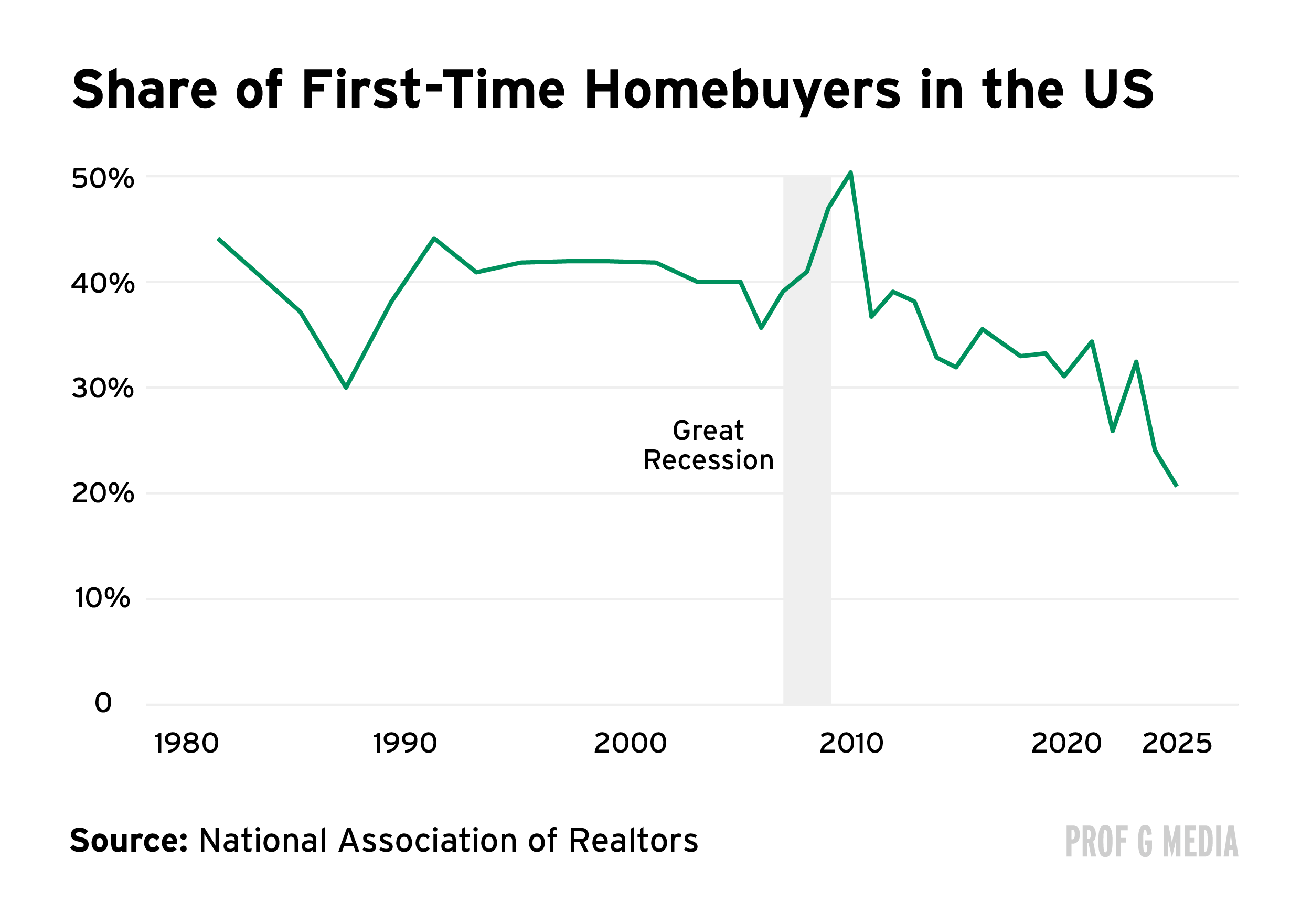
Young people have largely been shut out of the housing market, with first-time buyers now making up just 21% of all home purchases, down from roughly 40% throughout the 1990s.
It’s also a brutal time to find a new job: Fed Chair Jerome Powell said that after adjusting for statistical overcounting, net job creation is “pretty close to zero.”
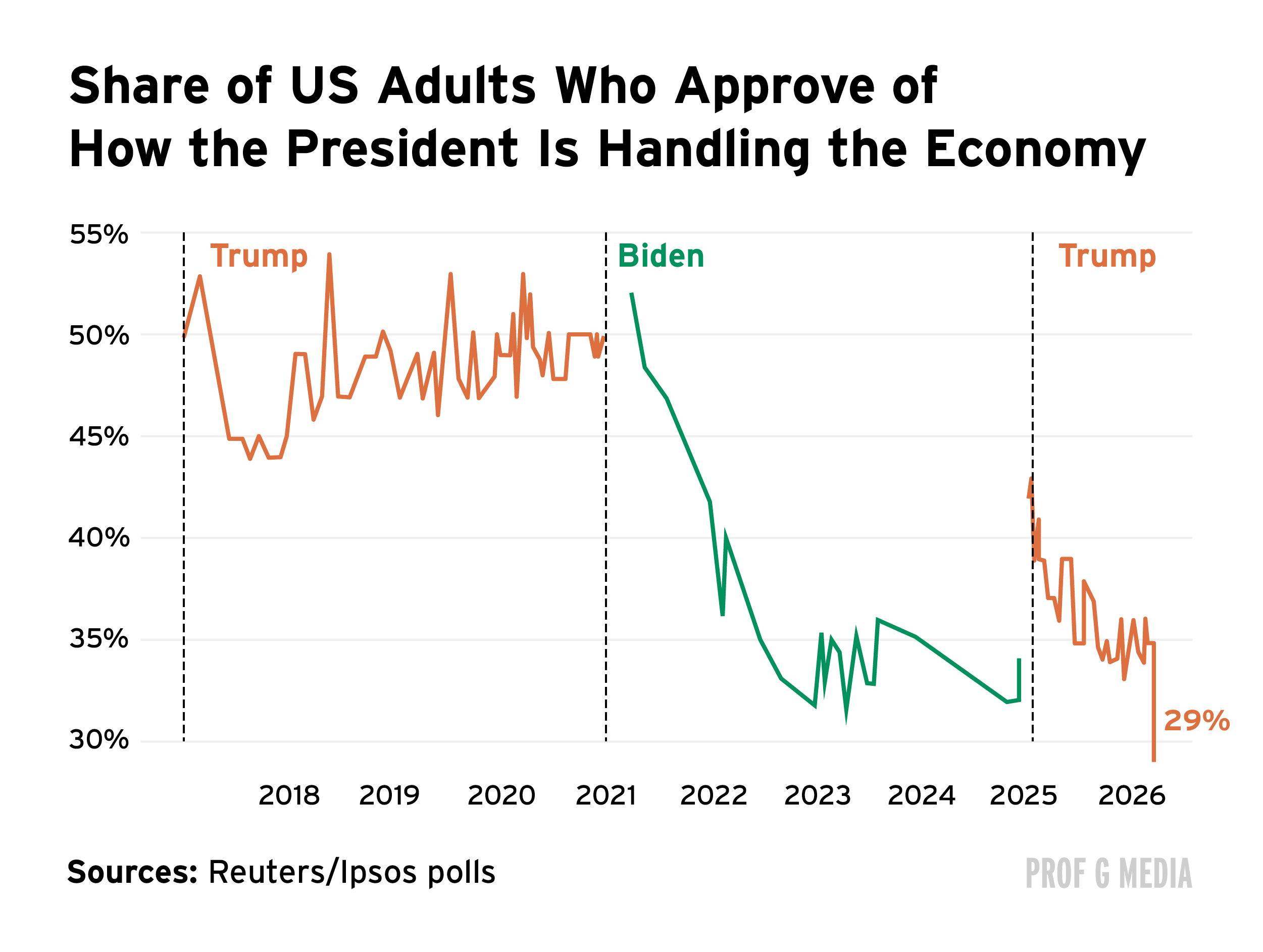
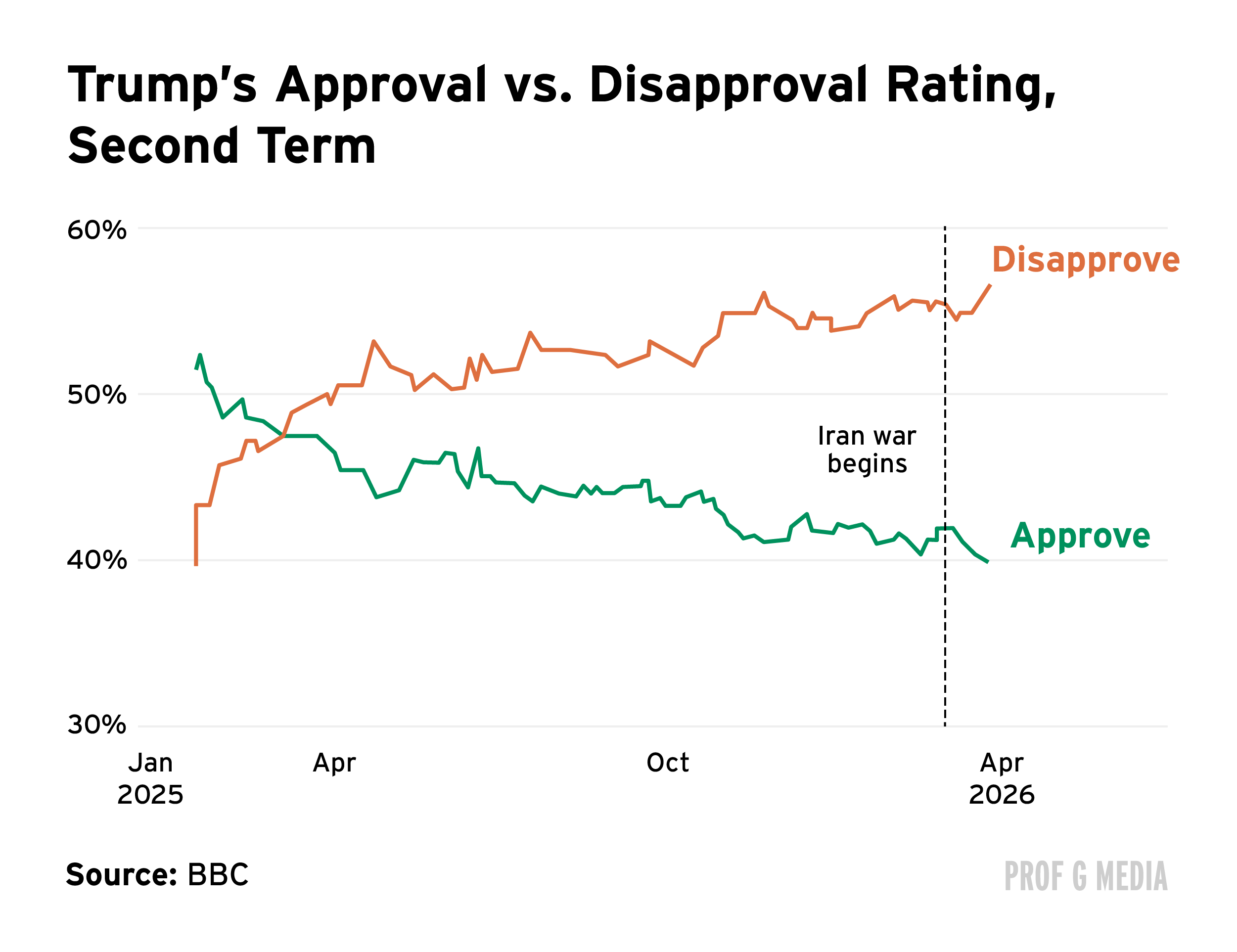
Consumer sentiment has only been worse 1% of the time in the series’ entire history. This is bad news for Trump, whose 29% approval rate on the economy is now lower than Biden’s worst scores during the post-COVID inflation spike.
Instead of addressing the growing economic crisis, Trump and his cabinet have maintained a faux optimism — not unlike the Biden administration’s decision to tout “Bidenomics.” However, in Trump’s case, the ignorance looks less like a result of political pressure, and more a reflection of their priorities.
When Kevin Hassett, the director of the National Economic Council, was asked how the Iran war might affect regular Americans, he responded that “it would hurt consumers … but that’s really the last of our concerns right now.” That’s it. That’s the quote.

The way I would describe America right now is how William Gibson described the future, and that is: Prosperity is here, it’s just not evenly distributed.
One of my favorite stats is the Gini coefficient. Zero means everyone has the same amount, 1 means one person owns everything. When France hit .83 in 1789, they started cutting people’s heads off. We’re at .85.
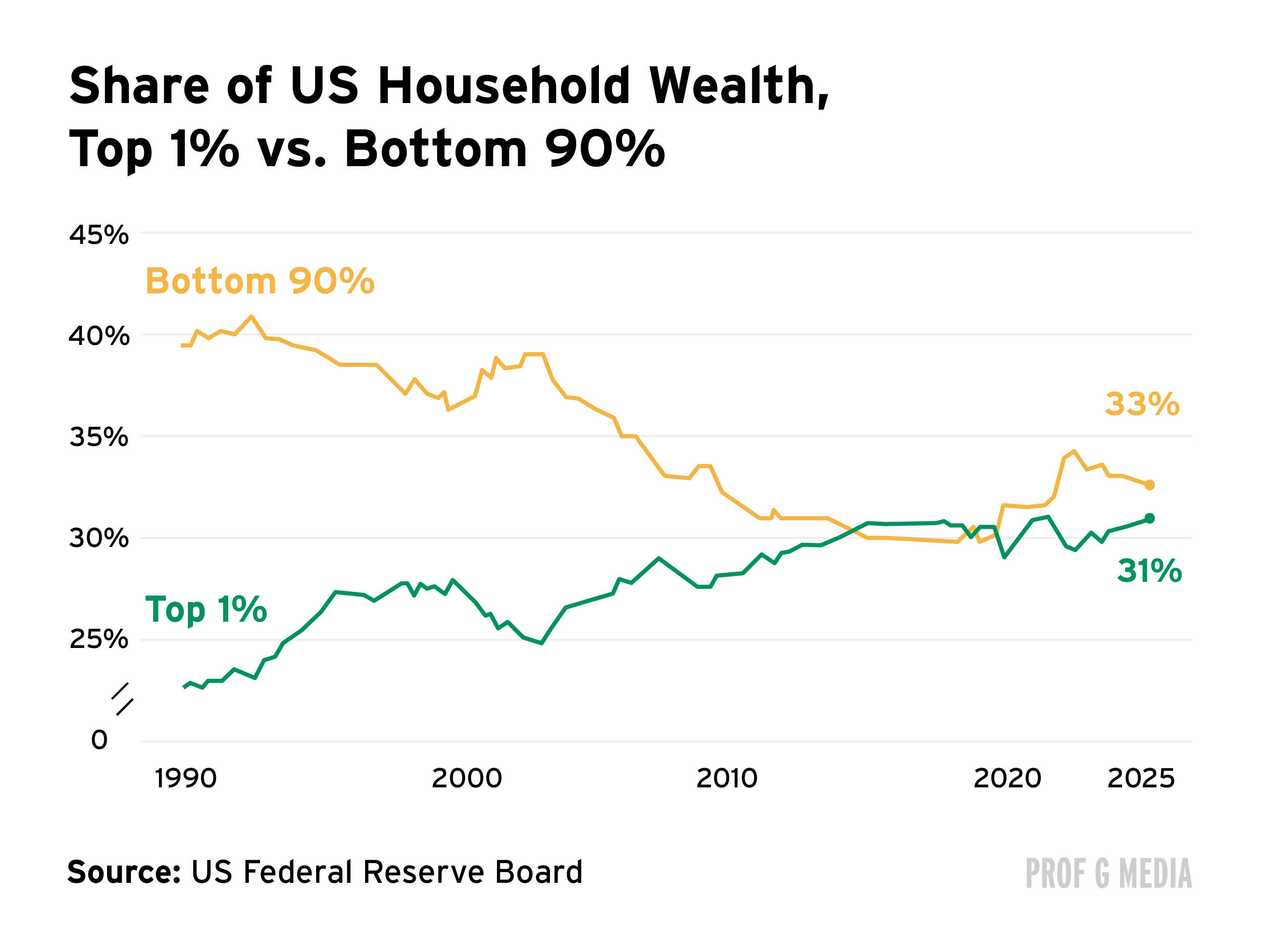
There are wealth gaps, and then there are lived experience gaps. When I was a kid, my dad’s boss drove a Cadillac and we had a Gran Torino. We went to the same country club. That’s gone.
If you’re in the 0.1% today, you fly private, skip the TSA, have private health care, private security, and your kids are in schools that bear no resemblance to the rest of America.
People don’t evaluate their lives in a vacuum. They evaluate relative to others. And when you’re reminded 210 times a day via phone notifications that you’re not in the 0.1%, it attacks your emotional well-being. Young people are told constantly that they’re not wealthy enough. The vibecession critique is valid in theory. But you can’t wag your finger at people and say “trust the GDP chart” when they’re telling you, clearly, that this isn’t working for them.


Bipartisan Bill Takes Aim at Prediction Markets
Prediction markets just got their first serious bipartisan pushback in the Senate. The Prediction Markets Are Gambling Act would ban sports-related betting on CFTC-regulated platforms like Kalshi and Polymarket and block them from expanding into casino-style games.
The legislation cuts to the heart of how these platforms make money: Sports events contracts represent between 75% and 90% of Kalshi’s $1.5 billion in annual recurring revenue. If sports contracts are banned, the company’s valuation could fall from $22 billion to $5 billion.
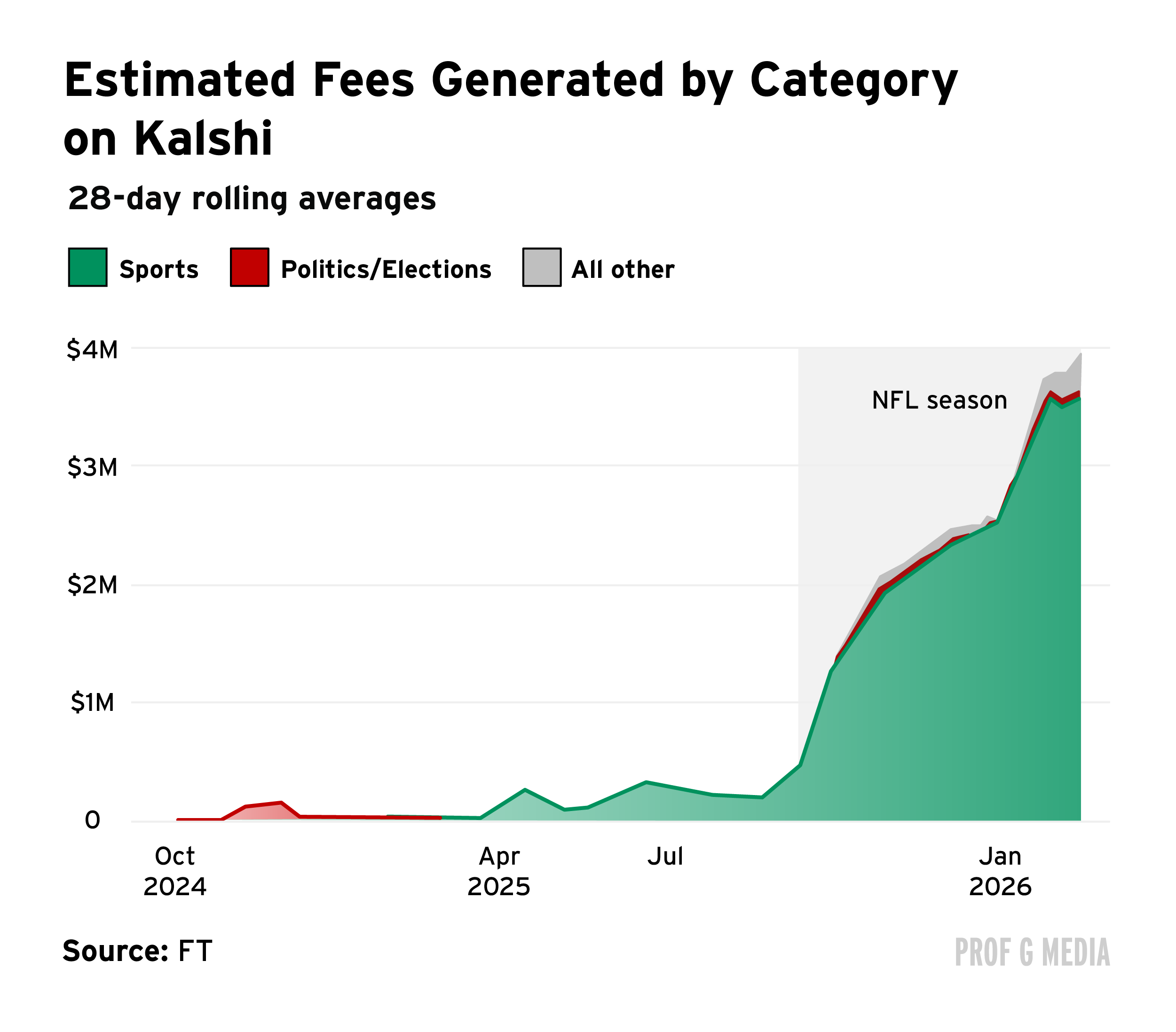
The bill reflects a tension that has been building for a while. Prediction markets have long argued they are sophisticated financial instruments, more similar to futures contracts than DraftKings. That framing made them subject to CFTC oversight instead of state gambling regulation, allowing them to operate in states where sports betting is technically illegal. This bill is the first real congressional attempt to dispute that classification.

The CFTC
The CFTC is the Commodity Futures Trading Commission. It’s the federal regulator that oversees derivatives markets such as futures, contracts, options, and swaps. It’s like the SEC, but for commodities and financial contracts rather than stocks.
Polymarket and Kalshi both have a not-so-secret advantage. Donald Trump Jr.’s venture capital fund, 1789 Capital, has invested in Polymarket, and Trump Jr. himself serves as a strategic advisor to both Polymarket and Kalshi.
Outside of sports contracts, Kalshi has become an important source of economic and political data. Federal Reserve economists determined that Kalshi is better than professional forecasters at predicting inflation, and the platform maintains a perfect forecast record on Fed rate decisions.
There are three categories here: traditional gambling, prediction markets, and options contracts. The prediction markets are offering what looks, smells, and feels like an options contract. You’re paying for an outcome against someone who believes in the opposite outcome. The distinction between betting on the Green Bay Packers and buying a zero-day option on Apple stock is thinner than people think, and I’d argue zero-day options are functionally gambling. Eighty to ninety percent of stock market purchases are effectively speculation, not long-term investing.
What I’d love to see is consistent regulation across all three. They should all be age-gated at 21. These products can be really damaging, especially for young people. Researchers at USC found that three to four years after states legalize online sports gambling, there is a 28% increase in bankruptcies.
The people who should be most nervous about this legislation aren’t the prediction markets, it’s the options exchanges. They are going to have a hard time arguing that their zero-day options products belong in a different regulatory category.

Where do you draw the line? As the great John Oliver said, you draw it somewhere. Sports betting is gambling, and it should be regulated like gambling. That means it shouldn’t operate in states where sports gambling is illegal. It doesn’t mean you ban it everywhere; if you want to set up shop in Nevada, go for it. But stop pretending you’re an options exchange when you’re taking bets on March Madness.

sponsored content

Keep Your SSN Off The Dark Web
Every day, data brokers profit from your sensitive info—phone number, DOB, SSN—selling it to the highest bidder. What happens then?
Best case: companies target you with ads.
Worst case: scammers and identity thieves breach those brokers, leaving your data vulnerable or on the dark web.
It’s time you check out Incogni. It scrubs your personal data from the web, confronting the world’s data brokers on your behalf. And unlike other services, Incogni helps remove your sensitive information from all broker types, including those tricky People Search Sites
Help protect yourself from identity theft, scam calls, and health insurers raising your rates.
Plus, just for PROF G MARKETS readers: Get 55% off Incogni using code PROFG
sponsored content

A Jury Just Ruled Meta and Google Harmed Kids. Now What?
Last week, for the first time ever, a jury found Meta and Google negligent for designing addictive social media features that are harmful to young people’s mental health. The rulings could mark a turning point for Big Tech.
Meta was ordered to pay $4.2 million in damages, and YouTube $1.8 million. Snap and TikTok settled out of court prior to the start of the trial.
Alphabet and Meta stocks fell 2% and 8%, respectively, on the news.
Earlier in the week, a New Mexico jury found that Meta violated state law by failing to protect its users from child predators and ordered the company to pay $375 million in damages.
Financial penalties at this scale are meaningless for companies worth trillions, but if these cases establish a precedent, the damages could add up. Social media companies face more than 1,600 plaintiffs with similar accusations.
Social media companies have thus far avoided liability by citing Section 230 of the Communications Decency Act of 1996, which protects them from liability for what their users post.
Last week’s case was different. The plaintiff focused on the design of Meta and YouTube’s apps, and how they are engineered to be addictive — not the content posted.
Research supports the argument that features like infinite scroll, constant notifications, and autoplaying videos make social media apps psychologically similar to gambling. Millions of young Americans agree, too. Forty percent of Americans 18 to 22 say they feel addicted to social media.
Tobacco took 30 years to get its reckoning. Opioids took 20. Social media went mobile in 2013, which means we’re right on schedule.
Why is this happening now? Juries.
Judges are trained to strip emotion out of the analysis. Juries are not, and these juries are made up of parents whose kids have struggled with self-harm, addiction, and predatory contact online. They feel lied to. And they rendered their verdict accordingly.
I want to be clear: I think these companies are a net good for society, except for Meta. I think Meta has jumped the shark and is now a net negative.
But Big Tech on the whole is a net positive for society. The problem is with the word net. We’re net beneficiaries from pesticides and fossil fuels, but we still have an EPA and emission standards. We have no regulation around these tech companies.
The people who’ve really paid the price here are low-income households. I have the resources to pay for after-school stuff, to keep my kids off screens. I have the time and attention to be at home to ensure they can’t go into the room alone with a screen. Parents working two jobs can’t do that.
The last interesting feature that my former colleague Maria Petrova highlighted is that the insurance companies are saying that they’re not going to protect against this type of liability, because if they had known Big Tech was intentionally breaking the law, they couldn’t have insured them.
I think this is a big moment. I’ve said that before, and I’ve been disappointed. But I think this is different this time.


The Prof G Media Predictions Framework
In the past two weeks, Mark Zuckerberg shut down the virtual reality platform Horizon Worlds, the foundation of his metaverse project, and OpenAI killed Sora, its video creation engine and social media platform. Scott predicted both. How?
Some Redditors suspected that Prof G had insider information. He didn’t. Scott has been making predictions for years, and while he doesn’t always get it right, he’s pretty good at it. Ten out of his 11 predictions for 2025 came true.
I’ve made Scott’s annual predictions deck since 2021, so I’ve had some exposure to how he comes up with these bets. The following is my best estimation of the Prof G Media predictions framework.
How to make a good prediction:
Read constantly and let data guide your hunches.
Never underestimate human nature.
Be skeptical when the crowd is certain.
Remember: Greatness is in the agency of others.
Read Constantly and Let Data Guide Your Hunches
If you want to make a good prediction, you need a deep understanding of the subject matter. If you’re making a prediction about the markets, for example, you should be reading, watching, and listening to market-related content all the time.
Continuity is important for pattern recognition. You can’t just be really plugged into financial news for three days. To make a good prediction, you need to treat the markets (or whatever you’re predicting about) like a best friend. You should be close to them for months — years even, to understand how they work and how they react to different situations.
Your reading should be biased toward data-heavy sources. Let that data guide you. Words lie easier than numbers.
We anticipated Sora would fail because we were following the data. The app was released at the end of September, and by December, downloads were decreasing more than 30% month over month. In January, they declined another 45%.
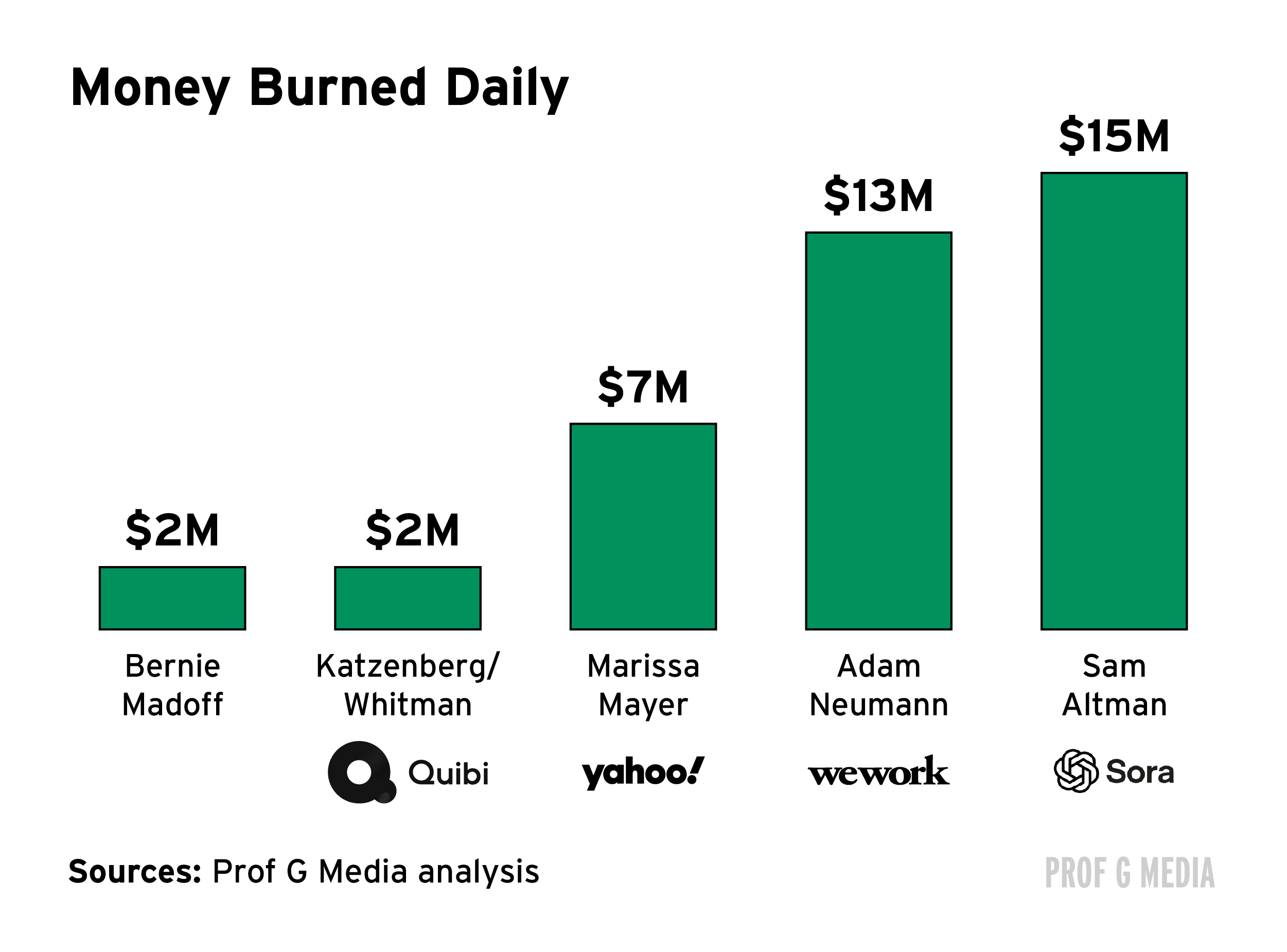
Not only was it unpopular, the economics were mind-bogglingly bad. AI video generation is 2,000 times more energy intensive than text, and more than 150 times more expensive. Forbes estimates that Sora burned $15 million per day. That’s more than Adam Neumann burned every day at WeWork.
In terms of revenue, Sora generated about $2 million from in-app purchases; in other words, its revenue covered the first three hours of its operation.
There was just no way that a side bet that disastrous could continue.
Horizon Worlds was even less popular than Sora. At its peak, it had roughly 300,000 monthly active users. MySpace, a social network popular in 2005, has almost 800,000 monthly visitors.
Never Underestimate Human Nature
Society and technology move faster than evolution. Ten thousand years ago, the most-exciting technological advancements were stone tools and the domestication of cows. Today, we have artificial intelligence in our pockets, but we’re navigating the world with the same controls (genes) as paleolithic humans.
This is all to say: Innate evolutionary tendencies are hardwired into our brains, and they influence us more than we’d like to think. We still have a desire for sugary and fatty foods because our bodies are built to avoid starvation. Negative memories are more salient to us because in our cave days, missing danger was costlier than missing an opportunity.
An understanding of biology and psychology fueled Scott’s prediction that the metaverse would fail back in 2021. Prof G explained that headsets obstruct our peripheral vision, exposing us to stalking predators (real quote), so people have a natural revulsion toward putting them on.
They also look stupid. Everything we put on our bodies is, at some level, about broadcasting attractiveness and value to a potential mate. VR headsets are sex repellant (his words).
Be Skeptical When the Crowd Is Certain
Predictions are trends, and as they grow in prominence, they can also appear to grow in prescience. As more people hop on the bandwagon, they bring with them their own justifications for why ___ is going to happen. Then the size and power of the trend starts to influence the media, which converts even more people.
The problem is that when predictions become trends, it becomes easier to overlook risks or ignore the potential for other possibilities. When everyone is already convinced of something, no one has to actually investigate the specifics.
In his book Mastery, Robert Greene argues that true expertise means developing such a deep understanding of a field that you can detect anomalies and outliers that others haven’t processed yet. Sometimes the contrarian call is just stating what’s plainly in front of you.
This is what happened with Sora. AI-generated videos from the platform went viral on social media, making everyone think this was the next big thing. Case in point: Disney bet $1 billion on this trend. But after the initial hype, no one stopped to consider whether this made it a good business, or if the masses actually wanted to create AI videos of themselves.
A skeptic might have realized that media consumption has long followed the “1% rule,” where a small fraction of people create content and the vast majority consume it.
4% of YouTube videos account for 94% of views on the platform.
3% of videos on Instagram account for 84% of all views.
5% of videos on TikTok generate 89% of the views.
The top 25 podcasts reach nearly half of U.S. weekly listeners.
Consumers don’t want to produce their own entertainment. They want to be entertained.
Greatness Is in the Agency of Others
Scott didn’t have insider information on Sora. The prediction came from Dan Chiolan, a member of our research team.
One of Scott’s superpowers is attracting and retaining top talent. He hires smart young people, and then gives them (us) a ridiculous amount of responsibility. Dan is 22. He made a prediction on a major platform that Scott put his name behind. At 24, Ed Elson, a classics major, became the co-host of a prominent finance podcast. At 26, I produced all of Scott’s slides for his TED Talk, a presentation that has now been viewed more than 17 million times.
Prof G Media exists and works because Scott is great, but also because Katherine, Drew, Claude, MJ, Mia, Ed, Claire, Jenn, Allison, Dan, Bella, Kristin, Laura, David, Erikk, Billy, Jorge, Gil, Corinne, Michael, Kami, Karen, and Lucy … are great.

An activist will take a stake in Nike and force job cuts. Revenue has grown 50% over the past decade, from $30 billion to $46 billion, but the stock is trading at a 10-year low. Head count has grown just 3% since 2020. Expect 10,000 to 20,000 layoffs in the next two to three years.

Prof G+ subscribers: join me (Mia) tomorrow for a live session on the science of better business storytelling.
P.S. Next week, April 6, all Prof G Markets content will live on its own YouTube channel. If you like our video content, head to the Prof G Markets channel and hit subscribe.

In 30 or 40 years, will people look back at photos of us in 2010’s and 20’s faces buried in our phones—the same way we now look at decades-old images of people with cigarettes hanging from their lips?
We need a different kind of social media- one that is boring but useful. That measures itself by how LITTLE you use it. Does the tool work for your personal goals? Or is it needy and hungry?