


No Mercy / No Malice has been nominated for two Webby Awards: Best Newsletter and Thought Leadership. We’d appreciate your vote for the People’s Choice award. Thanks.
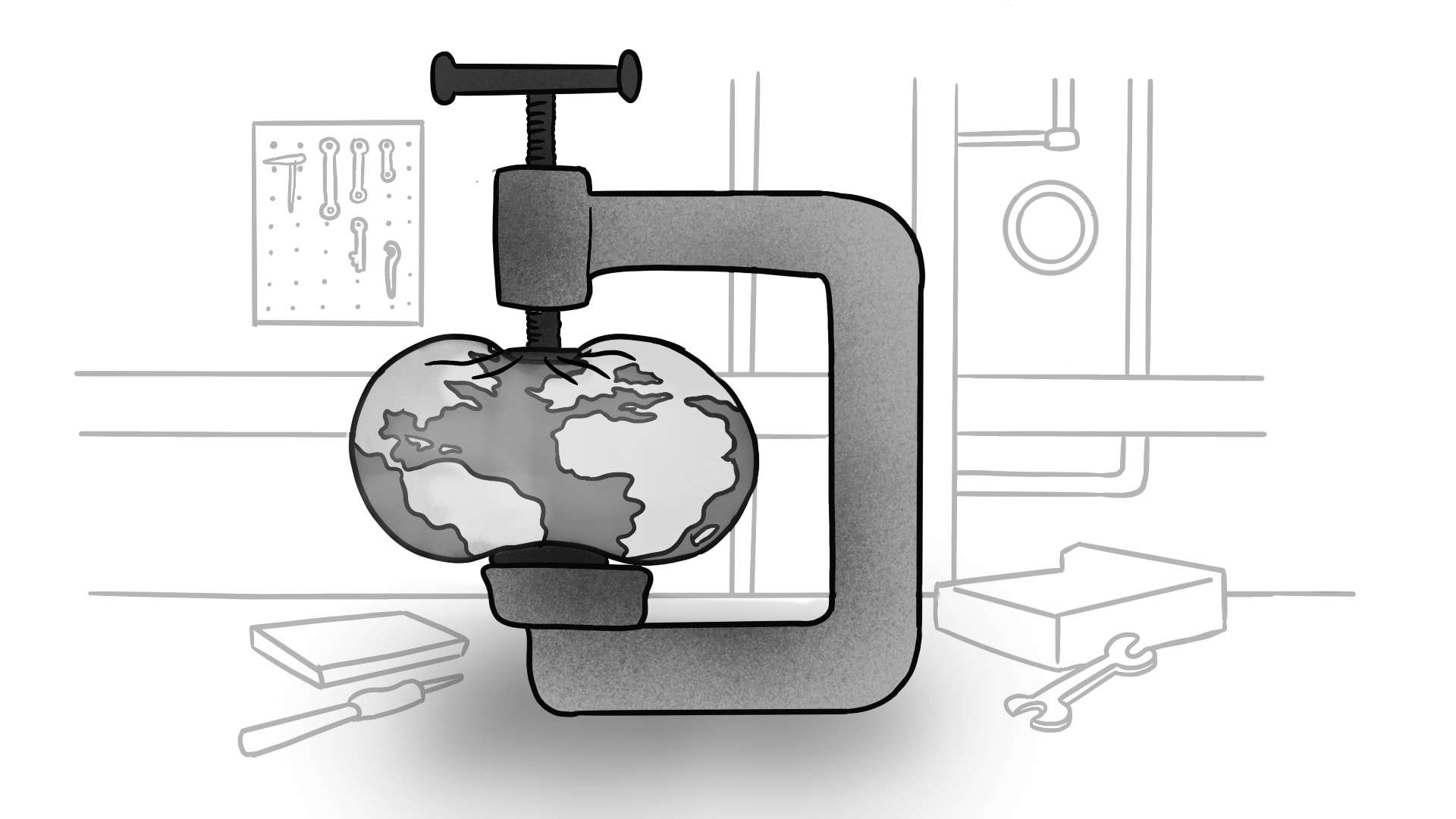
When you compress the carotid arteries, you cut off the flow of oxygenated blood to the brain. This causes unconsciousness in approximately 8 to 15 seconds due to cerebral hypoxia (oxygen deprivation to the brain). Globalization has expanded the economic corpus, resulting in an interconnected world and yielding huge — though unevenly distributed — prosperity. It has also formed carotid arteries the size of … wait for it … the Strait of Hormuz.
In 1984 a forgettable made-for-TV movie contemplated a Middle East conflict that closed the Strait of Hormuz. For decades, U.S. strategic simulations have explored similar scenarios. In one 2002 war game, the Red Team, deploying asymmetrical capabilities, including armed speedboats, decimated American naval forces in 10 minutes, effectively closing the Strait. Why didn’t the Trump administration anticipate this entirely predictable scenario? A: Despite a warning from the chairman of the Joint Chiefs of Staff, the president determined that the regime would capitulate before closing the strait, and that if it didn’t, the U.S. military could reopen it. He was wrong. This may be the greatest intelligence failure since CIA Director George Tenet famously told Bush it was a “slam dunk case” that Iraq had WMD. But let’s put aside the chokepoint (almost) everyone saw coming and discuss some others we choose to ignore.
Jekyll and Ketamine
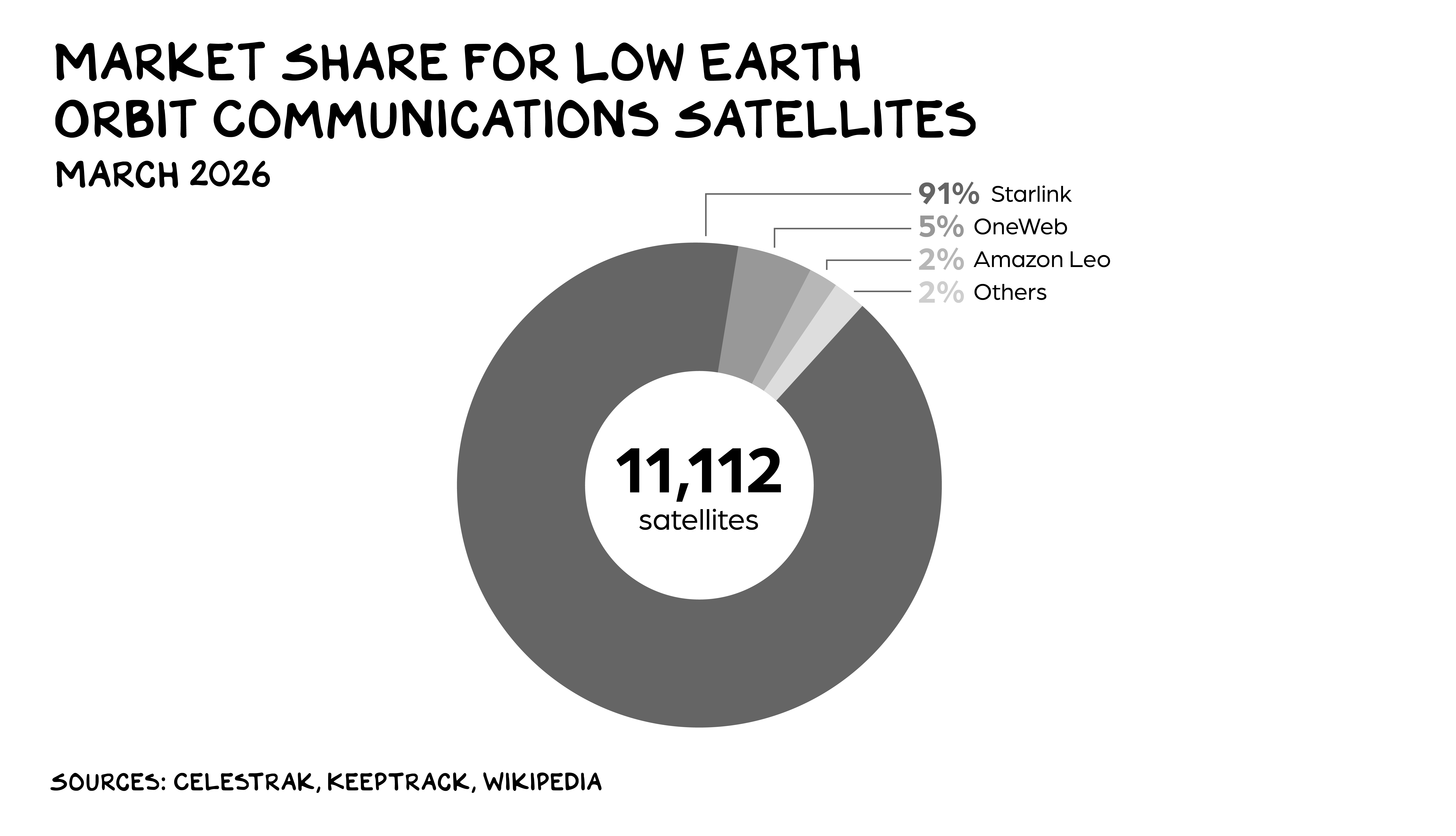
Last year, one company conducted 84% of U.S. space launches and 52% of global launches: SpaceX. Almost two-thirds of the satellites orbiting Earth belong to the company, but it really dominates in low Earth orbit, where it owns 91% of communications satellites. If you’re connecting from a cellular deadspot, going online while flying one of 30-plus airlines, out on a boat, or operating in a war zone, you’re at Elon Musk’s mercy. He recently combined SpaceX with xAI at a valuation of $1.25 trillion, registering a 43% equity stake and 79% of the voting power. This week, SpaceX filed to go public, seeking to raise $50 billion to $75 billion, meaning Musk will likely become the world’s first trillionaire. He says he’s “creating the most ambitious, vertically integrated innovation engine on (and off) Earth, with AI, rockets, space-based internet, direct-to-mobile device communications, and the world’s foremost real-time information and free-speech platform.” In other words, a global communications and information chokepoint.
With Musk, sometimes you get Dr. Jekyll (electric cars, reusable rockets, and medical breakthroughs for treating blindness and paralysis). Other times, you get Mr. Hyde (bullying a judge, Nazi salutes, and AI porn). Is Jekyll or Hyde the real Elon? A: Yes. As author Robert Caro, who’s written four volumes on power through the lens of LBJ, observed, power doesn’t necessarily corrupt, but it always reveals. “When you’re climbing to get power, you have to use whatever methods are necessary, and you have to conceal your aims,” Caro told the New York Times. “But then when you get power, you can do what you want. So power reveals.” Musk is, according to the Wall Street Journal, addicted to ketamine, determined to father a “legion-level” of offspring before the apocalypse, and (no surprise) perpetually engaged in custody battles. He also sleeps with loaded guns next to his bed. Is this the person we want at the epicenter of space, connectivity, AI, and media? A: No one person should have this much power.
I have no idea what Musk intends to do with his power, and that’s the scary part … he’s unelected and answers to no one, as we now live in a society where billionaires are protected by the law, but not bound by it. Even scarier, Musk may not know either (see: ketamine). To paraphrase Richard Pryor, ketamine is a helluva drug. I tried it once under therapeutic supervision. Shit got real / unreal fast. As Shayla Love wrote in the Atlantic, “Excessive use of the drug can make anyone feel like they rule the world.” For most people, the danger of that delusion is contained inside a relatively small blast zone — the addict, their friends and family, their world. In Musk’s case, his world is … our world.
Article Two
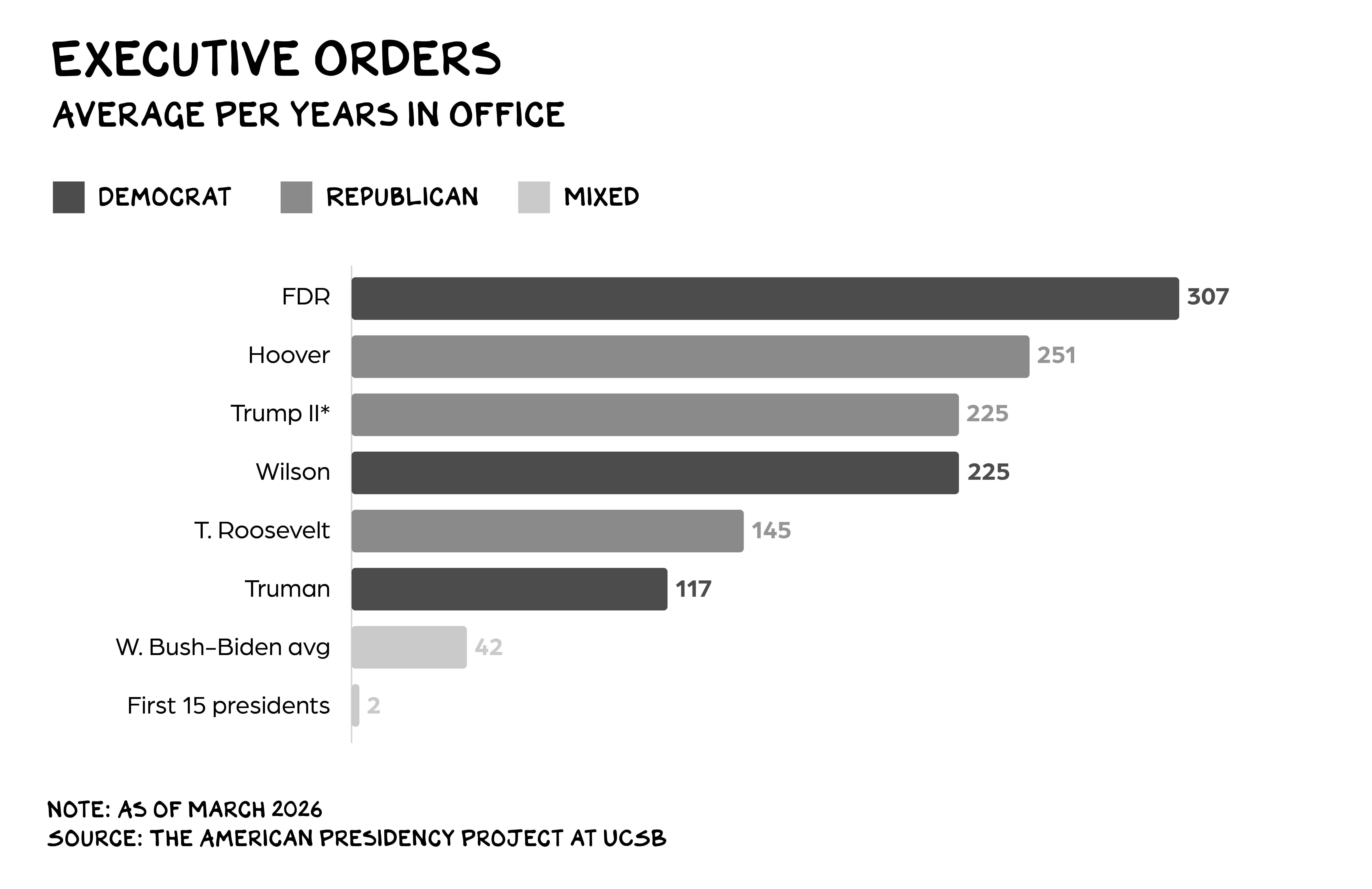
Last weekend, an estimated 8 million Americans participated in No Kings protests. The rallies speak to the moment, but the demonstrators’ concerns are as old as America. As James Madison wrote in The Federalist Papers, No. 47, “The accumulation of all powers, legislative, executive, and judiciary, in the same hands, whether of one, a few, or many, and whether hereditary, self-appointed, or elective, may justly be pronounced the very definition of tyranny.” After fighting a revolution against a monarch, the Constitution’s framers split power across three branches of government, devising a system of checks and balances to put each branch in tension with the other two. Cumbersome by design. We spent the next 230 years reassembling the king.
The Constitution grants the power to tax and regulate foreign commerce exclusively to Congress, but according to Duke Law professor Timothy Meyer, “functionally, trade policy has been dominated by the executive branch since the 1930s.” The War Powers Resolution of 1973, sold as a check on Richard Nixon after revelations that he’d secretly bombed Cambodia, actually codified a 60-day blank check for presidential military action. Meanwhile, the 2001 Authorization for Use of Military Force — passed one week after 9/11 — has been cited to justify classified military operations in at least 22 countries. Congress has never declared war in my lifetime — but we’ve fought many, and we’re fighting one now. On paper, our system was built to avoid chokepoints by distributing power. We built one anyway: It’s inside the Oval Office. For the past century, as we ceded powers from the legislative and judicial to the executive branch, we’ve been hoping “norms” would help us avoid strangulation. And it worked … until it didn’t.
Cloud
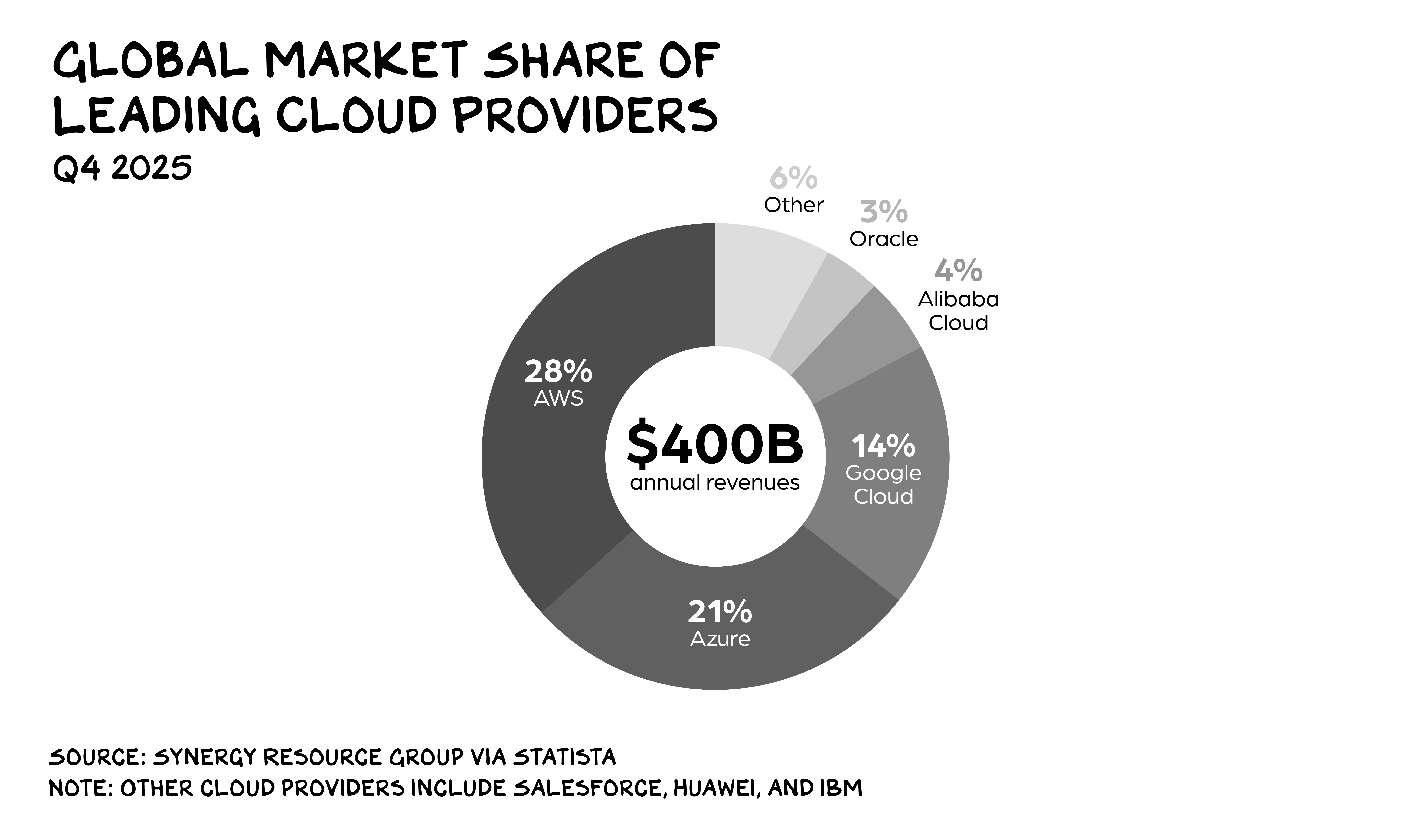
Last October, a database glitch in northern Virginia took down Snapchat, Fortnite, Ring doorbells, Coinbase, Reddit, DoorDash, and about a thousand other services. The culprit was a malfunction at an Amazon Web Services data center — the third major outage tied to that location in the past five years. Downdetector received 6.5 million outage reports. Three companies — Alphabet, Amazon, and Microsoft — own two-thirds of the cloud market. These service interruptions rarely result in clients switching providers; leaving is too costly and time-consuming. After a perfect storm of bad code and a widespread Azure outage knocked airlines, hospitals, and banks offline in 2024, one cybersecurity expert said, “This is a very uncomfortable illustration of the fragility of the world’s core internet infrastructure.” If you’re under 30, that fragility is your lived experience. That’s what makes the cloud such a potent chokepoint. It’s hiding in plain sight … until it isn’t.
Mistakes that cause outages are one thing, but attacks from malicious actors are the bigger threat. Since 2005, 34 countries have been suspected of sponsoring cyber operations, with China, Iran, North Korea, and Russia accounting for a combined 77% of suspected attacks. Since the start of the U.S.-Israel war on Iran, Iranian hackers have hit a medical technology company, stolen and tried to sell data from Lockheed Martin, and breached FBI Director Kash Patel’s personal email. Even more chilling is the emergence of a gray zone between war and peace, i.e., permanent cyberwar. As a 2022 Atlantic Council report explained, “Without firing a single bullet, U.S. adversaries are striking at the fibers of U.S. and allied societies, economies, and governments to test confidence in systems that underwrite both the U.S. constitutional republic and the U.S.-led, rules-based international order.” In other words, everyday, unseen hands reach across cyberspace and apply pressure to our air supply. When we gasp for air, however, we demand an immediate patch, rather than insisting on redundant airways.
Chip-Point
The Islamic Revolutionary Guard Corps is demonstrating a lesson we should’ve learned watching Ukraine repel Russia for the past three years — an $82 million fighter jet launched from a $13 billion aircraft carrier is an economic Goliath facing a swarm of $20,000 to $50,000 Davids, i.e., Shahed drones. While we’re bleeding resources and credibility, China is taking notes and looking at Taiwan. “The single biggest threat to the world economy, the single biggest point of single failure, is that 97% of the high-end chips are made in Taiwan,” Treasury Secretary Scott Bessent said at Davos this January. “If that island were blockaded, [or] that capacity were destroyed, it would be an economic apocalypse.” One company, TSMC, controls 72% of the global foundry market, producing chips for AMD, Apple, Nvidia, and Qualcomm. If China invaded Taiwan, global GDP would sustain an estimated 10% hit, according to a Bloomberg analysis.
But China doesn’t need to invade Taiwan or blockade it. They just need to flex — military exercises, missiles splashing down in shipping lanes to spook maritime insurance carriers, a cyber operation that takes TSMC offline for 72 hours — and watch Silicon Valley and JP Morgan scramble to derisk. The problem is, there’s nowhere to scramble to. Despite Biden’s carrots ($152 billion in CHIPS Act spending) and Trump’s sticks (tariffs), the soonest the U.S. can expect to have meaningful backup capacity is 2030. We’ve kept China at bay with a mix of globalization, strong coalitions, and military deterrence. The bulwark of allies defending our most critical technological chokepoint took decades to build, but only a year to disable with incoherent isolationist economic policies, insults, and now a war that exposes the gaps in our armor.
The Strait of Hormuz. One man’s satellite network. An autocracy cosplaying as a government. Three cloud providers. One island. We didn’t stumble into these chokepoints, we built them. The invisible, bipartisan hand of the market has been wrapping itself around our throat this whole time. We mistook shareholder value and purity tests for resilience, finding welcome distractions in Big Tech earnings calls and arguments over pronouns.
Life is so rich,

P.S.

Brilliant, thank you.
If you can’t see Elons racism you’re purposely and planned incompetent.