



After roaming the Earth for 35 years, my conclusion is the U.S. is the best place to make money and Europe is the best place to spend it. Though Europe does have dynamic countries that the shit-posting narrative re structural decline ignores. Living in the U.K. for the past four years, and traveling around the continent, I’ve observed two versions of Europe: a stagnant welfare state limping toward insolvency (exaggerated, but true in places), and a dynamic fusion of capitalism — full-body-contact violence in the market that unleashes innovation and opportunity — with a meaningful social safety net (real, but overlooked by Americans). Let’s discard the fiction and talk about the Europe I’ve encountered IRL.
Sweden
Last week, Elon Musk became the world’s first trillionaire. His wealth is greater than the combined fortunes of the next three men on the Bloomberg Billionaires Index: Larry Page, Sergey Brin, and Jeff Bezos. Of the 500 people on the list, 180 are Americans or reside in the U.S. Their combined wealth is equivalent to that of the bottom 54% of U.S. households. In American politics, the interests of the few are framed in opposition to the interests of the many. We can have billionaires, we’re told, or we can have universal healthcare, but we can’t have both. That’s a false choice. Sweden (among other countries) settles the argument: Billionaires and universal healthcare can coexist. It’s not capitalism vs. socialism. Capitalism actually works better when built on a foundation of empathy and equity.
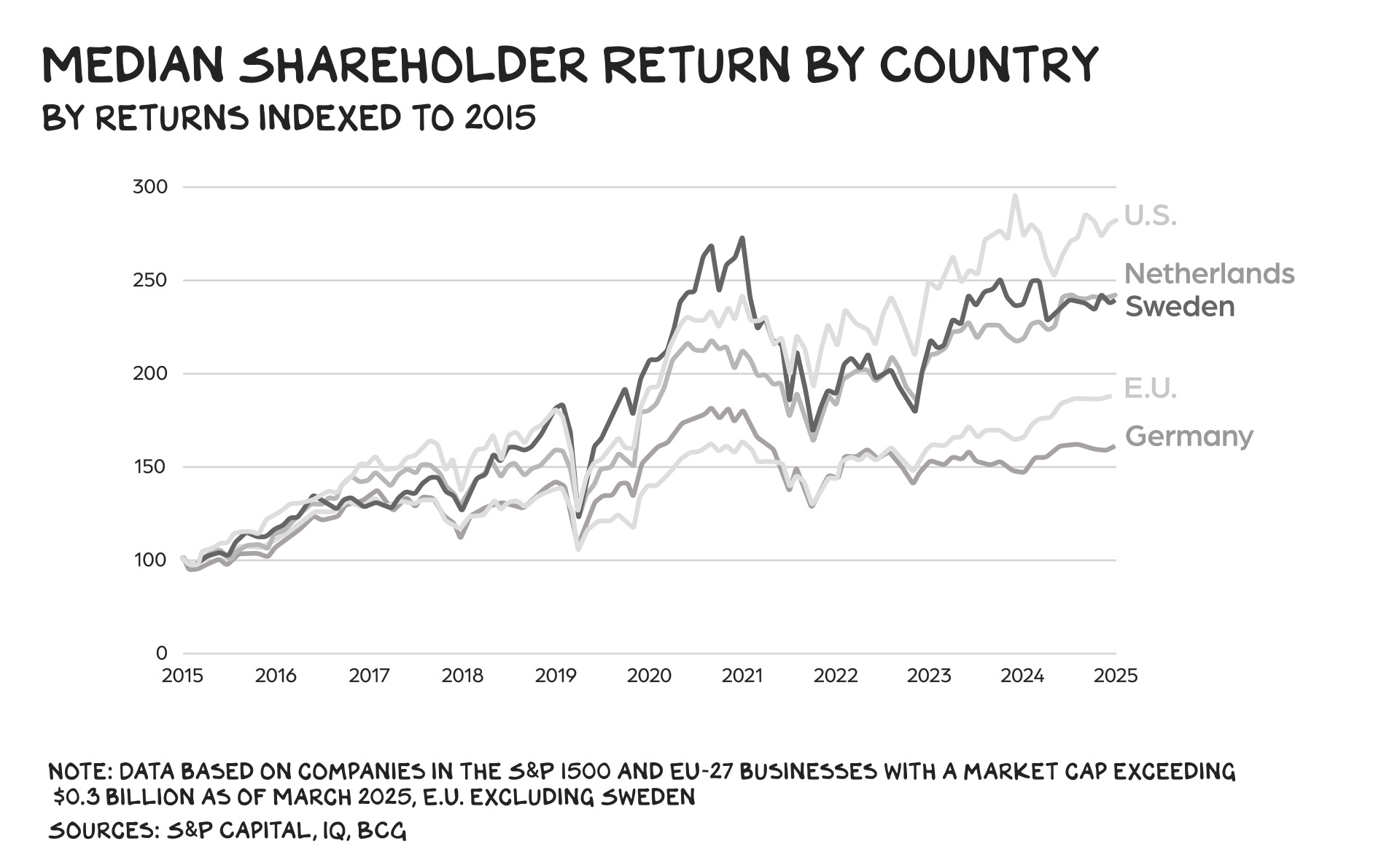
Sweden is a contradiction — an F1 engine running inside a Volvo station wagon. On the one hand, Senator Bernie Sanders praises its universal healthcare system — 11% of GDP spent on healthcare, life expectancy of 82.7 years, and outcomes on par with, or better than, those of other advanced economies. On the other hand, while the EU stagnates, Sweden is projecting 2% GDP growth. A recent analysis from Boston Consulting Group found that 30% of Swedish firms ranked in the top quartile of performance for their sectors, nearly double the performance of the best-performing EU nation, the Netherlands. The report cited three drivers of Swedish exceptionalism: a culture of risk-taking encouraged by worker mobility, paired with strong unemployment benefits, sustained government investment in R&D, and deep capital markets. As the Economist wrote last year, “Stockholm is the new capital of capital.”
Crucially, participation in Sweden’s capital markets is widespread. Thanks to the creation of ISK investment accounts, which simplify trading and eliminate capital gains taxes in favor of an annual standardized income tax, Swedish households invest over half their savings in equities — more than twice the European average. Although it has the population of North Carolina, Sweden has produced more than 30 unicorns, including Erickson, King, Klarna, and Spotify. With only 2% of the EU’s population and 3% of its GDP, nearly 1 out of every 5 of Europe’s best-performing companies are Swedish.
The Netherlands
Taiwan, which manufactures 97% of the world’s high-end chips and controls 72% of the global foundry market, is the chokepoint for AI and the digital economy, but the island nation is downstream of the Netherlands. Nvidia designs the most advanced chips, and TSMC manufactures them, but both companies, along with the rest of the industry, depend on a single company — ASML — for the machines that make any of it possible. ASML is the world’s only producer of the extreme ultraviolet lithography machines used to manufacture the most advanced chips, and it commands 90% of the broader lithography market. This month, ASML became Europe’s most valuable company, making the picks and shovels of AI.
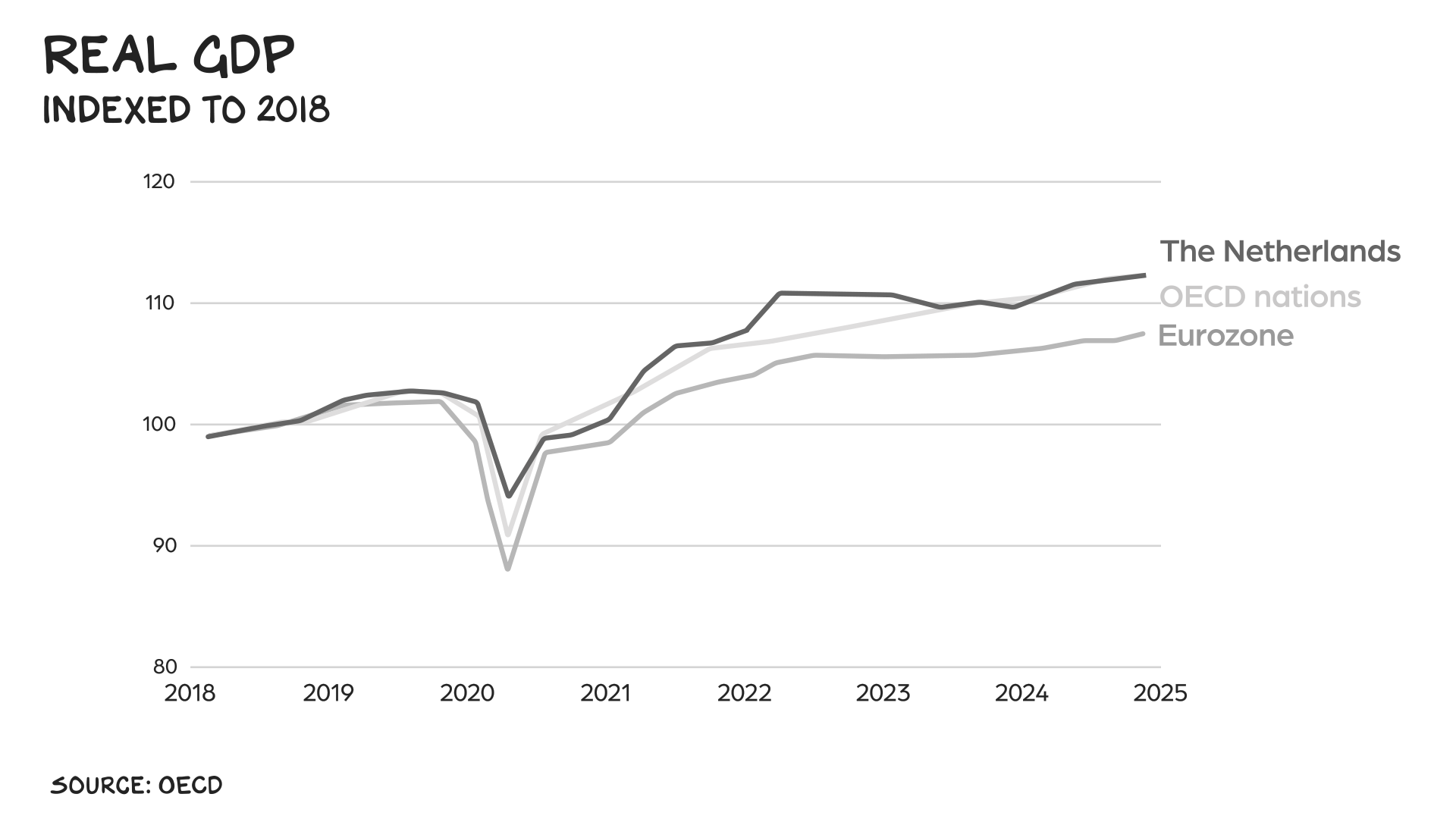
Dutch economic leverage isn’t an accident, but the result of government policies. Its infrastructure and R&D investments, highly skilled English-speaking labor pool, strong legal and regulatory frameworks, and favorable tax regime make the Netherlands a digital economy hub as well as the gateway to Europe. In terms of moving atoms, Rotterdam is Europe’s busiest port, handling 438 million tons of cargo annually — nearly double the capacity of Antwerp, Europe’s second-largest port. Advances in vertical farming, seed technology, and robotics have allowed the Netherlands in recent decades to halve the resources that go into food production while doubling the output. Last year, the country — the size of Maryland — was the second-largest agricultural exporter in the world by value, behind the U.S.
In terms of moving bits, the Netherlands is one of Europe’s key connection points for global information technology infrastructure. The country ranks second worldwide for online connectivity, with 98% of the population connected to high-speed internet, 20 points above the EU average of 78%. A 2025 report from London’s Centre for Economics and Business Research that looked at education, STEM employment, and overall innovation across 35 countries ranked the Netherlands 10th in global tech competitiveness, ahead of every G7 nation, and one spot behind Sweden. The Dutch focus on digital infrastructure has put the country at ground zero for AI — outside of the U.S., the Netherlands has the most data centers per capita — while also making Amsterdam the go-to EMEA headquarters for transnational companies, including Cisco, Netflix, Nike, PepsiCo, TikTok, and Uber, to name just a few.
None of what makes the Netherlands great comes at the expense of its commitment to empathy and equity. The Dutch poverty rate is 5%, half the rate in the U.S. Unlike most EU nations, the Netherlands leverages a heavily regulated private insurance sector to cover its citizens. Using a “managed competition” model, the Netherlands ranks third in healthcare globally based on public surveys evaluating medical quality, infrastructure, staff, wait times, and costs. The takeaway: If we followed the Netherlands, we might cut our per capita healthcare spending in half, improve outcomes, and keep private insurance.
Trust Deficit
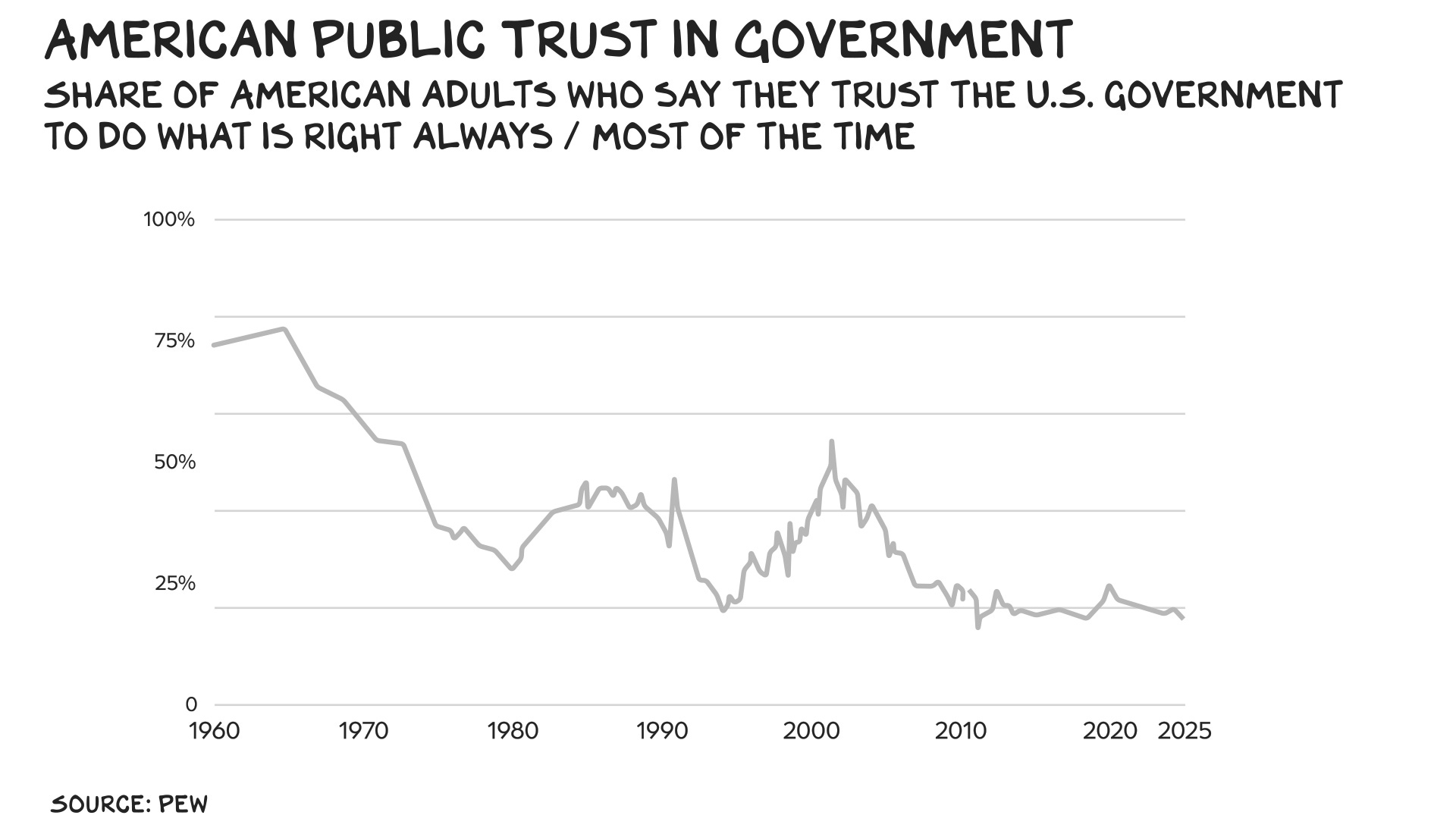
No system is perfect. Immigration, a housing crisis, and political volatility are among the issues facing the Netherlands. Sweden is trading its German-style fiscal discipline for deficit spending in order to ramp up defense. It also faces a potential housing bubble linked to high levels of private debt, and has struggled to integrate immigrants. Nevertheless, the Swedes and Dutch remain committed to capitalism built on a foundation of empathy and equity, whereas Americans are divided on fundamental questions. In the U.S., the right is cheering on crony capitalism and the hollowing out of the social safety net, the left is embracing socialism, and, as Joan Didion famously wrote, “the center will not hold.” This isn’t a matter of policy, but the scarcity of one of society’s most important assets: trust. Then-Senator Barack Obama made this point in a 2006 speech at the University of Nairobi, delivered as Kenya was in the throes of a constitutional crisis. “If the people cannot trust their government to do the job for which it exists,” he said, “all else is lost.”
When I visited Stockholm last week, I spoke with the founder and leadership team at Spotify. They’d all lived in Silicon Valley, but each had returned. None of them shit-post about higher tax bills. They told me they don’t mind paying more, as they trust their government to spend the money wisely. I witnessed a similar attitude in the Netherlands. Among the 38 OECD nations, Sweden ranks 8th when it comes to trust in the government, the Netherlands ranks 19th, and the U.S. is third from the bottom, ahead of Colombia and Slovakia. Meanwhile, when it comes to its citizens trusting one another, Sweden ranks 5th, the Netherlands 8th, and the U.S. 19th, sandwiched between Northern Ireland and Hong Kong. America has the parts to build a car that combines capitalism’s horsepower with a welfare state’s seatbelts and air bags. We just don’t trust each other enough to ride in it together.
Warning
After Stockholm, I visited Amsterdam for the wedding of my childhood best friend’s son — I’m now “that” age. I arrived early and stayed late. Amsterdam is a singular city — prosperous, beautiful, weird — where tolerance is the connective tissue between personal freedom and social order. It’s also a city that reminds residents and visitors, with every step they take, that democracy is fragile. Hundreds of brass-plated “stumbling stones” mark the homes of Amsterdam’s Holocaust victims. The Netherlands wasn’t especially antisemetic, but after the Nazi occupation it became a kill zone for Jews; 75% of Dutch Jews were murdered during World War II — nearly double the rate in Belgium and triple the rate in France. The takeaway: If it can happen here, it can happen anywhere.
Whenever I return to America, I get Weimar Republic vibes. The demonization of immigrants and hollowing out of institutions; the demagogue vilifying Americans as the enemy within with rhetoric inspiring violence, while decent people refuse to condemn it; the weaponization of the legal system; the K-shaped economy where incumbents always win and everyone else, especially young people, falls behind. The question isn’t why trust in America is eroding, but where the absence of trust is leading us. A: Somewhere dark. Trust is infrastructure — invisible until it fails, causing a catastrophe. Sweden and the Netherlands keep reinforcing theirs; we ignore the cracks, believing our exceptionalism exempts us from history’s stumbling stones.
I don’t drink wine or buy art, as it feels disingenuous — trying to be something I’m not. I do, however, have a photograph I spent real money on. It’s a photo of Otto Frank returning to the Amsterdam attic where he and his family hid until they were betrayed, his wife and daughters ultimately murdered. It hangs outside my bedroom door, so it’s the first/last thing I see each day. It reminds me that I have inconveniences but no real problems. I worry that Americans’ declining empathy for one another will turn inconveniences into real problems.

Life is so rich,

P.S.
At the start of every year, I make predictions. This year, I’m holding myself (extra) accountable by doing a mid-year check-in. Join me live on Substack on Tuesday, June 30, at 3 p.m. ET. The livestream is exclusive to paid subscribers. Register here. And if you aren’t a paid subscriber, but want in, upgrade here.
Scott—your "F1 engine in a Volvo wagon" line applies even more forcefully to the country sitting right on America's border. The usual American dodge on Sweden is "sure, but they're small and homogeneous—can't scale here." Canada kills that excuse. Continental, immigrant-built, federal, resource-and-market-driven, economically fused with the US at the hip. Same model as America almost everywhere—except the safety net.
And the result? Universal healthcare at 11.3% of GDP (the US burns 16.7% for shorter lives), life expectancy of 81.7 years, 33 unicorns, and in Shopify a homegrown ~$200B company. Hardly a stagnant welfare state.
But your real thesis is trust, and that's where it lands hardest: Canadians trust their federal government at 49% against an OECD average of 39%, and trust each other at 66%. The US, as you note, scrapes the bottom on both. Canada isn't some far-off Nordic experiment Americans can wave away. It's the same continent, the same neighbourhood, the same capitalist engine—and it still chose to build the seatbelts. The variable isn't geography or scale. It's whether people trust each other enough to ride together. Canada does. That's the whole story.
~1/3 GoFundMe listings are medically related
~27 million Americans are uninsured
~60-70 million Americans are underinsured
~$200+ billion of medical debt is in active collections
~$38K = Avg cost of health insurance through an employer (family w/ PPO coverage) PER YEAR
The math isn't that complicated. Our "lower taxes" just means our wages are intentionally depressed so that we can pay for-profit corporations a premium for the privilege of going broke - and then crowdfunding our cancer treatments.