


President Trump was recently asked when he thinks our war with Iran will be over. “When I feel it in my bones,” he replied. Translation: There’s no end in sight.
There are many angles from which we can investigate this war. Last week we discussed America’s long history of regime change. (TLDR: very unsuccessful.) We also discussed the price of oil, and the impacts it will have on U.S. inflation. (Hint: bad.) But there’s one angle we’ve yet to fully examine, which might help us understand how we got ourselves into this mess, and why it will likely continue.
That angle is the following: Who’s getting rich off of this war?
Financial Audit: Iran Edition
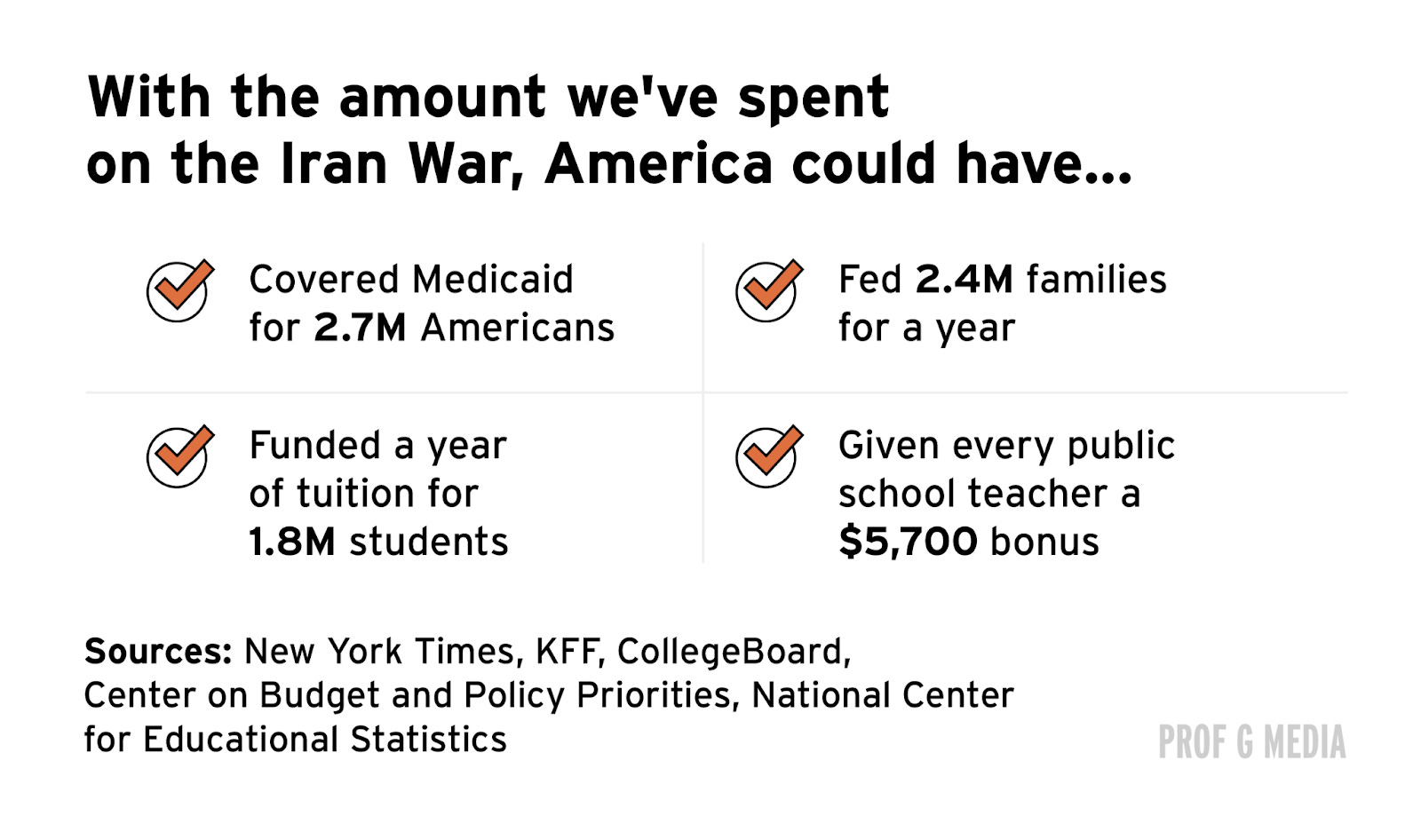
First, a quick financial audit. Based on what the Pentagon has told us, it’s estimated we’ve spent nearly $22 billion on Operation Epic Fury so far. To put that in perspective, that’s enough money to cover Medicaid for 2.7 million Americans, or feed 2.4 million families for a year, or cover a year of tuition for 1.8 million students. Keep in mind, we’re only 18 days in. Consider what the Iran bill might look like in six months, or even six years.
As with every business expenditure, the Iran war has its accounts payable and its accounts receivable. The spenders in this transaction are obvious: us. American taxpayers will bear the financial burden of this war, either directly through taxes or through deficit spending for which younger Americans will disproportionately pay the price. We’re also set to pay hundreds of billions in higher food and energy costs, but that’s a conversation for another time.
Then there’s the people who’ll make money. These individuals are slightly trickier to identify, as the downstream impacts are (purposely) opaque. There are the defense companies who, as we discussed this morning with Liz Hoffman, are set to net $200 billion in nationally-syndicated investment from Trump over the next three years. There are also the investment bankers whom Trump has assembled to underwrite these deals. But there are plenty of others, many of whom were in the rooms where the decision to go to war was made.
So without further ado, let’s go through some of the biggest winners of the Iran war.
Eric & Don Jr.
We’ll start with the President’s sons, Eric Trump and Don Jr. The Trump brothers are the new backers of a tactical drone company called Powerus, which “builds and scales autonomous drone systems for military and commercial use in high-risk environments.” Eric Trump also recently invested in an Israeli drone company, which is known in the defense community for its “low cost per kill” drone munitions. Both of these investments will likely outperform due to 1) our newly-waged war, 2) the Pentagon’s new ”drone dominance” program, which will issue $1.1 billion in procurement contracts to drone companies, and 3) the fact that the defense department is among their biggest clients.
Finding hot government contractors before anyone else is, of course, the Trump brothers’ bread and butter. That’s why they also created the New America Acquisition I Corp., an investment vehicle whose stated goal is to identify companies “well-positioned to benefit from federal or state-level incentives, such as grants, tax credits, government contracts or preferential procurement programs.”
The Trump brothers continue to make a fortune through monetizing their relationship to the President. It started with crypto but has now devolved into frontrunning bloodshed with early investments in advanced weapons manufacturers. This is a level of corruption unlike anything we’ve seen — not just in terms of scale but also shamelessness, as the Trump brothers have made almost no efforts to cover it up. Think of this as the Trump family’s Hunter Biden laptop, only this one’s a million times worse.
Jared Kushner
Jared Kushner has essentially bet his career on the elimination of Iran — a risky wager, but one made less risky because of his connection to the president. Over the past several years, Kushner has raised billions of dollars from Middle Eastern sovereign wealth funds with the central goal of reconstructing the Gulf. His vision requires establishing a cohort of economic cooperation among the major Gulf players (Saudi Arabia, Qatar, the UAE) and Israel — a feat that cannot materialize if Iran continues to call for Israel’s destruction.
As such, Kushner’s investment firm, Affinity Partners, has begun deploying its $5 billion AUM into strategic Gulf assets such as Shlomo Group, an Israeli conglomerate with large holdings in, yes, defense. His firm is also a large investor in Phoenix Holdings, one of Israel’s largest asset management companies. Jared is even working on plans to put data centers in Gaza.
None of this would necessarily be problematic if it weren’t for the fact that Kushner appears to be one of the people who decided we should go to war. Last week, Trump admitted this. He said the reason he believed Iran was an imminent threat was because Jared Kushner told him so. Keep in mind, Kushner has no formal position in the White House. However he is married to the President’s daughter, which (apparently) makes him qualified to advise our government on global warfare. Taken in concert with his multi-billion-dollar bet on reconstructing the Middle East, it’s hard to see this as anything other than an act of historic corruption.
The Witkoffs
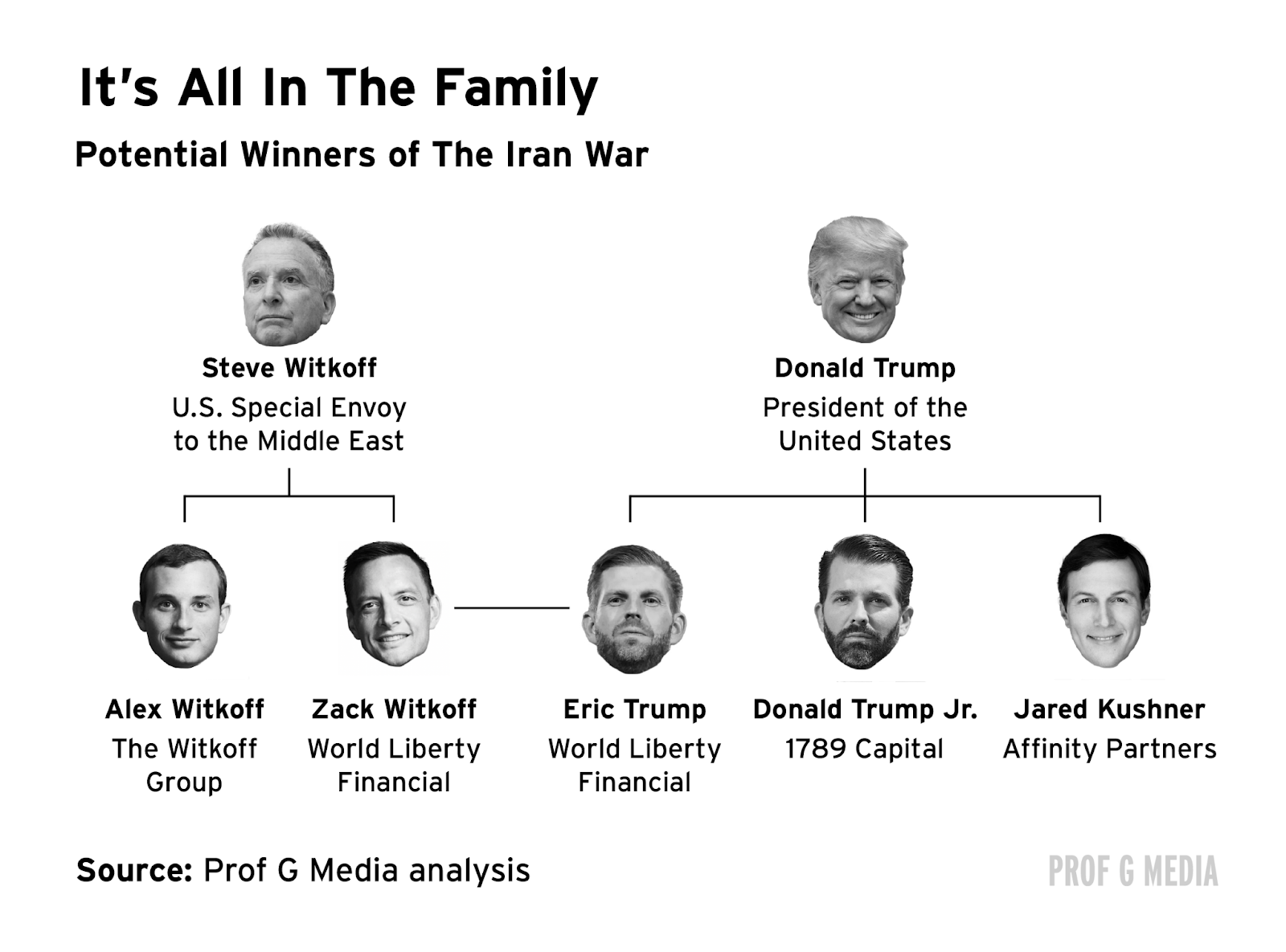
Another key winner is Steve Witkoff, the real estate developer who was appointed as U.S. special envoy to the Middle East by Trump. After winning the position, Steve handed control of his investment firm, The Witkoff Group, to his son, Alex Witkoff, who proceeded to strike multiple real estate deals with entities in the Middle East. He even bragged about it as he pitched more investors at home. The father-to-son handoff was also a cunning workaround to government ethics laws, which require officials to fully divest of any assets that may benefit from state policies. This is fast becoming a popular tactic in Washington. Commerce Secretary Howard Lutnick, for example, recently employed a similar strategy for his firm Cantor Fitzgerald before his sons reportedly began buying up tariff refund claims.
As Alex Witkoff expanded his family’s real estate network in the Middle East, his brother Zach was busy establishing the Trumps’ other family business: crypto. In 2024, Zach teamed up with Eric Trump to form World Liberty Financial. Together they generated billions of dollars in crypto earnings alongside “projects” such as Trump Coin and Melania Coin. I’ve put “projects” in quotes because, as I explained on The Bulwark, we need to start calling these operations out for what they really are: theft. Don’t take it from me — take it from the hundreds of thousands of victims who lost billions of dollars to their own President.
It keeps going. It was later revealed that Zach and Eric had sold 49% of their crypto firm last year to the United Arab Emirates for $500 million. I.e. the same people with whom their dad had been presidentially appointed to broker diplomatic relations. The corruption runs deep, and it goes in a circle.
Defense Tech Investors
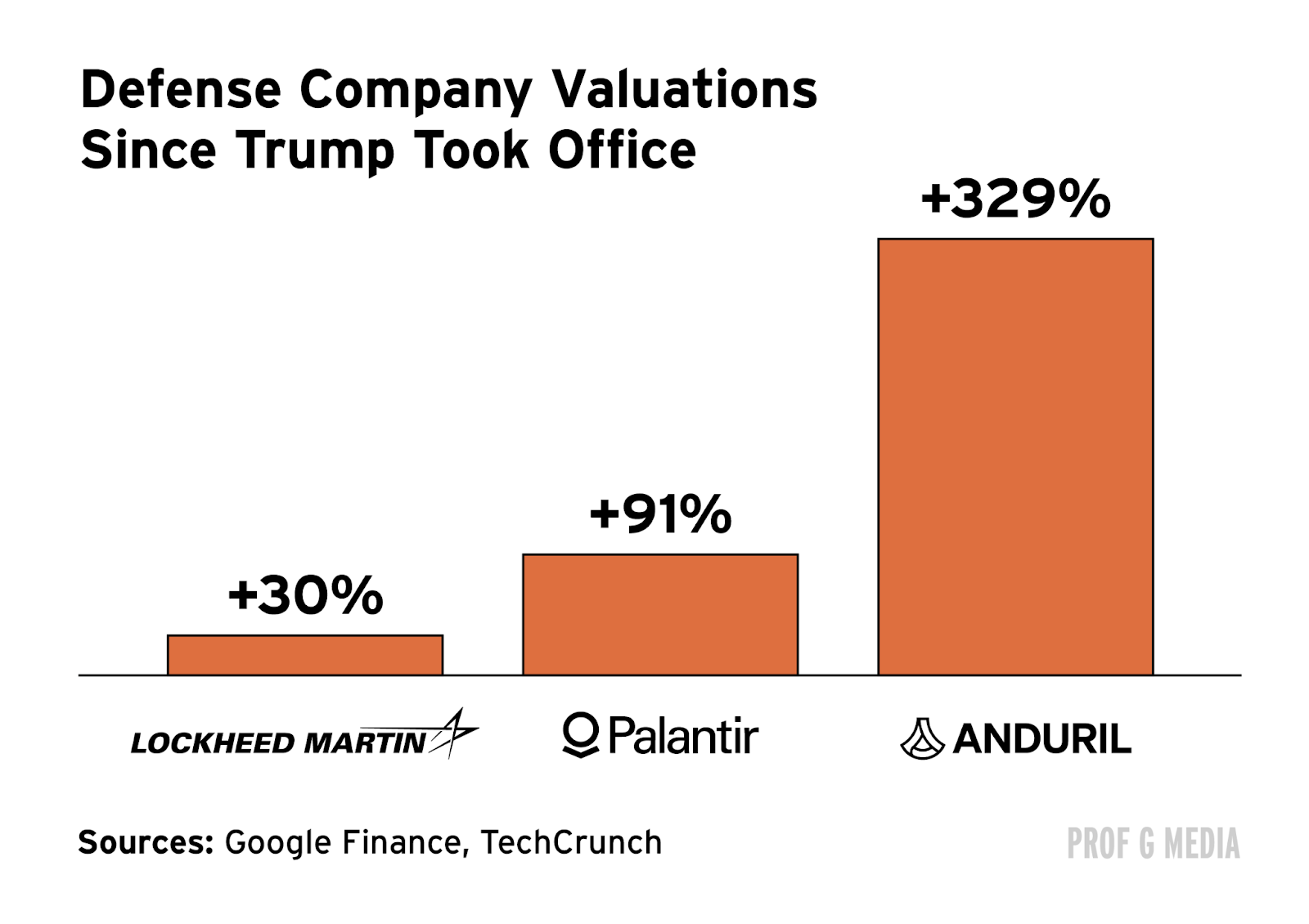
Startups are getting in on the action too. Palmer Luckey, the founder of defense tech company Anduril, hosted multiple fundraisers for the Trump campaign, including a roundtable at Newport Beach that cost attendees $100,000 a pop. Since then the company has won multiple significant defense contracts, including agreements to help build the Golden Dome, integrate autonomous surveillance at the border, and of course, build drones. Anduril’s valuation has more than quadrupled since Trump took office. Meanwhile, shares in defense tech company Palantir (whose founder was one of Trump’s top backers) have risen nearly 15% since the Iran war began and have almost doubled since the start of the President’s second term.
Prediction Markets Bettors
This post wouldn’t be complete if we didn’t mention the numerous individuals who made millions betting on the Iran war via prediction markets. More than half a billion dollars were traded on the timing of these strikes, and one account netted more than half a million. At first I thought this person might just be a smart trader, until I learned their first trade was placed roughly one hour before the news broke publicly. In other words, they definitely knew something.
Next question: Who is this person? Answer: We don’t know, as the trades are anonymous. This forces us to consider the possibility that this person is either in the administration, or at least associated with it. This is made even more possible when you remember that both of the largest prediction markets platforms are actively advised and backed by members of the Trump family. Which also means that if there was foul play, we shouldn’t expect anyone to be held accountable any time soon.
How Deep Does It Go?
The more you dig into this war, the more corruption you find. What’s especially appalling, however, is that I’ve barely done any digging. Most of my observations are simply a function of reading headlines and noticing names. For example, it’s impossible not to acknowledge Witkoff’s conflicts of interest when his title is literally “special envoy to the Middle East” and his son is publicly brokering deals in the region. It’s also hard not to believe that Jared Kushner is steering U.S. war policy when the President literally told us.
All of this forces us to conclude we’re only scratching the surface. If the tip of this iceberg is already iceberg-sized, how big is the rest of the iceberg? This is where investigative journalism is supposed to come in. Unfortunately for us though, the majority of our news outlets are in the process of being bought out by the President and his operators. Once again, we know this because Trump told us.

We’re in a tough spot. The guy who previously said going into the Middle East was the “worst decision ever made” has now launched us into another Middle East war without receiving any congressional approval, and after accidentally blowing up a children’s school (and saying he didn’t), we are now beginning to learn that the reason any of this is happening might be to make a handful of friends and family members richer than they already are.
The previous sentence should be enough to make every American’s stomach turn. But then again, America voted for this. As Ken Levine once wrote: “We all make choices, but in the end, our choices make us.”
See you next week,
Ed
Bravo, Ed! I truly cannot believe that the open corruption undergirding this war is not the biggest scandal of the century. Thank you for illuminating it — hopefully you will inspire others.
This feels like an "end of empire" period, where resources and opportunities are being pillaged irrespective of the long-term consequences.
And none of this is going to be put through court in the future, there won't be any reversals or reprisals if the next admin is blue. In fact, it almost sets a precident for how future admins can get away with stuff without much consequence.