


As OpenAI and Anthropic prepare to go public, a cloud of doubt hangs over AI. The biggest question isn’t whether people will use the technology (they already do), but whether the business model actually works. So far … it doesn’t. Anthropic lost nearly $6 billion in 2024. xAI lost $2.5 billion in a single quarter. Worst of all, financials leaked last week revealed OpenAI lost a staggering $38.5 billion in 2025. I’ll put it simply: These losses are not sustainable.
At the same time, there’s some confusion over how “real” those losses actually are. Someone “familiar with the matter” said OpenAI’s true loss last year was actually $8 billion. Big deal if true. In addition, the Wall Street Journal recently reported Anthropic is “about” to see its “first profitable quarter.” Again, big if true. Maybe AI isn’t unprofitable after all?
The stakes are too high for us to have only a vague understanding of whether these businesses even work. This week I’ve decided to demystify just how (un)profitable these two AI labs really are.
OpenAI
Up until last week, investors knew next to nothing about OpenAI’s business. Then Ed Zitron got his hands on their 2025 financials (which were independently verified by the Financial Times), and the truth of OpenAI was finally brought to light.
Here’s what we learned: The company generated $13 billion in revenue last year, up 240%. (!!!) However, it also lost $38.5 billion. (???) Much of that supposedly included “one-offs” like stock-based compensation and a charge related to their reorganization into a for-profit company. (This is the basis of the “those losses weren’t real” argument … we’ll return to that in a moment.)
We also got a clean look at a financial metric that’s a lot harder to bullsh*t: operating profitability. As a reminder, this is a measure of how much money is made/lost in day-to-day operations. I.e. it doesn’t include capital expenditures. Still, the numbers were ugly.
Let’s go line by line. OpenAI spent $1.6 billion last year on General & Administrative costs (i.e. paying employees), $5.7 billion on Sales & Marketing (i.e. ads), $7.5 billion on Cost of Revenue (i.e. inference costs), and $19.2 billion on Research & Development (i.e. training costs). That’s a grand total of … $33.98 billion in spending. Add back $13 billion in revenue and you get OpenAI’s no bullsh*t operating loss: $20.92 billion. That makes OpenAI one of the most unprofitable companies in history.
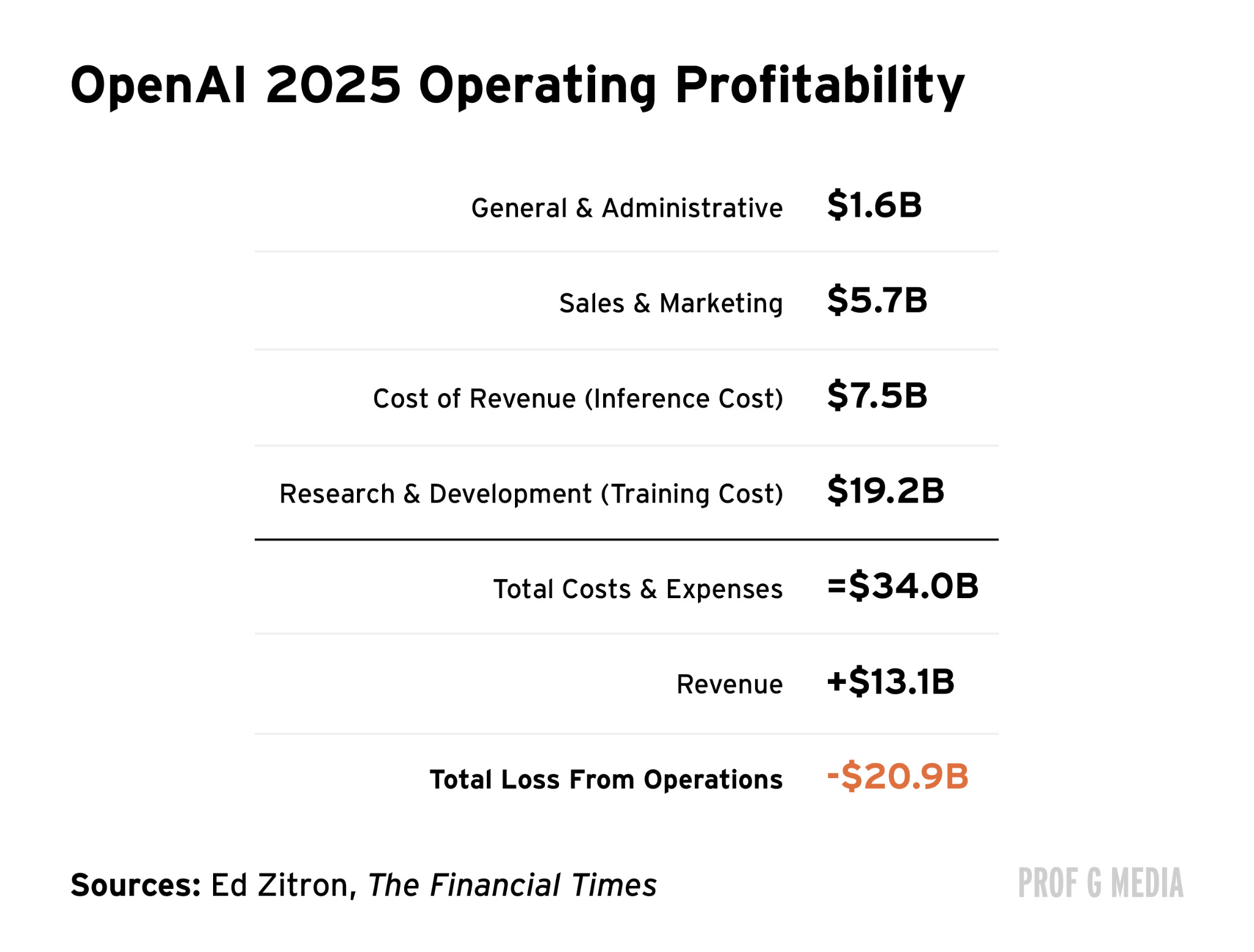
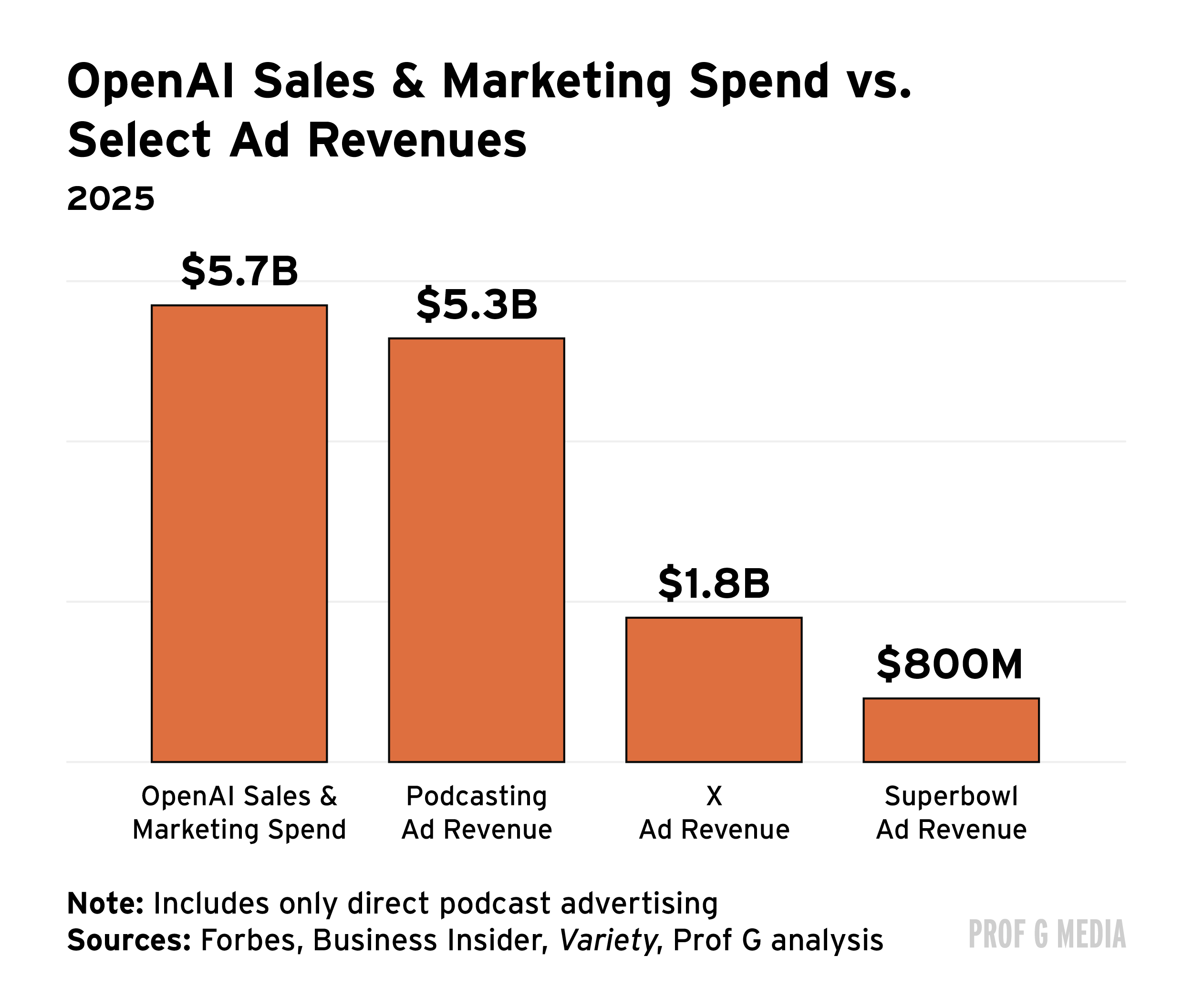
These tremendous losses were brought to you by batsh*t spending. $34 billion in costs means OpenAI spent roughly as much as the US government did last year on the FBI and NASA combined. Also, take another look at that $5.7 billion Sales & Marketing bill. OpenAI spent more on ads in one year than the entire world spent on podcast ads. With that budget they could have also bought every ad-slot at the Superbowl for the past seven years. I suppose the only thing more expensive than building AI … is selling it.
Wrinkle
But wait … didn’t someone familiar with the matter tell the Financial Times OpenAI’s true loss was $8 billion? This is where the numbers become irreconcilable. While billions of dollars could have been lost due to a “one-off charge,” the company’s recurring loss could not have been less than $21 billion. Why? Because we know the operating loss. It was $21 billion.
Which leads us to conclude one of two things: Either someone is confused … or someone’s lying. The next question is who you think that someone is. Either it’s 1) Ed Zitron and all the news outlets that independently came to the same conclusions, or 2) the person “familiar with the matter.” I know who my money’s on.
Anthropic
Moving onto Anthropic, here’s what we actually know: the company’s annual recurring revenue hit $47 billion in May (self-reported but I believe it), and last year revenue hit $4.5 billion. That growth is obviously staggering, however we still don’t know the part that matters most: how much they spent.
There have been estimates. The Wall Street Journal pegged Anthropic’s 2025 compute costs at $7 billion. In that same article, however, they also estimated OpenAI’s to be $17 billion — roughly 60% lower than the real figure we learned last week.
Then came the blockbuster WSJ report claiming Anthropic was on track to be profitable this quarter. That seemed significant … until I dug further and realized the statement relies on a two-month period in which Anthropic’s SpaceX contract (one of its largest expenditures) was heavily discounted (for reasons unclear) — after which the bill would balloon to $15 billion per year. In other words, Anthropic’s path to “profitability” is a theoretical snapshot of a world that doesn’t actually exist … hence the article’s highly conditional language and Anthropic’s bizarrely modest silence.
So what’s the truth then? We don’t know, but we can try to piece it together. Assuming The Wall Street Journal was off by the same margin it was for OpenAI (60%), it’s likely Anthropic’s compute costs came out to around $11 billion last year. We can then guesstimate the company’s other line items. Most B2B ad budgets are about a third smaller than consumer, so let’s assume Anthropic’s Sales & Marketing bill was a third lower than OpenAI’s: $3.8 billion. Anthropic’s headcount is also 50% lower, so let’s cut their G&A expense in half: $0.8 billion. Add back the revenue and you get an operating loss of … $11 billion. This is all highly theoretical as we’re working with almost no information, but still, that number’s not great.
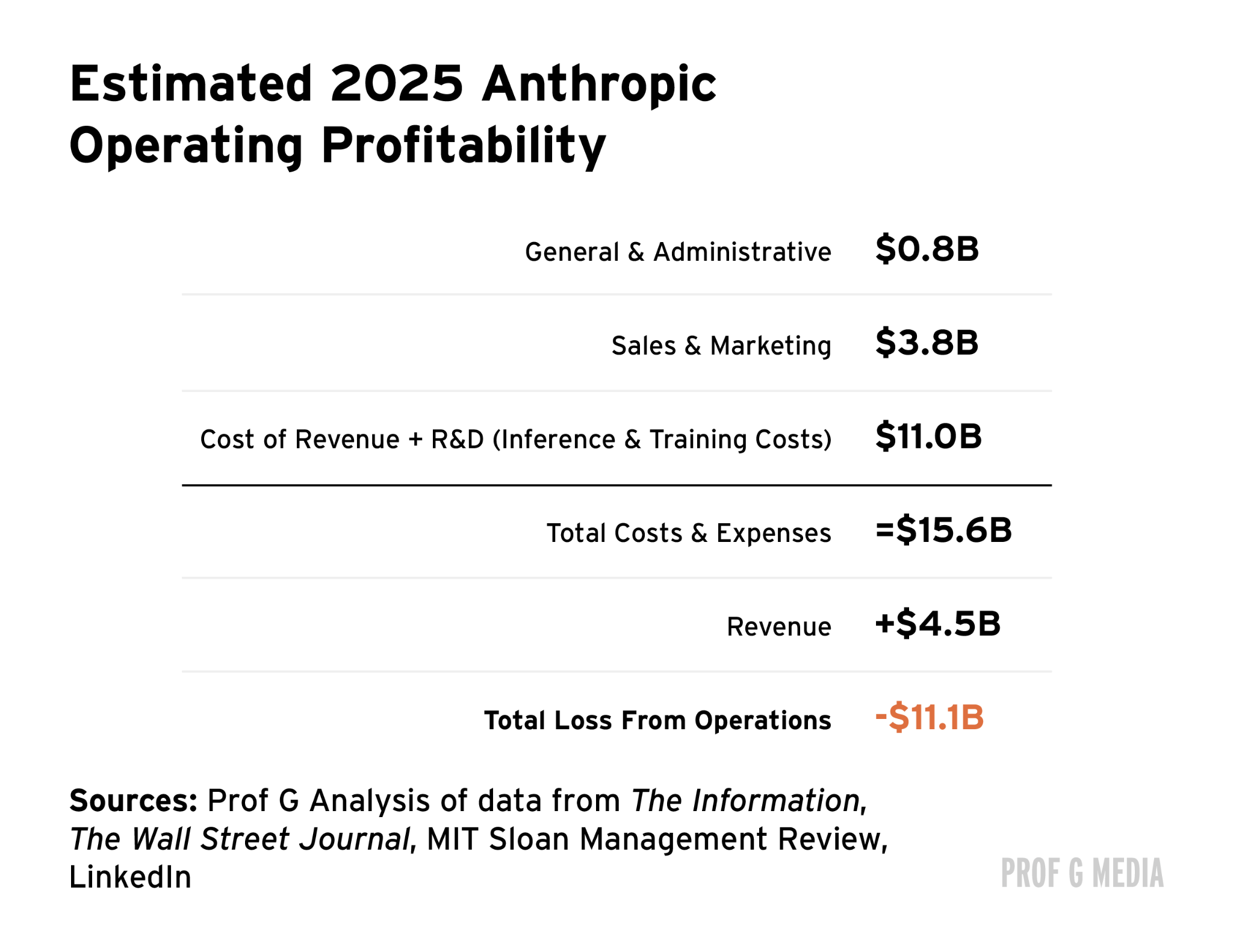
However, let’s also acknowledge that Anthropic’s (estimated) loss is roughly half the size of OpenAI’s. That’s not saying much, but it’s something. If you had to bet on one lab to not hemorrhage billions of dollars every year, it would be Anthropic.
The Way Out
If Anthropic can actually book $47 billion in revenue this year (difficulty: hard), and if they can limit their costs from growing more than 150% (difficulty: extremely hard) … then the company could theoretically turn a profit this year. However, those are big if’s — I wouldn’t bet on them.
As for OpenAI, profitability is still lightyears away. Even if they flatline spending growth (they won’t), revenues will still need to go parabolic. That is an increasingly unlikely scenario given the company is already considering marking ChatGPT prices down.
Conclusion: Profits are currently within the realm of possibility for Anthropic, but not for OpenAI. Do with that what you will.
So What?
I’m obsessive about these details for a simple reason: If AI can’t make more money than it spends, it’s uninvestable. As reductive as that might sound, it’s true. The point of a company is to make profits – and so far, none of these AI labs have gotten close.
It’s possible Sam Altman and Dario Amodei can paper over these gaping holes in the same way SpaceX did: with a ridiculously small float, a cartoonishly large TAM, and a cult-of-personality CEO. But that would also mean developing a personality … something neither Sam nor Dario are equipped to do.
Ultimately, it will come down to getting the boring stuff right. No more cosplaying as social media or acquiring hot podcasts. No more scuffles with the White House or predicting doomsday. Determine which costs are necessary and which aren’t. Then delete them aggressively. The most important person at the company is no longer the CEO, but the CFO. It’s time for the labs to sober up.
See you next week,
Ed
Thank you for the article, but I think it might be helpful to review a couple of financial/accounting concepts for future analysis (not trying to be sarcastic at all!). All of those figures quoted include non-cash expenses like SBC, D&A, and one-time charges, which are usually embedded within those operating expense line items. The people stating the true losses are $8bn are likely referencing a cash flow metric that unburdens profitability of those non-cash charges. Calling it deception isn't quite accurate; within an investment firm, analysts strip these out to determine true steady-state cash generation or burn (done for a variety of reasons like true cash runway, SBC being non-cash - equity dilution problem and not cash problem, etc.). If you’re looking for a "no bullsh*t" figure for sustainability, industry standard dictates using UFCF or LFCF, not GAAP operating loss. Also, the characterizations of R&D and G&A are highly oversimplified, the R&D breakout for OpenAI likely carries much more depth than just training costs (I would posit it would be difficult to even say that is the majority of R&D cost). Thanks again for the article.
$5.7 billion on Sales & Marketing is where this piece stops being about AI and starts being about unit economics. Companies with genuine product-market fit don't outspend NASA on ads. They don't need to. The product sells itself because the value is obvious at the price being charged. $5.7 billion tells you one of two things: either the price needs to come down to match actual willingness to pay, or the demand isn't as deep as the TAM slides suggest. OpenAI is now reportedly considering cutting prices, which answers which one it is.
The Anthropic "profitability" is the other number worth pausing on. Profitable for a two-month window when SpaceX compute costs were discounted, after which the bill balloons to $15 billion a year. That's not a profit. That's a coupon. And the WSJ language around it, "about to," "on track," "first profitable quarter," is doing the same conditional heavy lifting that "we're almost there" has done in every pre-IPO narrative that didn't survive contact with actual financial reporting. The most important person at these labs is the CFO. The problem is that nobody is listening to the CFO yet.