



In my next life, I’m coming back as a Navy Seal, Broadway dancer, or chiropractor. However, in this life, I should have gone into insurance. Yeah … insurance. If you meet someone who has a middling IQ, exceptional EQ, and is making $600k/year, there’s a decent chance they’re in insurance. This industry thrives by tapping into an instinct: fear. We’ll gladly suffer a series of guaranteed losses to avoid the possibility of a catastrophic one. Nowhere is this more evident than with health insurance. Of the wealthy nations at this year’s World Cup, the U.S. is the only one that doesn’t guarantee healthcare.
In many industrialized nations, employers play a small role, via payroll deductions, in funding universal coverage, but only in America is employment tied directly to that coverage, meaning employers can shift rising healthcare costs to labor, while workers who lose their job also lose their coverage.
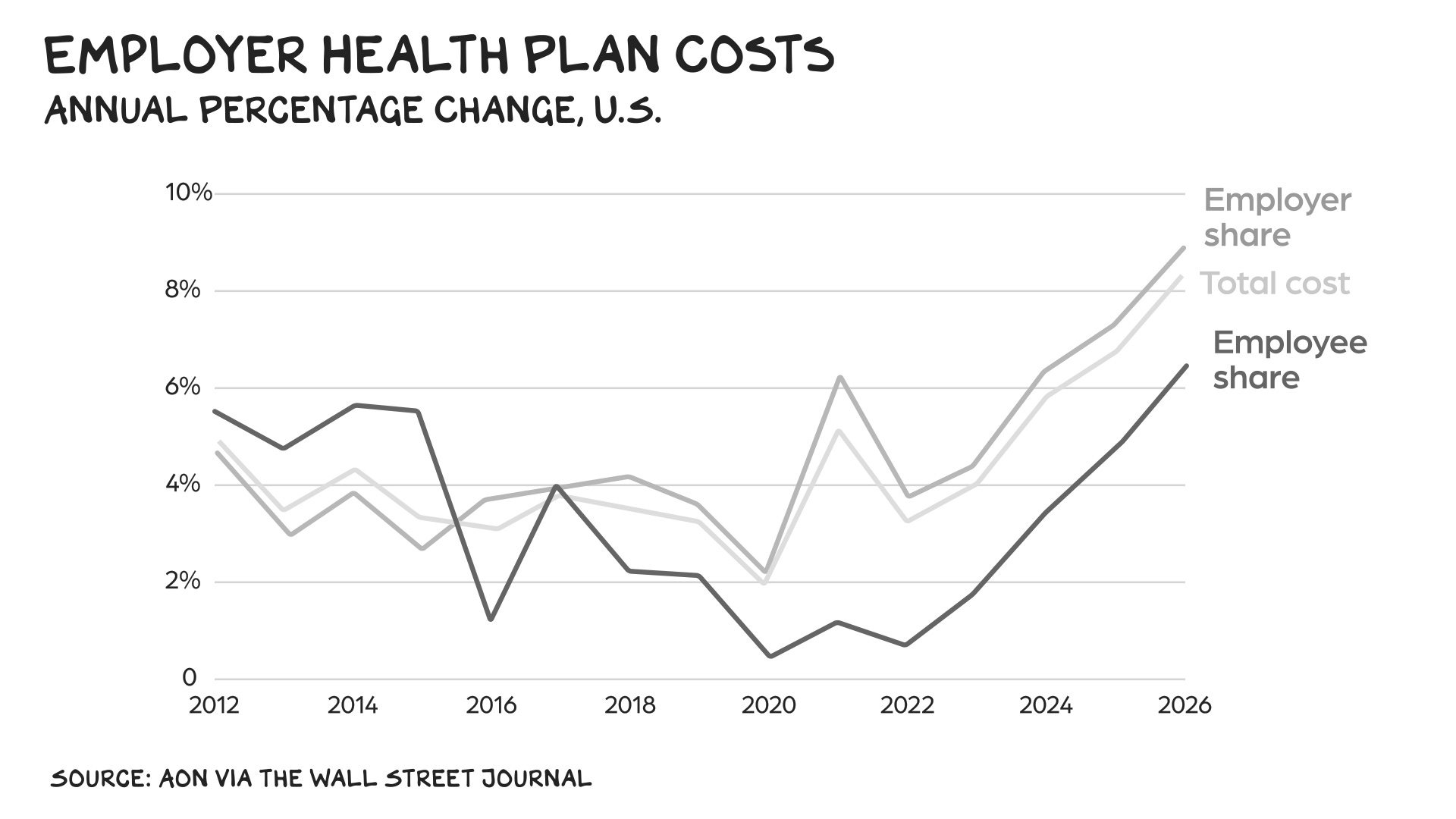
For people under 65, employer-sponsored plans are the leading source of health insurance, providing benefits to approximately 165 million American workers and their families. Without reducing benefits, premiums for employer-sponsored plans are projected to increase this year by an average of 11% YoY — the steepest rise in two decades and more than 3x the rate of inflation. (Prof G Media’s premiums are increasing 9% YoY. We’re seeing a slightly smaller jump thanks to the Professional Employer Organization that handles our payroll, taxes, etc., allowing a firm like ours with fewer than 50 employees to participate in a larger plan.) Meanwhile, many companies are shifting a greater share of their costs to their employees, with the average worker paying 8% more YoY to cover higher payroll deductions for premiums and out-of-pocket charges including deductibles and copays. If you’re getting the feeling that America’s private health insurance market is a drag on businesses and workers, trust your instincts.
Subsidizing Cost Increases
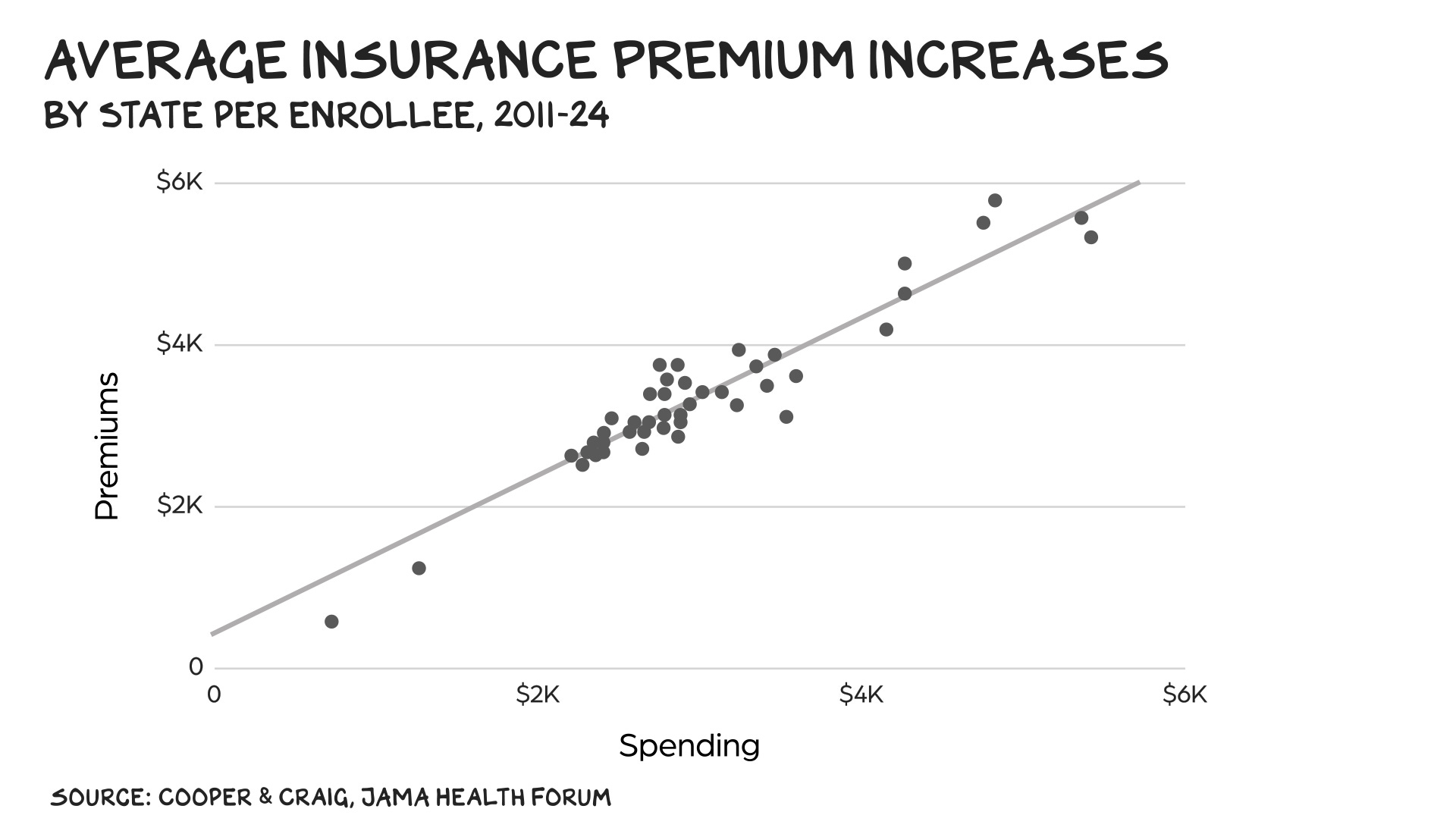
When a market fails, our tendency is to provide demand-side subsidies. If healthcare is unaffordable, the logic goes, we should subsidize access, helping more companies and people pay for it. The demand-side approach feels (morally) right, directing help toward those who need it. But because demand-side solutions do nothing to control costs, subsidies are akin to pouring fuel on a flame. Actually, it’s worse than that. Between 2011 and 2024, the average insurance premium increased by $3,143 (78%), while health spending per person rose by $2,844 (84%), according to an analysis by Yale economist Zack Cooper and University of Wisconsin Business School professor Stuart Craig. Over the same period, insurer markups — the portion of the premium that covers insurance companies’ administrative costs and profits — decreased from 19% to 15%. The growth in health spending accounted for 91% of the overall growth in average premiums. “We found that health insurance premiums increased nearly dollar-for-dollar with health spending,” Cooper said.
That’s Where the Money Is
Over a 40-year career, Willie Sutton robbed more than 100 banks, stealing an estimated $2 million (roughly $20 million in today’s dollars) by the last time he was apprehended, in 1952. According to legend, when a reporter asked him why he’d hit all those banks, Sutton said, “Because that’s where the money is.” If he were alive today, Sutton would likely have directed his talents toward the healthcare industry. Total U.S. healthcare spending makes up 18% of GDP, and that’s expected to rise to 20% by 2034. Healthcare is projected to account for 37% of all new jobs created through 2035, according to data from the Bureau of Labor Statistics. Not all growth is good growth, however. An aging population and the growing prevalence of chronic conditions — heart disease, cancer, diabetes — are the primary drivers.
Several trends are sending healthcare costs higher. AI, which many had hoped would lower administrative costs, is actually increasing reimbursements paid by private insurers. Providers are using AI to better document care, meaning the same healthcare interactions generate more billing codes and greater profits. Increased demand for GLP-1s is also a factor, fueling an 81% increase in pharmaceutical spending to treat obesity and a 13% increase in spending on diabetes treatments, according to a PwC report. Greater demand for mental health services is also raising costs, with utilization increasing 10% from 2023 to 2024 and surging 62% since 2018. Finally, the No Surprises Act, which was meant to protect patients from unexpected out-of-network bills, has inflated costs, because providers are using its arbitration provision to dispute reimbursements and winning 88% of the time. To save money, some employers are increasing employee premium contributions and/or reducing benefits, including coverage for GLP-1s. Meanwhile, the share of companies turning to Health Reimbursement Arrangements — essentially, stipends that let employees buy their own coverage on the open market — increased 53% YoY in 2026.
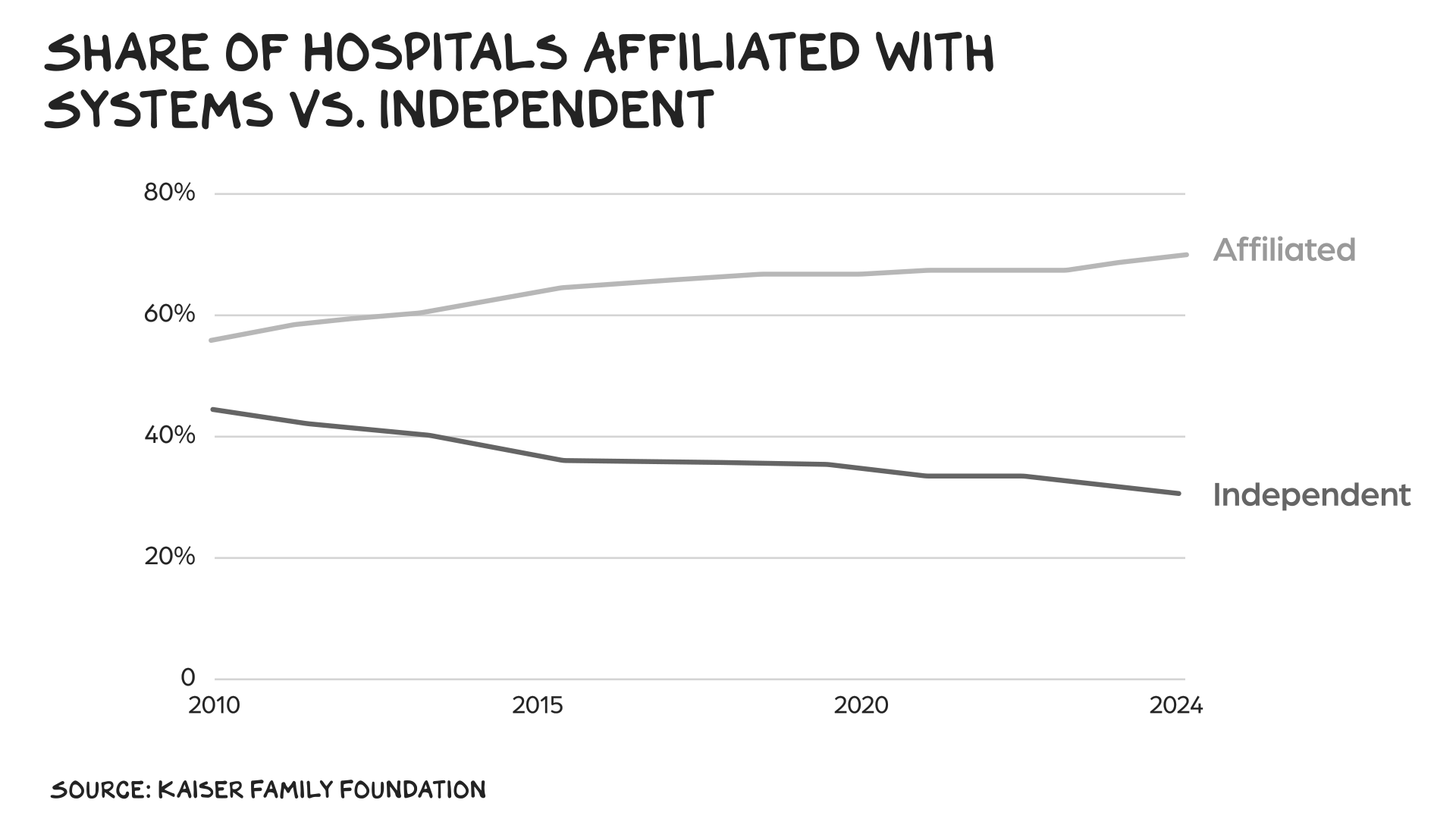
All of this is happening against the backdrop of industry consolidation. From 1998 to 2023, there were more than 2,000 hospital mergers. The share of hospitals operating independently declined from 90% to 31% from 1970 to 2024, and now 9 out of 10 U.S. hospital markets are classified as “highly concentrated.” Meanwhile, only 42% of physicians work in an independent physician-owned practice — down from 60% in 2012. A 2025 HHS analysis found that hospital mergers in concentrated markets can raise prices up to 65%. Willie Sutton needed a gun and a getaway car. Today’s health systems just need to merge their way toward a captive market.
Scarcity vs. Abundance
Every election cycle, candidates tell Americans their healthcare system is expensive and broken. We spend 2x what other OECD nations spend, and by that metric should be the healthiest nation on Earth, but instead we achieve worse results than our peers. “The U.S. continues to be in a class by itself in the underperformance of its healthcare sector,” researchers at the Commonwealth Fund wrote in a 2024 report. For those in the back, that’s the wrong kind of exceptionalism. As it turns out, we’re also exceptional when it comes to the scarcity of our healthcare supply. According to federal data, 92 million Americans live in an area where there’s a shortage of primary care. The U.S. produces just 8.6 new medical graduates per 100,000 people, well below the OECD average of 15.
Another sign of scarcity? We average 2.8 hospital beds per 1,000 people, compared to the OECD average of 4.3. Hospitals, clinics, and doctors’ offices account for 52% of total healthcare expenditures, compared to 8% for drug costs. Talking about drug prices wins elections, as patients typically pay for prescriptions out of pocket. Addressing provider costs by unblocking supply bottlenecks makes for a lousy stump speech, but good policy.
So what’s the fix? The Niskanen Center has a blueprint, and it comes down to one word: more. More doctors, more clinics, more competition. Start with the pipeline. Congress froze Medicare-funded residency slots at 1996 levels, so we’re training the same number of doctors for a country with 70 million more people. In 2023, Congress added 1,000 residency slots over a five-year period — a good start, but we need more doctors, and we need to steer them toward primary care, especially in underserved areas, where the shortage is worst. The best way to do that, as my friend Mark Cuban has argued, is to make medical school free while empowering universities to require students to work for a stint where shortages are most acute. Next, remove local barriers to practice so labor can freely move where demand is greatest. Only 30 states grant nurse practitioners full practice authority, while state licensing laws restrict the supply of primary care doctors by an estimated 27%. We should also welcome foreign-trained providers. This year nearly 12,000 foreign-trained doctors applied for U.S. residency. More than 5,000 didn’t get one, and without a U.S. residency, most states won’t let them practice. Perversely, some of those doctors attended American medical schools but were forced to return to their home country because they couldn’t get a visa. Meanwhile, an estimated 263,000 immigrants and refugees with undergraduate degrees in health-related fields — mostly nurses and physician assistants — are underutilized, due to licensing restrictions. This isn’t a labor shortage, it’s an oversupply of red tape.
We’re also driving up costs by restricting the supply of hospitals. Thirty-five states still have “certificate of need” laws, which let incumbent hospitals veto future competitors. Imagine Chipotle needing Taco Bell’s permission to open a store. The supply crunch is further compounded by healthcare costs that vary widely for the same services. Here’s how: Medicare pays a hospital-owned clinic nearly double what it pays an independent practice for identical care. So hospitals spent years buying up doctors’ offices, hanging a new sign on the door, and sending taxpayers a bigger bill … for the same service. Paying the same rate for the same service — i.e., site-neutral payments — removes one of the biggest incentives for consolidation. It would also save Medicare an estimated $170 billion over a decade.
Medicare for More
We often frame healthcare reform as a choice between public and private solutions. But that’s misleading. Employer-based plans, as well as plans purchased via the Obamacare exchanges, are both heavily regulated and heavily subsidized, making healthcare the most favored sector in the tax code. In 2025 taxpayers poured $512 billion into the healthcare industry through Obamacare premium tax credits and deductions for employer-based premiums, certain medical expenses, and health savings accounts designed to derisk individuals with high-deductible plans. As economist Paul Krugman wrote in August, “the government’s role is so large that U.S. healthcare is better described as partially privatized socialism than as anything resembling a free market.”
I’ve argued in favor of expanding Medicare slowly by lowering the eligibility age by two years every year for the next decade. That would reduce premiums for employers, since people ages 45 to 64 register 32% of healthcare spending, compared to 31% for those 44 and younger. It would also set free the 1 out of every 4 workers who say they’re “locked” into their job because of healthcare. With more enrollees and legal reforms, Medicare will have greater leverage to negotiate lower prices. Medicare is also more efficient, with just 1.3% of its spending going to administrative costs. Medicare Part D (prescription drugs) and Advantage plans, both of which engage private insurance companies to manage benefits, spend 8% and 17%, respectively, on administrative costs.
But as long as we keep subsidizing inefficient, wildly profitable private insurance, costs will keep climbing across the board. Expanding Medicare while propping up the private side is like flooring the gas with your other foot on the brake: There’s lots of noise, the smell of burning rubber, and you go nowhere. Insurance sells fear. American healthcare monetizes this fear, as we’ve built the only system in the developed world where losing your job is a medical emergency.
We need less insurance, and less fear. And the cheapest way to reduce fear is to stop manufacturing it: Let’s kill private insurance subsidies and embrace Medicare for More.
Life is so rich,

P.S. In the minds of many Americans, rising costs frequently reverse-engineer to private equity. Prof G+ paid subscribers can catch my Deep Dive on America’s favorite corporate villain here.
Growing up, I remember my father saying "the insurance business is a license to steal." That was 50+ years ago. Plus ca change...
We need to kill Employer Sponsored Insurance (ESI). Anything else is just rearranging deck chairs. Medicare For All (M4A) is a good slogan - but we already know that Medicare pricing won't work - so the slogan is just that. A slogan.
https://danmunro.substack.com/p/why-we-need-to-end-employer-sponsored?utm_source=share&utm_medium=android&r=8d11k