


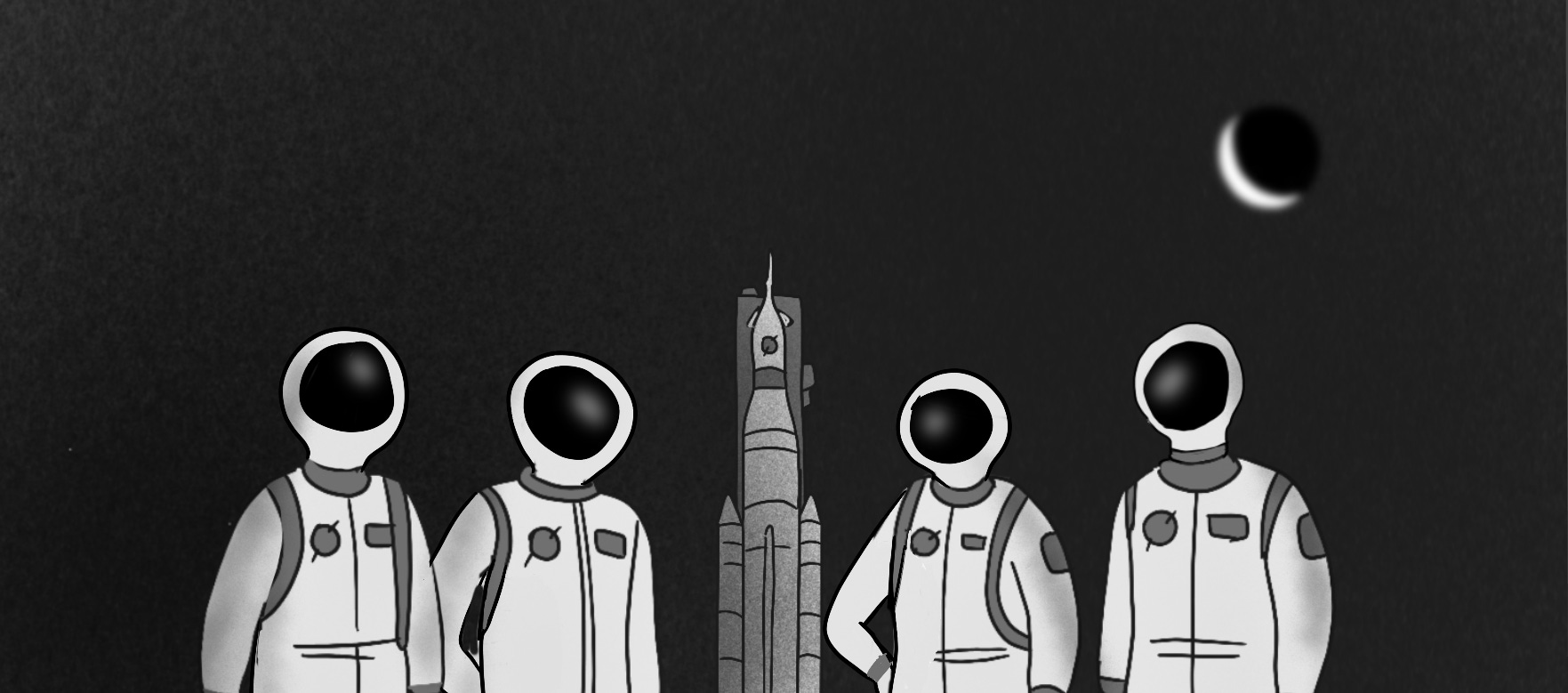
It’s more interesting, and you sound smarter, to catastrophize vs. articulate the arc of history: Things will likely get a bit better … every day … yawn. But it’s always healthy to ask, “What could go right?” Last week, with so many things on Earth going wrong, something went right — in space. Let’s talk about NASA’s Artemis II mission.
Houston, We Need a Story
One query I get often: “What class/skill would you suggest our kids take/learn to compete in the modern economy?” A: Storytelling. The flow of capital, like the trajectory of history, clots around compelling stories. Entrepreneurs, aka storytellers, deploy a narrative that captures imaginations and capital to pull the future forward. Before America was a nation, it was a story told by traitors who recast their rebellious colonies as bastions of liberty and themselves as patriots. Mastery of narrative is humanity’s superpower, as the arc of evolution bends toward good storytellers. Communities with a larger share of skilled storytellers experience greater levels of cooperation and procreation. Storytelling reinforces their evolutionary resilience, efficiently transmitting survival-relevant information.
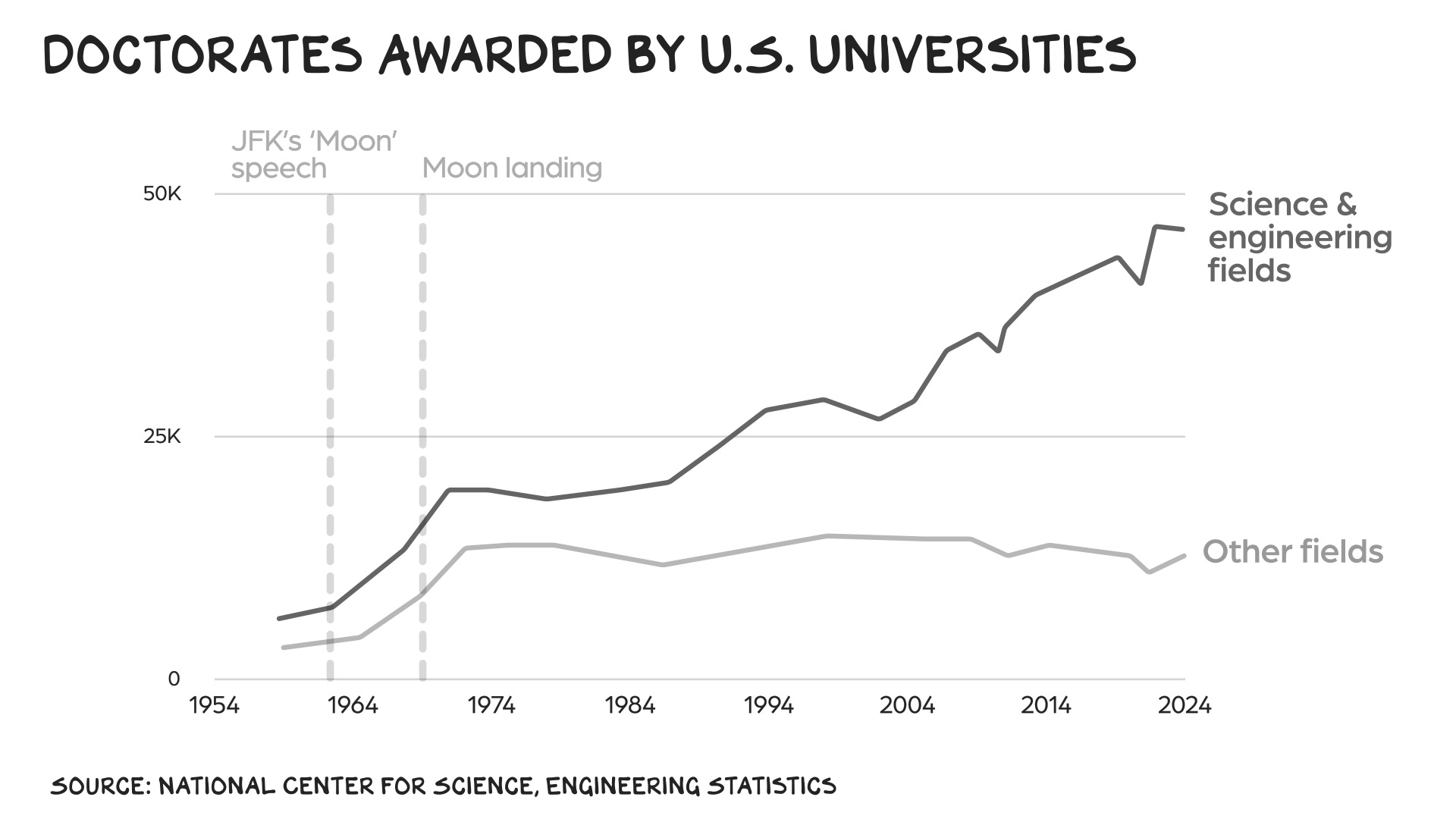
At the beginning of the space race, the story was about Soviet pioneering and American stagnation. The Soviet space program had put the first satellite into orbit (Sputnik), sent the first dog into space (Laika), and completed the first manned mission (Yuri Gagarin). So, how did we beat the Soviets to the moon in less than a decade? A: We changed the story from one about us falling behind (the space race) to one we could win (the moon race). Privately, President John F. Kennedy told NASA administrator James Webb he wasn’t that interested in space, but he said we were going anyway to “demonstrate that starting behind … we passed them.” In his 1962 speech at Rice University in Houston, JFK tapped into a sense of national urgency. He defined space as a new frontier and leveraged America’s competitive, pioneering spirit with a call to action: “We choose to go to the moon in this decade and do the other things, not because they are easy, but because they are hard; because that goal will serve to organize and measure the best of our energies and skills … and we intend to win.” JFK’s story pulled the future forward by capturing America’s capital (5% of federal spending at the height of the Apollo program) and imagination, especially among young people. A number of NASA’s key scientists and engineers were in high school or college when JFK gave his speech. Seven years later, when Neil Armstrong and Buzz Aldrin landed the Eagle module at a site later named Tranquility Base, the average age at mission control was 28.
The narrative arc continues to bend toward expanding human knowledge, as JFK’s story inspired multiple generations to dedicate their careers to science and engineering. As President George H.W. Bush explained nearly two decades after it ended, the Apollo program was “the best return on investment since Leonardo da Vinci bought himself a sketchpad.” By one estimate, every dollar spent on the moon race returned $7 in economic growth over the following decade.
Artemis II
When we think about the Apollo story, we jump-cut from Kennedy’s speech (act one) to Aldrin and Armstrong planting a flag on the moon (the climax). The Artemis program, named for Apollo’s sister in Greek mythology, is the beginning of the next chapter in human space exploration. At first glance, sending four astronauts on a 252,757-mile roundtrip journey to the moon — breaking the distance record for manned space flight previously held by Apollo 13 — seems like a sequel nobody asked for. Three years ago, when NASA announced Artemis II, the first manned mission in the program, Stephen Colbert asked an obvious question: “Why are we going back to the moon?” In response, Mission Commander Reid Wiseman said, “Because we want to see humans on Mars.” Bold.
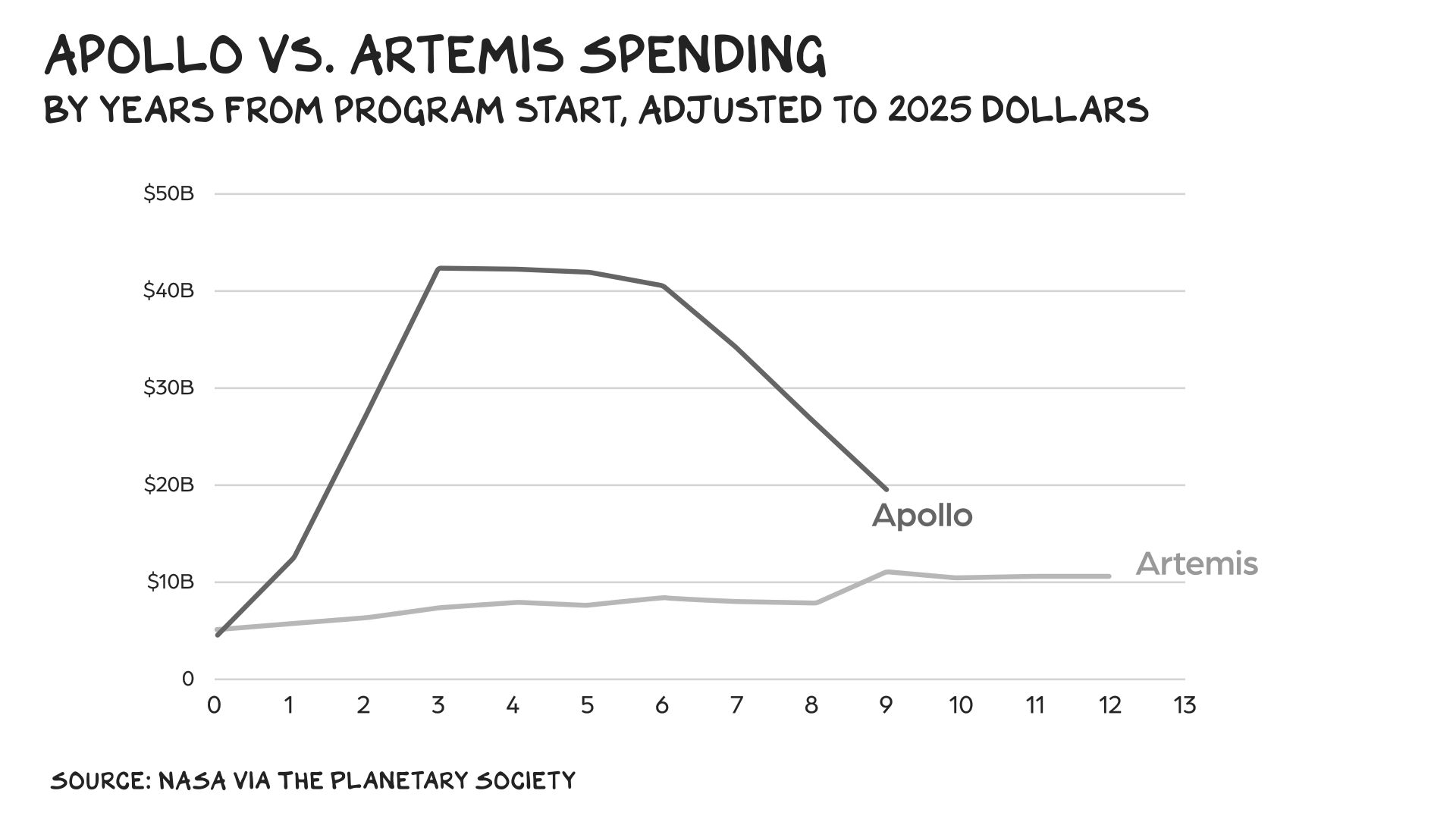
Artemis II was a shakedown flight to test the Orion spacecraft, similar in purpose to Apollo 8 — the first manned mission to orbit the moon and return. Success sets the stage for a moon landing in 2028, and more important, the establishment by 2030 of a permanent lunar base. In the short term, a permanent lunar base can be a proving ground for operating in deep space. Long term, this is about water, i.e., space oil. Sending one kilogram of material to the moon currently costs an estimated $1.2 million. But if NASA can turn ice at the moon’s poles into hydrogen (fuel) and oxygen (life support), it’ll transform space economics. A moon base could become a staging point for further space exploration, without having to rely on expensive resupply missions from Earth. Philip Metzger, an expert on spaceflight engineering at the Florida Space Institute, told National Geographic that a permanent lunar base puts us on a path, within a few years, for monthly moon missions. Read that sentence again. We choose to go to the moon … every month. Apollo was the Wright Brothers at Kitty Hawk; Artemis is jet travel. “This is the moment where we should all start believing again, when ideas become missions and when hard work delivers world-changing accomplishments,” NASA Administrator Jared Isaacman said in March. “NASA once changed everything, and we’re going to do it again.” The ambition is real. The funding, less so — NASA’s story hasn’t attracted the same flow of capital as the Apollo program, which peaked at 4x the spending of Artemis, adjusted for inflation.
Crew
One of NASA’s longest-running debates is the value of crewed vs. uncrewed missions. In 2008, Nobel Prize-winning physicist Steven Weinberg argued in Smithsonian magazine that science takes a backseat to astronaut safety on a crewed mission. “Manned missions to space are incredibly expensive and don’t serve any important purpose,” he wrote. “It isn’t a good way of doing science, and funds are being drained from the real science that NASA does.” But according to John Logsdon, professor emeritus at George Washington University and founder of its Space Policy Institute, exploration is about testing the belief that humans can become a multiplanetary species. We “have to be able to live off the land and do something worthwhile,” he wrote in response to Weinberg. “Exploration lets us find out whether both of these are possible.”
I believe the question isn’t whether or not to send humans, but which humans to send. Stories deploy audience surrogates, i.e., heroes. As Will Storr, author of The Science of Storytelling wrote, the human brain is “a story processor … designed to absorb the story world of the groups we identify with.” Gene Roddenberry created Star Trek to tell stories about the (mostly human and Vulcan, i.e. humanoid) Enterprise crew, not the ship. As Captain Kirk said at the beginning of each episode, it was about people choosing “... to boldly go where no man has gone before.”
In 2021, when Jeff Bezos and Richard Branson began selling six-, seven-, and eight-figure tickets to the Kármán Line, I wrote that they were a new breed of space traveler: The egonaut. Nobody identified with these imposters. We paid attention to their rocket-powered branding events with a mix of loathing, mockery, morbid curiosity, and the sinking feeling that billionaires would rather burn cash on their Martian escape fantasies than pay taxes to make Earth more habitable. Artemis II is a different story, because these are our astronauts, they are us. Three years ago, then-NASA Administrator Bill Nelson said of the Artemis II crew, “Each has his or her own story, but together they embody our credo: E pluribus unum, or ‘Out of many, one.’”
Commander Wiseman is a former naval aviator and decorated test pilot. He’s also a single dad, who named a lunar crater after his wife, Carol, who died of cancer in 2020. His crew is equally exceptional: Two accomplished military pilots and an electrical engineer who spent nearly a year living aboard the International Space Station. For a country poisoned by rising White nationalism, entrenched misogyny, and isolationism, the Artemis II crew is an antidote. It included the first Black astronaut (pilot Victor J. Glover), the first female astronaut (mission specialist Christina Hammock Koch), and the first non-American astronaut (Canadian mission specialist Jeremy Hansen) to travel to the moon. As individuals, each broke barriers, but as a crew they achieved greatness, as greatness is in the agency of others. “A crew is a group that is in it all the time, no matter what, that is stroking together every minute with the same purpose, that is willing to sacrifice silently for each other, that gives grace, that holds [each other] accountable,” Koch said. The Artemis II crew went to the moon, not for the money — astronaut pay tops out at around $150,000 per year — or to serve their egos, but for us. As Mission Specialist Hansen said at liftoff: “We go for all humanity.”
Moon Joy
Confession: I posted a lot of Artemis pictures, but privately wondered, “What’s the big deal, we’ve already been to the moon?” I didn’t experience “moon joy,” a phrase from CapCom that went viral, creating a rare moment of unity and good will. This week, Mia Silverio, my research lead, wrote that NASA is one of the most underrated brands in the world. Many luxury brands, hundreds of rappers, and Ariana Grande have associated themselves with NASA or its logo. NASA’s cultural cachet is … wait for it … on another planet. The average age of the Prof G research and production team is 25. They never saw us land on the moon (the Apollo programs ended in 1972). The Challenger disaster is something their parents remember. In their lifetimes, our biggest moments in space have been probes (great science, no story), commercial space flights and reusable rockets (great stories … for investors), and tourism (a story nobody wants). The Artemis program offers a story to inspire today’s young people, just as the Apollo program inspired my generation.
The reason the Artemis II story is so much more compelling is not the script, but the actors. The crew fits a decent definition of an aspirational vision for masculinity (a wonderful attribute not sequestered to people born as male). These impressive people are optimizing for service, vs. attention. This story is a welcome reminder, to those whose lived experiences are shaped by forever wars, financial crises, pandemics, and an insurrection, that America is still capable of moonshots. Still capable of going where no person has gone before. Still capable.
We aren’t going back, we’re going farther …
Life is so rich,

P.S.
We’re taking the Markets podcast on tour. Ed Elson and I will record with live audiences in San Francisco, Los Angeles, Miami, Chicago, and New York. Skip the FOMO, buy your tickets here.
I don't even consider myself an environmentalist, but we were so much more collectively concerned about the state of our own planet way back when Apollo missions were happening. The idea that we would continue to burn the fuel we do and trash planet Earth to the extent that we are doing, while chasing childlike dreams of interplanetary life, seems wrongheaded to me. We ought to commit to bringing our degradation of THIS planet to a zero state before spending more capital and funding on going to others.
I'm all for using space to further humanity. But it bothers me how we have cut so much out of the social safety net. It brings to mind a little ditty by Gil Scott Heron:
A rat done bit my sister Nell
With whitey on the moon
Her face and arms began to swell
And whitey's on the moon
I can't pay no doctor bills
But whitey's on the moon
Ten years from now I'll be payin' still
While whitey's on the moon
The man just upped my rent last night
Cause whitey's on the moon
No hot water, no toilets, no lights
But whitey's on the moon
I wonder why he's upping me?
Cause whitey's on the moon?
Well I was already giving him fifty a week
With whitey on the moon
Taxes taking my whole damn check
Junkies making me a nervous wreck
The price of food is going up
And as if all that shit wasn't enough:
A rat done bit my sister Nell
With whitey on the moon
Her face and arm began to swell
And whitey's on the moon
Was all that money I made last year
For whitey on the moon?
How come I ain't got no money here?
Hmm! Whitey's on the moon
Y'know I just 'bout had my fill
Of whitey on the moon
I think I'll send these doctor bills
Airmail special
To whitey on the moon