


“He’s distracting from the Epstein Files.”
That’s a sentence you’ve likely heard a lot this year. It’s a sentence that captures our current moment — the underlying feeling that every major headline is a diversion from the real story. Call it the “Epstein Theory of Distraction.” Is it real? Is our war with Iran actually just a decoy? I don’t know. But if it is, the data would suggest it’s working.
There are other theories of distraction that have also gotten popular. The Insider Trading Theory of Distraction, for example: Trump is “flooding the zone” to distract from the millions of dollars his inner circle has made trading on insider information. Or the Crypto Theory of Distraction: All of “this” is a ploy to make us forget the billions of dollars his family has made on digital Ponzi schemes. There are many distraction theories out there, but they all adhere to the same premise: The headlines are designed to distract us from the crimes the President has actually committed.
I’ve always found these theories a little ridiculous. For two reasons: 1) They’re conspiratorial, and 2) they act as if it’s on us (the public) to solve crimes. But that’s just not how the law works. It’s the police’s job to fight crime — our attention span has nothing to do with it. So why are we suddenly acting like it’s our job? Why are we all moonlighting as cops?
By the end of this post we’ll conclude that these theories are, in fact, not ridiculous. Actually, they’re quite reasonable. Because while catching criminals is obviously the police’s job, we are increasingly learning that America no longer has a police. (Or at least, the kind of police that would catch sexual predators and fraudsters.) This is part of a larger movement that’s grown popular in Washington to defund and dismantle federal law enforcement — an effort which I call … “Defund The Police.”
The Defund the Police movement has many supporters, but its greatest champion is (ironically) Donald Trump. That might sound crazy, but the point of this post is to show you that it’s true. Under his leadership, American law enforcement has been systematically disarmed, weakened, and ultimately neutralized — to the point where it may as well not even exist.
But before we unpack this movement, let me first prove to you that it’s real. In this post we’ll take a tour of the Defund the Police campaign. We’ll examine the various sites of wreckage that have now rendered our law enforcement anemic, and unearth the history of the most alarming trend no one is talking about.
Site #1: The Department of Justice
We begin our tour with the agency most responsible for (mis)handling the Epstein Files. The collapse of the DOJ was in many ways made self-evident when, instead of cooperating with questioning regarding the President’s potential involvement in a sexual abuse scandal, the Attorney General chose to brag about the performance of the Dow. Pam Bondi aside, there’s still plenty of other evidence to unpack.
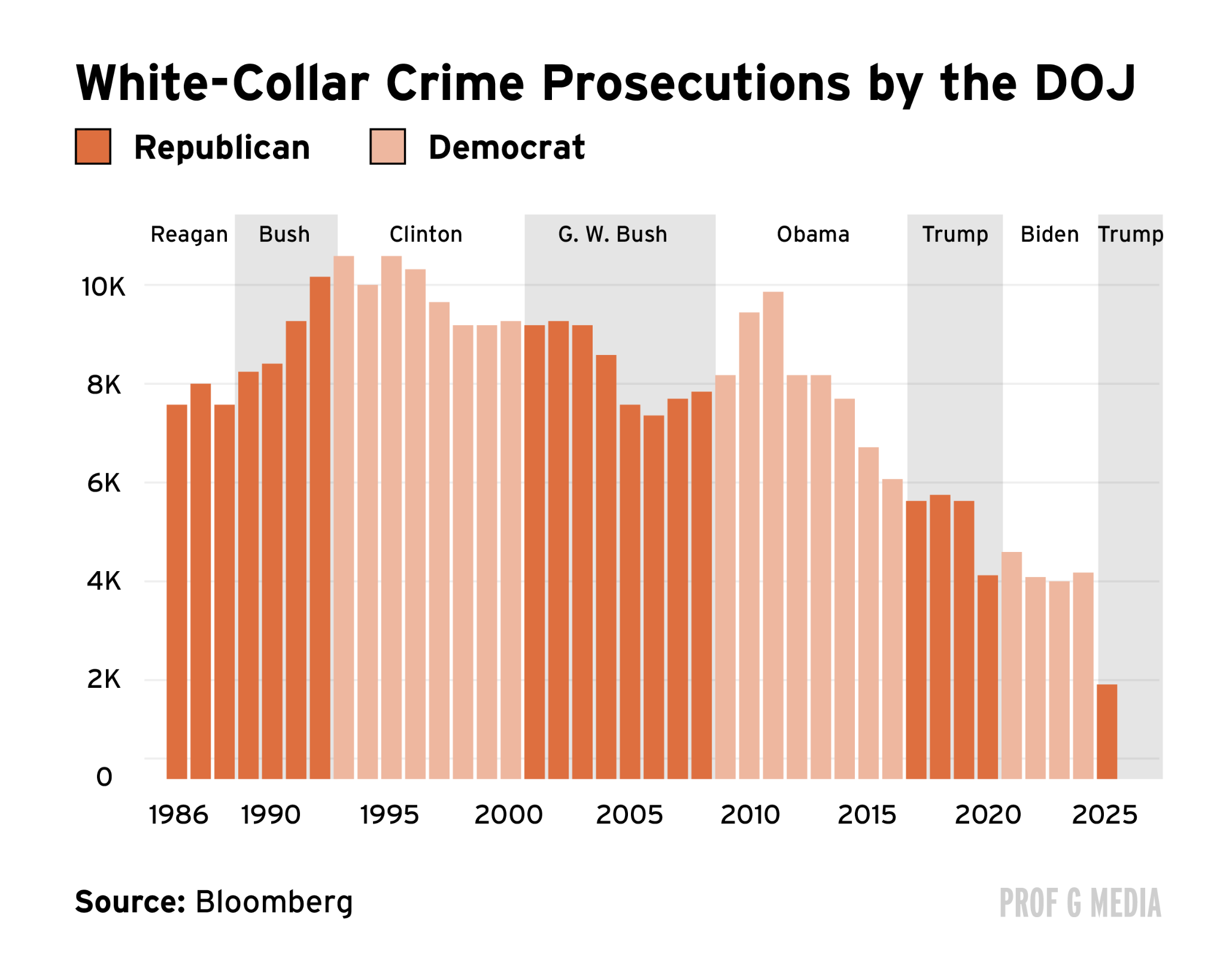
For one, staffing at the Department of Justice has been significantly cut. Some divisions, such as the National Security Division and the Civil Rights division, have seen their headcount reduced by roughly half. In an alternate universe that might have been a story of efficiency, but in this one it’s a story of incompetence. Federal drug trafficking enforcement has dropped to its lowest level in more than twenty years. Prosecutions against white-collar crime are on track to reach a record low. We discussed this a few weeks ago.
But it’s not just that employees are getting thrown out — it’s why they’re getting thrown out. In most cases, it’s for doing their job. Take Gail Slater, for example, the DOJ’s (former) antitrust chief, who got in trouble after she tried to break up a $14 billion merger after flagging that the acquirer had a compromising relationship with the Trump administration. Ms. Slater was swiftly overruled, the merger was approved, and two of her deputies were soon fired for “insubordination.”
It wasn’t long before Slater was herself ousted. That conveniently happened right before the landmark Live Nation-Ticketmaster trial. Most had agreed this was a layup for the DOJ. (The combined company has an 86% market share.) So it was strange that just a few weeks later the DOJ reached a secret settlement with Live Nation, preventing the merged entity from being broken up. Soon after, four of the department’s most prominent antitrust lawyers quit in protest. Clearly they’d tried to do their jobs, and someone didn’t let them. We’re just getting started.
Site #2: The SEC
You might have noticed that insider trading has become rampant in the past year, and you might be wondering why. The answer is that the SEC, the agency whose job is to prevent these crimes, is asleep at the wheel.
The SEC brought only 56 enforcement actions against public companies last year — the lowest transition year in a decade and down 30% from the year before. Those numbers are generous, however, as 93% of those actions were filed before the administration change. In other words, Trump’s SEC brought only four enforcement actions. Four. Meanwhile, monetary settlements have been cut in half, and disgorgement collections (essentially, repayments for ill-gotten gains) have hit a record low.
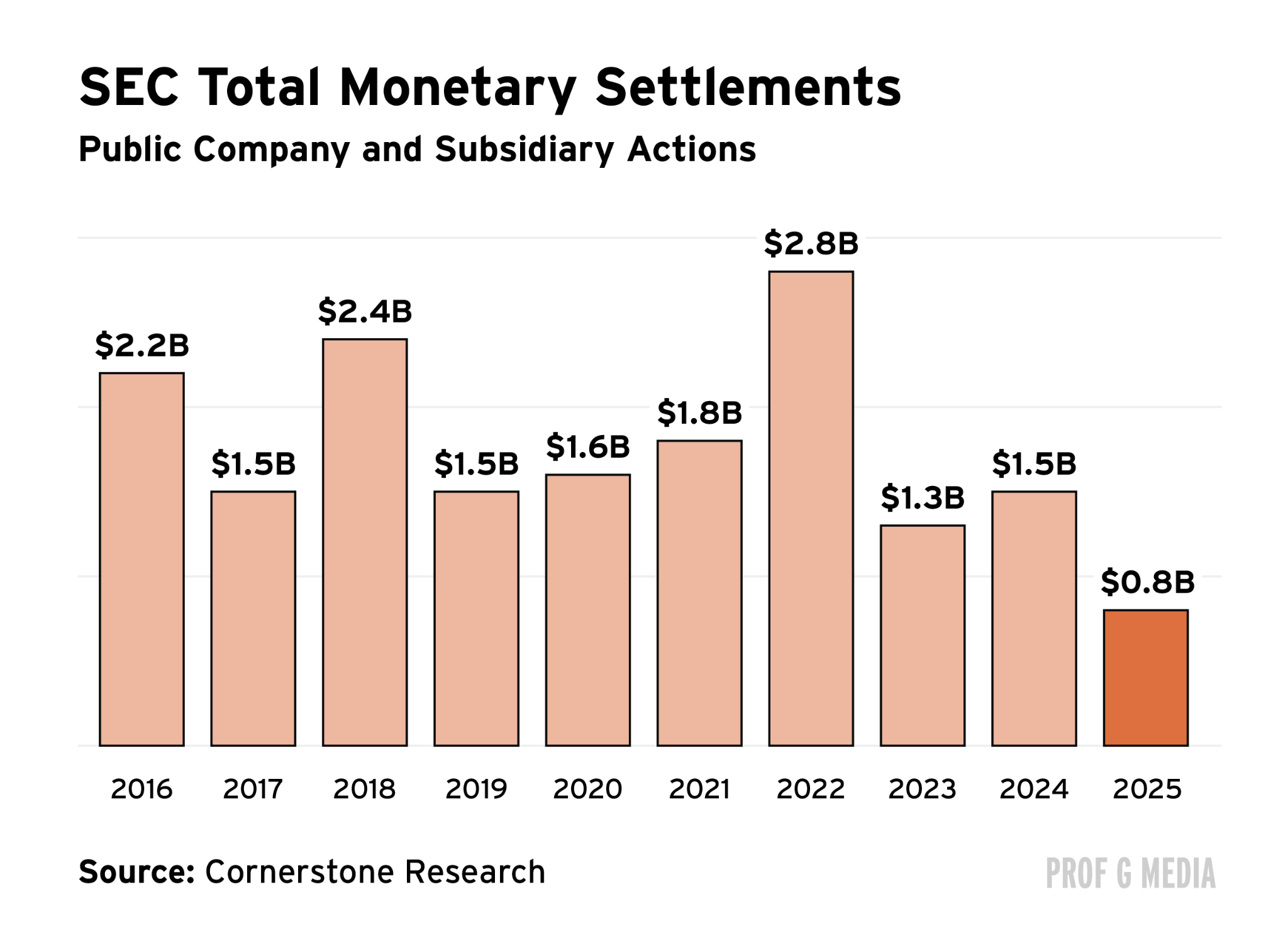
This all comes amid a targeted defunding of the SEC. So far, the agency has lost roughly 15% of its workforce. As with the DOJ, those who try to do their jobs get pushed out. Margaret Ryan, for example, the agency’s enforcement director, recently expressed interest in bringing charges against members of the Trump family (who’d quite clearly engaged in insider trading). This was apparently no-no. Ms. Ryan was soon admonished by her superiors, and within a few weeks she was gone.
Every insider trading scandal you’ve seen — from the mysterious oil bets made minutes before Trump’s ceasefire comments, to the suspicious puts placed right before the tariff announcements — should have been dealt with by the SEC. Even Megyn Kelly has voiced concern. Many are asking the pertinent question: Can’t the SEC simply identify the people who made these trades? The answer is sad but simple: Yes they can, but they no longer want to.
Site #3: The CFTC
The CFTC is like the SEC, only their focus is commodities, derivatives, and in some cases, crypto. Either way, they’re also in the financial crime prevention business — and the story is similar.
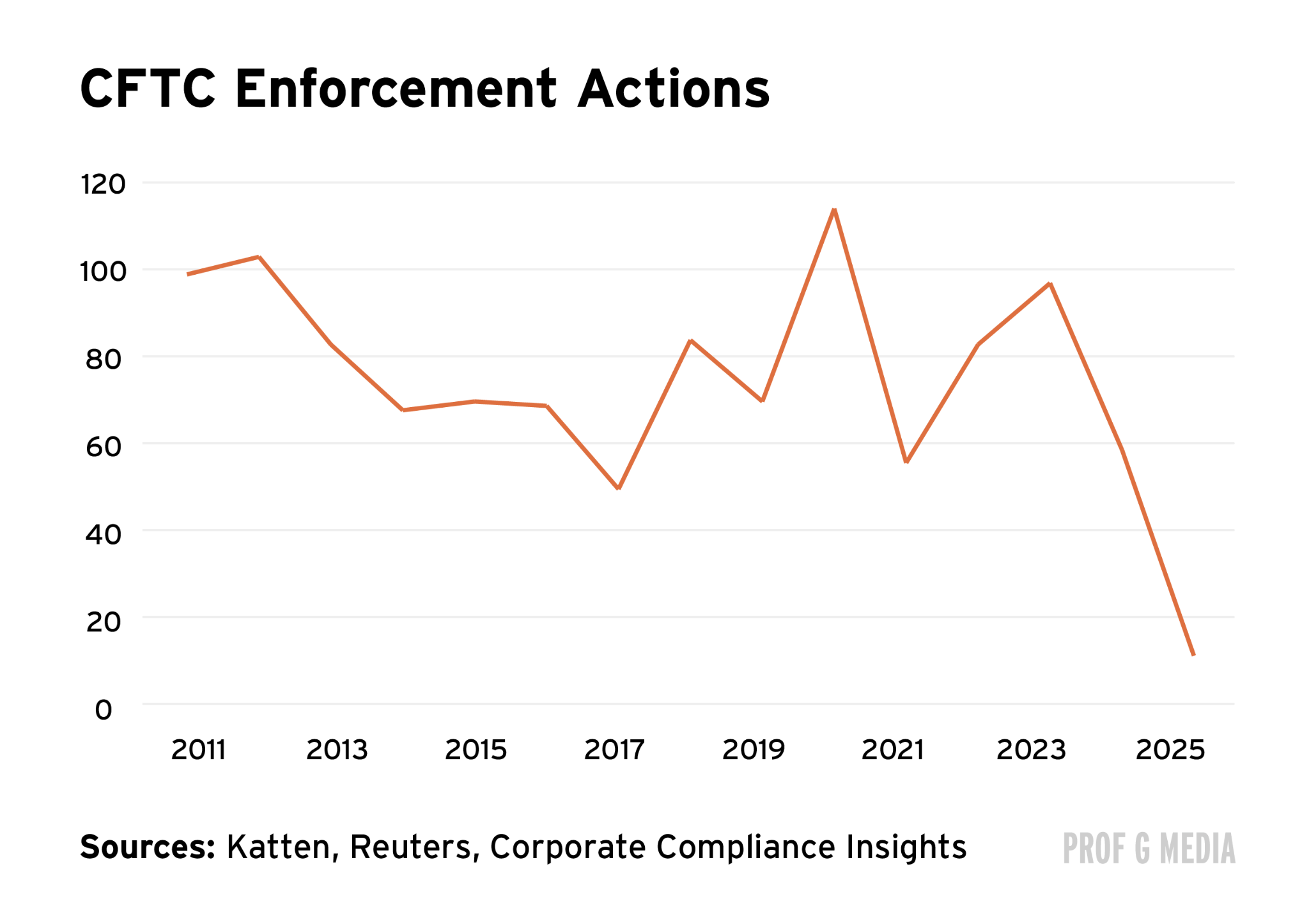
Last year the agency’s headcount was reduced by a fifth. Their Chicago office, historically the hub for their most complex cases, went from 20 enforcement lawyers to zero. This would all be fine if they’d gotten better at stopping crime, but they’ve gotten worse. Last year they filed 80% fewer enforcement actions than the previous. They also collected less than $1 billion in penalties, down from $17 billion the year before. If it weren’t for cases filed before Trump took office, however, the real number would be even smaller: $10 million. In other words, the CFTC literally isn’t doing its job anymore.
The agency has rotted from the head down. While it’s historically been led by a commission of five (as is still stated on its website), the department currently has just one. That’s because the White House hasn’t bothered to nominate the other commissioners. Actually, that’s not entirely true. Trump did put forward another candidate, but his nomination was stalled and withdrawn. Why? Many reasons, including conflict of interest: He sits on the board of Kalshi, the prediction markets company the CFTC is supposed to regulate.
Site #4: The FTC
You may know the FTC as the agency that regulates antitrust, but that’s not all they do. Their main gig is stopping companies from defrauding people. They are increasingly not doing that.
It started with layoffs. First, Trump fired both of the FTC’s commissioners, leaving the agency without a quorum. Then the new chair decided to lay off 10% of the staff, bringing headcount down to its lowest level in a decade. Eventually, cases were dropping like flies. The PepsiCo price discrimination suit, which sought to address the company’s practice of offering preferable pricing to large corporations like Walmart, was cancelled. The Microsoft-Activision Blizzard suit, which tried to block an anticompetitive merger, withdrawn. It soon became clear that the real goal of the FTC was to delete itself. No more cops, in the name of liberty.
Site #5: The IRS
Our final stop is the IRS. These are the guys who are supposed to stop tax evasion. Emphasis on supposed to.
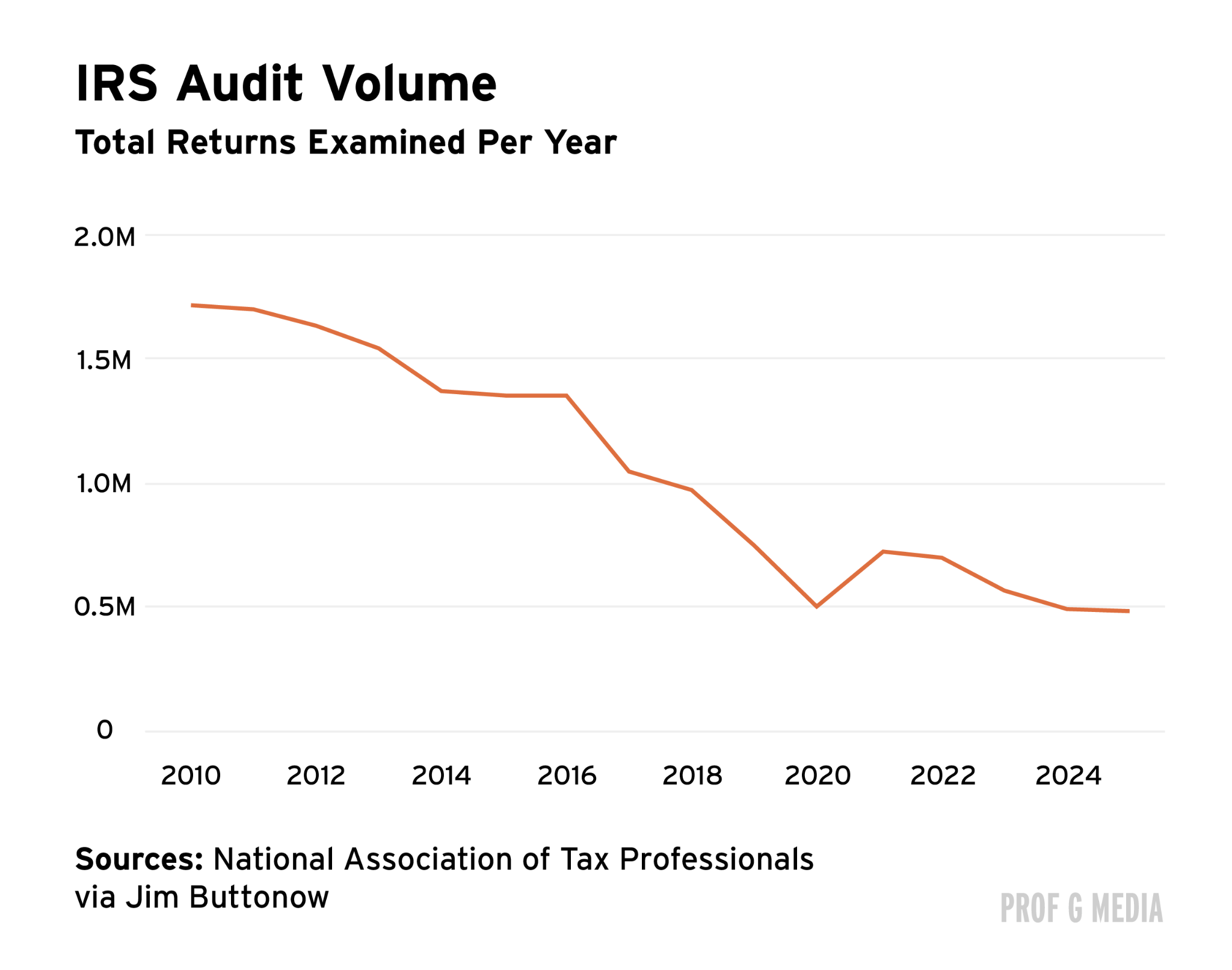
DOGE was the beginning: More than 3,600 revenue agents were fired in one go. But the gutting continued. Overall headcount fell more than 25%. Over at the Global High Wealth division (the unit that audits billionaires) that number was nearly 40%. This has led to a collapse in audit rates — especially for the ultrawealthy — with 2025 marking a historic low. According to many tax attorneys the IRS is now a “zombie.”
What’s even more striking is that the IRS had already been in decline. The agency’s staffing levels are now far below those of the 1990s. In the 2010s alone, the IRS’ enforcement budget decreased by nearly 30%. Over the same period, the audit rate for those making over a million dollars fell by 70%. People wonder how corporations still get away with not paying taxes, or how America is losing a trillion dollars to tax evasion every year. The answer is simple: No one is enforcing the law.
Accelerant
Washington’s Defund the Police movement was undeniably championed by President Trump, who called it “the largest deregulation campaign in history.” But he didn’t start it. This is a story that spans decades, across multiple administrations and parties. White-collar crime prosecutions have been sliding for years — down 60% from 1995. The same is true of federal corporate prosecutions, which are also in free-fall. The prosecution rate for white-collar criminal referrals has fallen to 24% — a record low, meaning three out of four referrals are simply declined. In other words the movement is structural, and Trump is merely an accelerant.
The longer this goes on the worse it’ll get. Last year marked the largest one-year reduction to the federal workforce since the demobilization of World War II. If the outcome of laying off millions of cops were a decrease in crime, then great. But that’s not what we’re witnessing. Insider trading is now ubiquitous. Tax evasion is standardized. There’s no better reason to commit a crime than the knowledge you won’t get caught, and no better time to be a criminal than now.
Refund The Police
I began this post with a snarky question: Why are we all moonlighting as cops? I hope the answer is now clear: because there are no more cops. The reason regular citizens suddenly feel the need to investigate insider trading is because no one else will. The same is true of crypto fraud and the Epstein Files. Put another way, the cops aren’t coming. Those who don’t yet understand this will eventually.
So I end this post with a proposal to start another movement — one that was once espoused by the Republican Party, but in recent years seems to have been abandoned. I call it “Refund the Police,” and the thesis is simple: If you want to reduce crime, hire more cops.
We can also call it “Law and Order” or “Tough On Crime.” Either way, these slogans have been abused and perverted by leaders who’ve systematically exempted themselves from the bounds of the law. The cops are now nowhere to be found.
We created the police because we learned what happens without them. We’re about to learn again.
#RefundThePolice.
Ed
All the protections we had as Americans have been destroyed by Trump. I wish more Americans would see this. Thanks Ed for highlighting the destruction. Hopefully people will wake up and vote accordingly.
Thanks for doing the Job the WSJ should have done, better than they would have done it. Carry on