


This is going to get much worse.
Nvidia CEO Jensen Huang admitted to having an affair with a woman U.S. intelligence officials believe was spying for China. This may have jeopardized his company’s operations and opened him up to blackmail. He also apparently had an affair with a subordinate, as well as another employee, in violation of company policy. The affairs didn’t cost Huang his job — his board was searching for reasons to keep him on when he did the right thing and resigned on Thursday. The real question is what they cost America.
IP Theft
Every great economic power has a rap sheet. Innovation is slow, expensive, and uncertain. Commercial espionage is a hack. In the sixth century, monks smuggled silkworm eggs out of China for the Byzantine emperor. In the 1840s, a Scottish botanist disguised as a Chinese official stole China’s tea plants and production secrets for the British East India Company. Enticed by private and state government bounties, a British mill worker memorized the design for a cotton-spinning machine, boarded a ship to America, and upon arrival helped kickstart our Industrial Revolution; within a decade, U.S. cotton production increased 60x. In his book, Trade Secrets, historian Doron Ben-Atar observes, “The U.S. emerged as the world’s industrial leader by illicitly appropriating mechanical and scientific innovations from Europe.”
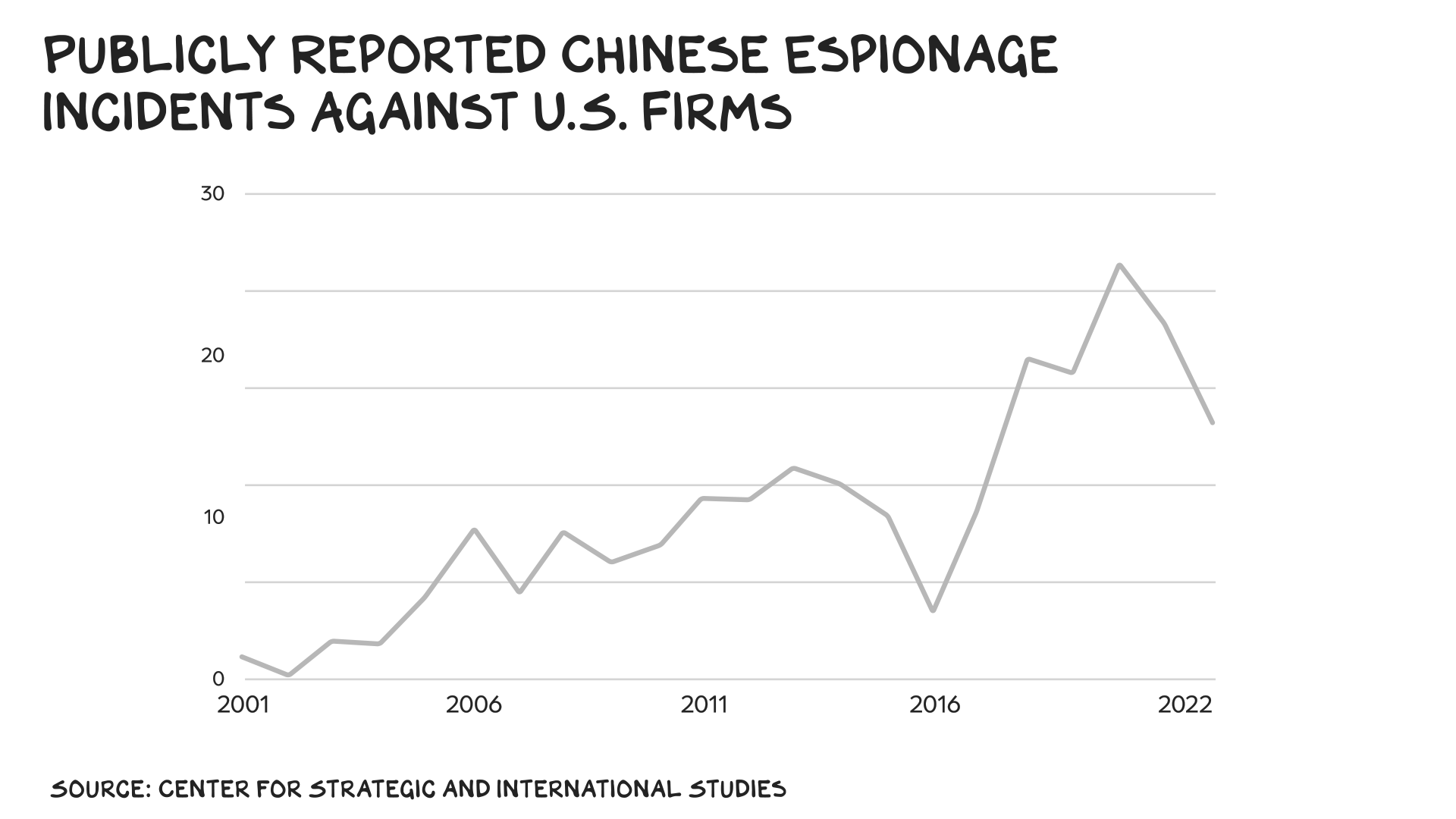
China is the new leader in IP theft. An analysis of espionage cases against U.S. companies, drawn from publicly disclosed cyberbreaches and espionage prosecutions dating to 1996, found that China has been the beneficiary 80% of the time. The revenue at targeted businesses fell about 40% within five years, R&D spending dropped by a similar amount, and neither had recovered eight years later. Across targeted industries, U.S. exports fell by roughly the same share over the following decade. The Center for Strategic and International Studies catalogued 224 publicly reported incidents of Chinese espionage against the U.S. from 2000 through 2023, far more than by any other country, Russia included. More than two-thirds came after Xi Jinping took office in 2013, and 54% sought commercial technology. And that tally is an undercount — it doesn’t include the more than 1,200 civil lawsuits filed by U.S. companies against Chinese entities, alleging IP theft.
Compromised
Pre-remote work, 1 in 3 relationships began at the office. In an era of loneliness, maybe that’s a good thing. However, at a certain level of seniority, relationships pose too much risk to the firm. Power is a drug: It inflates the rewards, mutes the costs, and surrounds you with people who laugh at your jokes, making you the last person in the building who can discern whether the attraction is mutual or mandatory. Mix power with sex and you get trillion-dollar decisions made with the judgment of a guy texting his ex at 2 a.m. Intel, McDonald’s, and Nestlé all showed their CEOs the door over relationships with employees, and none of those affairs involved a suspected foreign spy or a customer under federal investigation. Huang’s did. That’s no longer career suicide. It’s a suicide pact U.S. citizens never signed on to.
I’ve served on the boards of two companies with sensitive technology. Nothing on the scale of Nvidia, and nothing touching national security, but sensitive nonetheless. I told both CEOs — men in their 30s and 40s — that if a woman expresses sexual interest in them, they should assume she’s a spy. Sounds like a line from a Bond film, but social science is on my side. In a famous study from the 1980s, researchers had college students approach strangers of the opposite sex and ask, “Would you go to bed with me tonight?” Roughly 70% of men said yes. Not one woman did. The gap shows up even when no stranger is asking: In a survey of 16,000 people across 52 nations, men were 4 to 8 times as likely as women to want more than one sexual partner in the next month. Men also consistently overestimate women’s sexual interest. Sexpionage exploits a bug that ships standard in the male operating system. Success doesn’t patch the bug; it widens the surface of attack.
Guardrails
America has bet its economy, technology lead, and national security on AI — and the linchpin of AI is Nvidia, where security protocols are closer to WeWork than Fort Meade. Corporate boards are supposed to provide guardrails, but Nvidia’s instinctively rallied around its CEO, hiring a law firm to conduct an independent investigation. An “independent” counsel’s findings are based on one thing: who’s paying. The consensual hallucination that Huang could ride this out didn’t last a week. The board likely lawyered up, and counsel told them this is a weapons-grade national security issue — fire this guy, or face investigations and prosecutions.
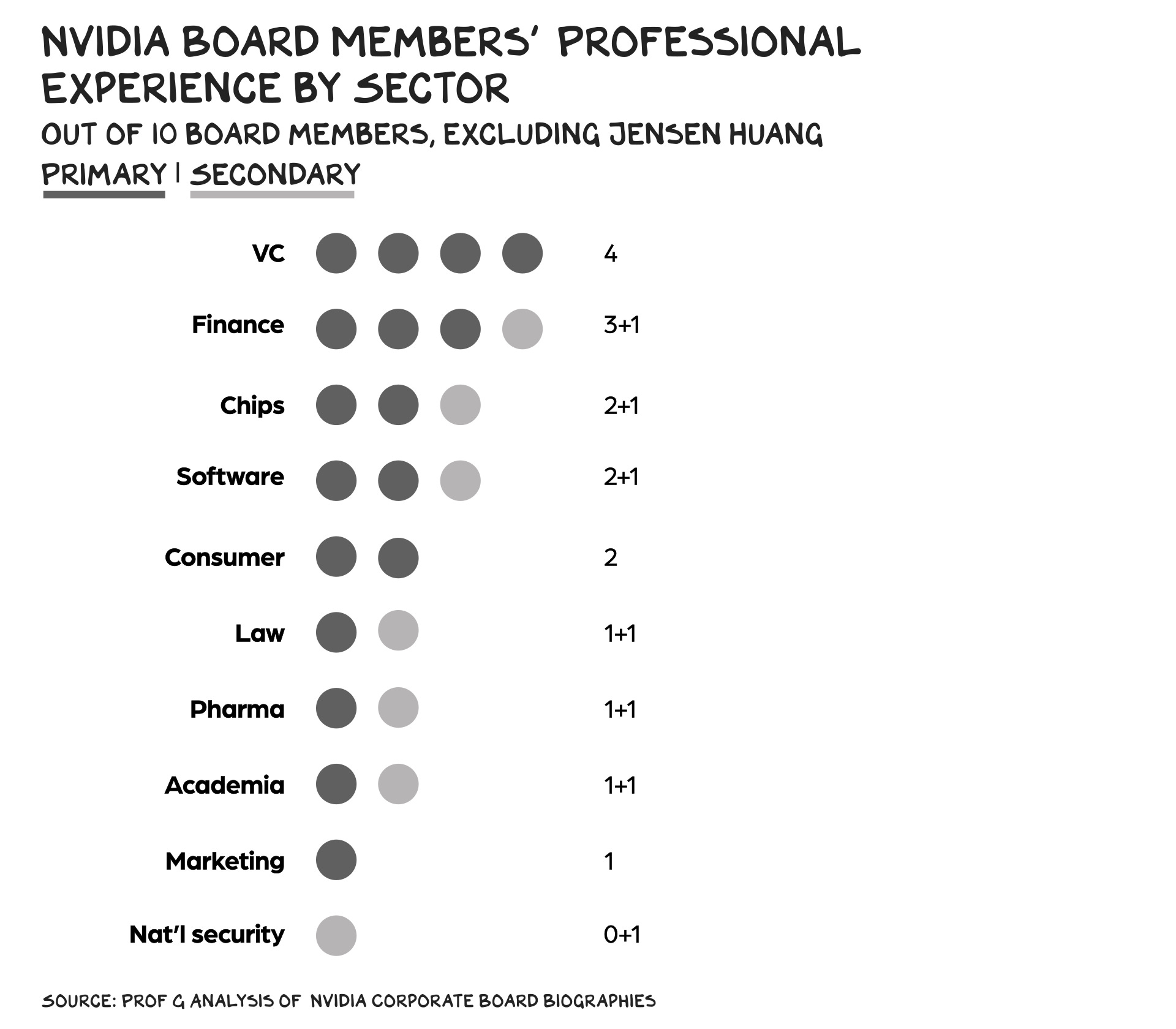
Why the delay? A: This is a middling board, constructed to be a rubber stamp. Consider the composition: Excluding Huang, half of the directors joined when Nvidia was still a video game chipmaker. The average board member has been there almost 15 years — nearly twice the average S&P 500 director. Three directors got in on the ground floor in 1993, and Nvidia’s stock has made all three of them billionaires. By my calculations, someone who joined the board in 2013, the year Huang pivoted Nvidia to AI, has registered $80 million in compensation. No board member has significant national security experience. None of them are current or former S&P 500 CEOs. Nvidia’s board is underwhelming for a company of its size and national security footprint.
Idolatry of Innovators
As the scandal unfolded, investors and founders rushed to Huang’s defense. “Two mistakes don’t make a right, and I believe Jensen is irreplaceable for America’s AI leadership,” Sequoia partner Shaun Maguire wrote on X. With word spreading that Nvidia’s board would push Huang out, Anduril co-founder Palmer Luckey posted: “China wants Jensen out, so I want him in.” After the board announced Huang’s resignation the next morning, Maguire’s irreplaceable CEO became a “void” for the AI community to “fill.” His post mentioned infidelity twice and national security not once. Andreessen Horowitz general partner Martin Casado called Huang’s ouster a “horrible decision for the U.S. and the western world.” OpenClaw creator Peter Steinberger, now at OpenAI, posted, “If that spy’s goal was to destabilize one of the most successful American companies, they achieved their goal.” Translation: The problem isn’t the CEO who had a relationship with a suspected spy. It’s the board that noticed. Part of this is the primacy of shareholder value — you don’t hold whoever makes you rich to the same standards. In America, grace is a function of shareholder returns, and Nvidia’s stock has returned more than 700,000% under Huang.
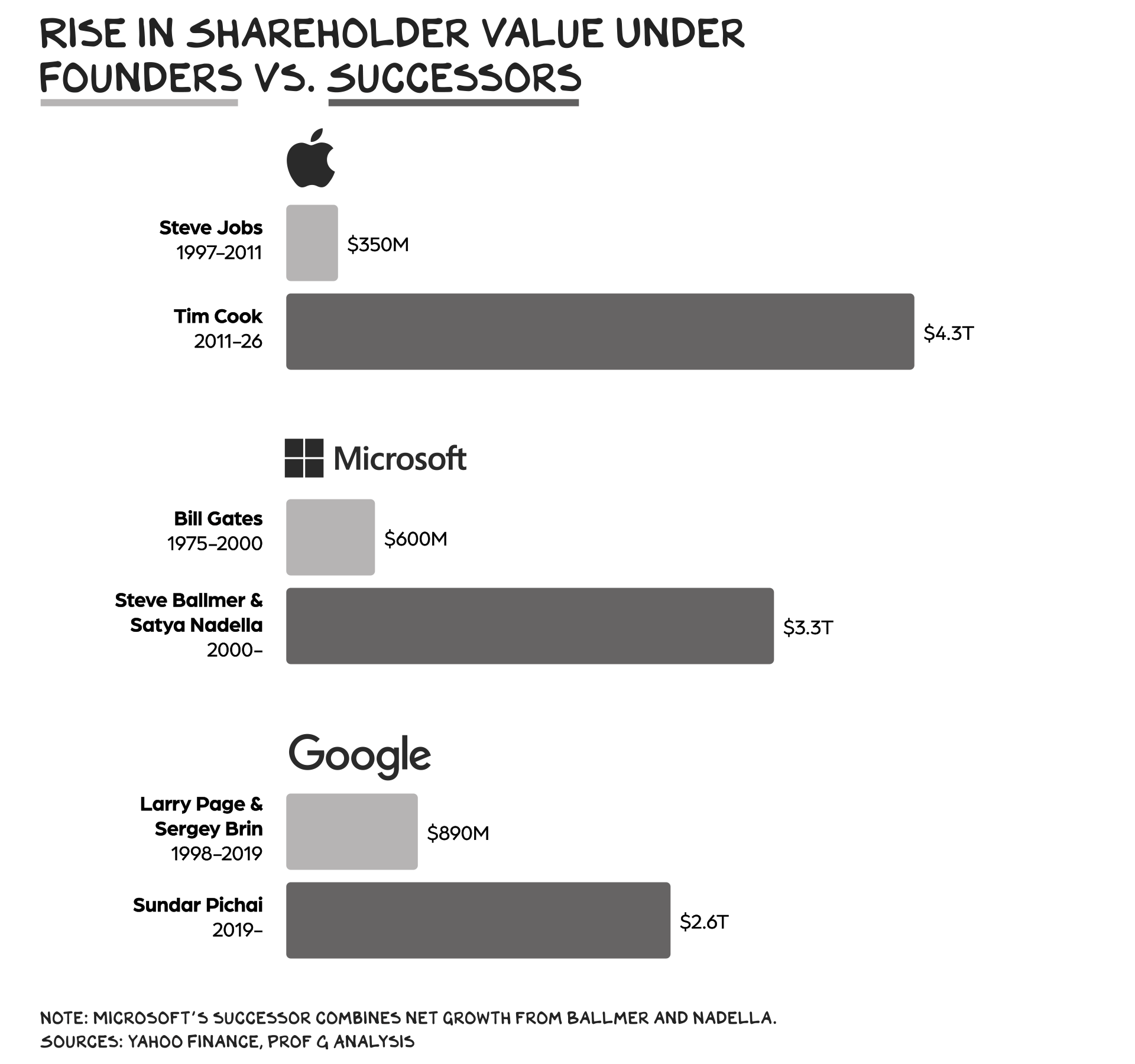
Another symptom of our idolatry of innovators is the myth that founders can’t be replaced. Reality check: You don’t build a $4 trillion enterprise without deep talent at every level. There are likely several CEO-level executives at NVDA HQ, we just don’t know who they are. Every major decision flowed through Huang — a management red flag. At 63, he’d said he wanted to hand off the company in 20 years, when he’d be 83. Asked about succession, he sounded more like Sumner Redstone than a fiduciary for shareholders and said he hoped to stay healthy. Succession planning isn’t for the day you choose to leave; it’s for the day you don’t get to choose. For Huang, that day came Thursday, and Nvidia had no successor ready. The board named CFO Colette Kress interim CEO. The absence of a successor isn’t proof Huang was irreplaceable, but an indictment of his leadership. He once conceded as much: “Unlike many CEOs, I’m completely fireable,” he told Bloomberg. He was right. The irony is that the idolatry of innovators can work against shareholder value. At Apple, Google, and Microsoft, the CEO(s) who replaced the “irreplaceable” grew shareholder value 3x to 12x.
National Security
In 1943, Allied bombers hit the central node in Germany’s war machine — the ball-bearing plants that produced essential parts for tanks, planes, and U-boats. Nvidia occupies an arguably more vital place in America’s national security. Its chips run the Pentagon’s classified AI, the spy agencies’ models, and the supercomputers that maintain America’s nuclear arsenal. And Huang didn’t just run the plant. He helped set the strategy, and his own position did a 180 in two years. Through 2024 he publicly accepted U.S. restrictions on exporting advanced chips to China. That changed in April 2025, when Washington restricted Nvidia’s made-for-China chip. By July, China was “our competitor and adversary, not our enemy.” Huang lobbied the administration to let Nvidia sell advanced chips there and won: Trump approved H200 sales last December. A month later, China was “also a partner in many ways.” His argument: selling China our chips would keep it from building its own and keep the world running on “the American tech stack.” The logic never tracked — we’d stay ahead of our chief rival by … supplying it? At the time, it looked like what most CEOs focus on, maximizing shareholder value. In retrospect, he looks compromised. According to the New York Times, China’s goal was to expand its access to American technology. There’s no public evidence he knowingly did Beijing’s bidding. And that’s the problem: We don’t know.
The White House did. While Huang is shaping up to be the mother of all Useful Idiots, the spotlight has already turned to the Trump administration and its decision not to intervene. Trump was briefed a year ago that a woman close to Huang was suspected of spying for Beijing. Commerce Secretary Howard Lutnick reportedly sidelined efforts to stop Megaspeed, where she was appointed CEO after a stint as a TV journalist, from buying advanced Nvidia chips, despite evidence they were being routed to China. Fun fact: The fourth-largest unhedged position at Cantor Fitzgerald (Lutnick’s firm, run by his sons) is … NVDA. This spring, Trump was briefed again, this time by Secretary of State Marco Rubio aboard Air Force One en route to Beijing — with Huang, a last-minute addition to the delegation, on board. Trump says he “didn’t hear about it then.” After the scandal broke, he asked Huang if he’d known she was a spy. Huang said no. “I really believe him,” Trump said. Huang never received a defensive briefing, the warning the FBI sometimes gives Americans targeted by foreign intelligence. Secretary Rubio reportedly sent a memo outlining his concerns about the alleged spycraft. When you have direct access to the president, a memo is more to cover your ass than for illumination.
Why didn’t the administration shut down a suspected Chinese intelligence operation aimed at the CEO of America’s most important company? The dark explanation: The most corrupt president in American history has so corroded national security that one scandal now breaks in the middle of another. The simple explanation: AI is cloud cover for the Trump economy, propping up markets that would otherwise fully reflect the damage caused by his tariffs and inflation, and Nvidia is one company the boom can’t afford to lose. To keep AI rolling, the White House let national security slide. Even after the story broke, the president urged his AI messiah to fight for his job.
In 1943, the Allies had to fly bombers deep into Germany to hit its single point of failure. China didn’t need bombers. It needed a text asking “u up?” Our most critical node isn’t a factory. It’s a handful of men who are protected by boards vs. governed by them. Germany’s weak point was an industrial complex. Ours is an idolatry complex: founders we treat like gods and a president too invested in them to care about the risk.
Life is so rich,

P.S.
Nobody knows what Jensen Huang’s exit means for the AI race, but last week voters made it clear that they don’t like data centers. Prof G Media research associate Dan Chiolan breaks down the anti-AI vote and what happens next. Read Dan’s analysis here.