


God, I’m sick of talking about SpaceX. More impressive than the Falcon Heavy rocket, and it is impressive, is Elon Inc.’s ability to manufacture scarcity. Getting the Nasdaq to waive requirements applied to every company until now, so he can force index funds to purchase shares, aims a demand cannon of $75B at a business with a small float. The result is a price that in no way reflects the underlying value. But I digress. This isn’t an investment, but a trade. So … where to “invest”?
The technology with the greater asymmetric upside, as well as the clearest path to transforming the economy and the well-being of more than 200 million Americans, isn’t Falcon 9 boosters or GPT-5, but GLP-1s.
IED
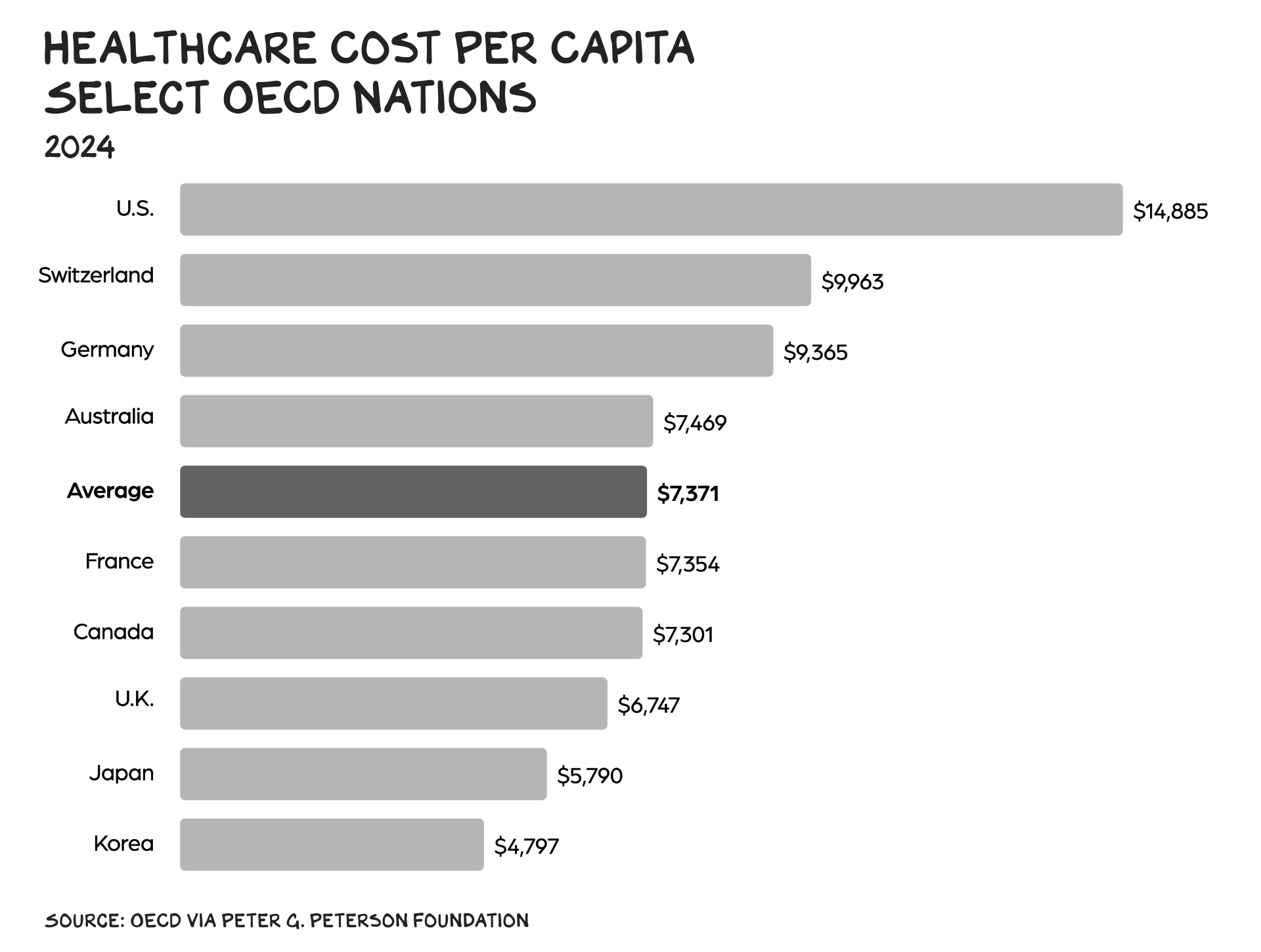
U.S. obesity rates have tripled over the last 60 years. Our instincts, developed over hundreds of thousands of years when food was scarce, haven’t kept pace with industrial production, so we gorge. Obesity is a comorbidity for 200-plus chronic diseases, the central node in a network of poor health outcomes. The total bill for national health expenditures, including public and private spending, is $5.3 trillion. By 2033, 1 out of every 5 dollars in the economy will go to healthcare. This is the IED at the center of the U.S. economy.
Silver Bullets
Five years ago, when Ozempic and Wegovy were first approved for weight loss, GLP-1s looked like a silver bullet for obesity. Today, they’re a fully loaded magazine of silver bullets aimed at obesity, addiction, cancer, sleep apnea, and a growing list of other diseases and chronic conditions. The velocity of innovation is remarkable. “Usually when a new medicine happens, we have time to learn how to use it,” Dr. Melanie Jay, director of the NYU Langone Comprehensive Program on Obesity, told the New York Times. But with GLP-1s, “everyone is kind of iterating in real time.”
Some recent iterations: Last month, Eli Lilly announced that its phase 3 trial for retatrutide — a triple agonist dubbed “Godzilla” that activates GLP-1, GIP, and glucagon receptors — appears to exceed the performance of other weight-loss medications. On average, patients on Zepbound or Wegovy lose between 14% and 20% of their initial body weight over 72 weeks. Patients in the retatrutide trial taking 4mg, 9mg, and 12mg doses lost an average of 19%, 26%, and 29% of their starting weight, respectively.
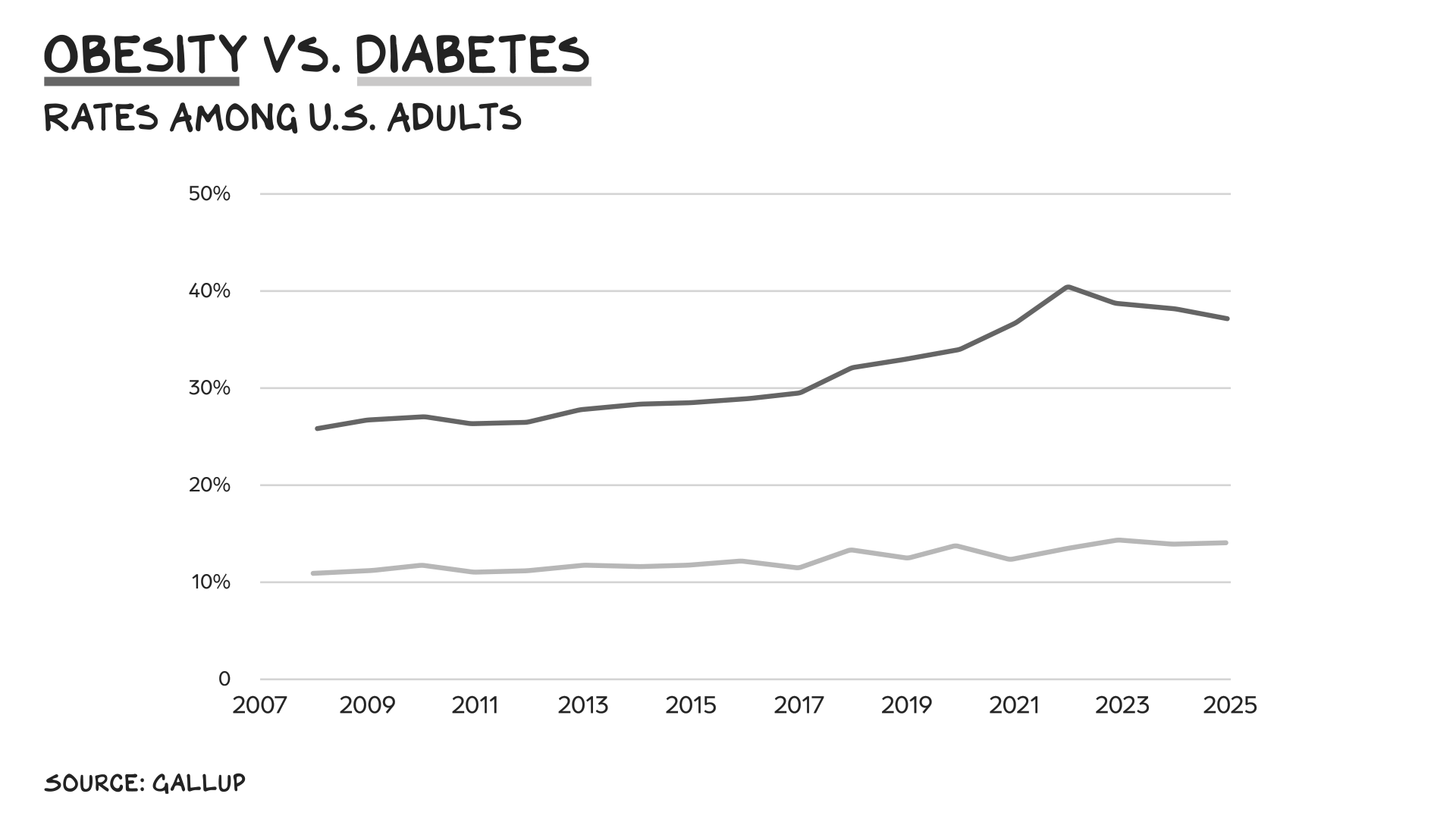
But the most promising drug is Foundayo, a daily pill from Eli Lilly the FDA approved for weight loss in April. In clinical trials it resulted in 12% weight loss over 72 weeks — less effective than shots, but a good alternative for the 66 million Americans who are afraid of needles. The pills also show promise as a maintenance tool. As Nicholas Florko wrote in the Atlantic, “America has a new GLP-1 playbook,” with a shot to lose weight and a pill to keep it off. In the U.S., 1 in 8 adults currently take a GLP-1, with prescriptions for weight loss doubling from 2024 to 2025. It’s working. A year after the drugs were approved for weight loss, the U.S. obesity rate peaked at 40%, but it has since begun to decline. Sadly, GLP-1s haven’t had the same impact on their initial target: diabetes.
Distribution
William Gibson famously said, “The future is already here — it’s just not evenly distributed.” He could’ve been describing GLP-1s. A recent Cleveland Clinic study found that cost is by far the primary reason people quit, with 47% of those who discontinued the drugs citing insurance denial, expiration of a discount coupon, or unaffordable out-of-pocket expenses. Side effects were the second-most-common reason, cited by 14% of respondents, while less than 2% quit due to unsatisfactory weight loss. In other words, GLP-1s can change society … if we distribute them to everyone who needs them, regardless of their ability to pay.
The good news: Beginning July 1, Medicare Part D will cover certain GLP-1 treatments with a $50 monthly co-pay for seniors. The bad news: Private insurance plans, which provide pharmaceutical benefits for two-thirds of Americans, are scaling back GLP-1 coverage, if they even offered it to begin with. According to the Wall Street Journal, 11% of employers have dropped or are planning to drop GLP-1 coverage for weight loss altogether, and more than a quarter of big companies are adding hurdles, such as requiring multiple weigh-ins a month, meal-tracking on apps, or mandatory health coaching. The U.S. is simultaneously hitting the gas while pumping the brakes on the best tool we have for combating obesity.
Subscribe and Lose?
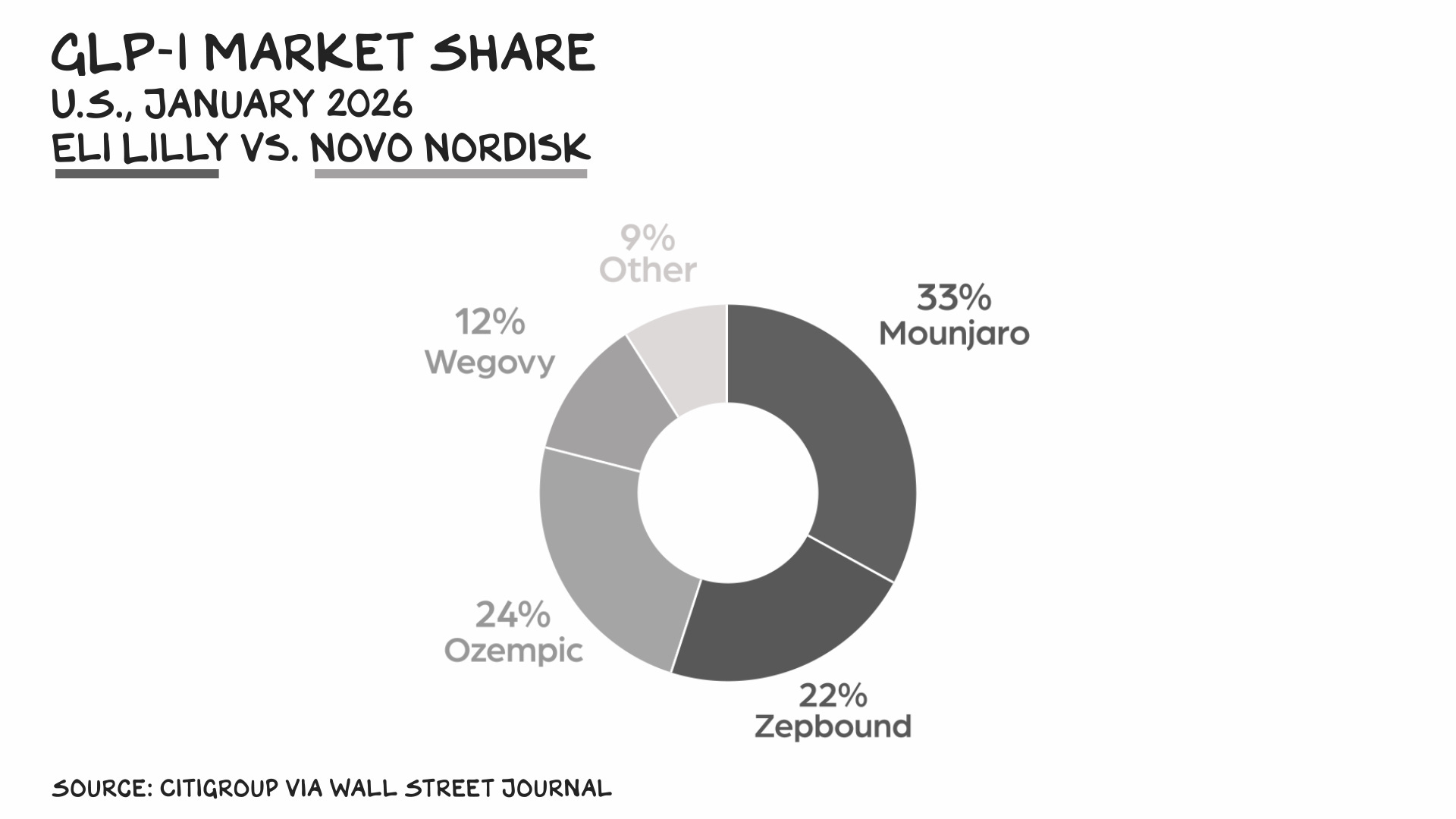
With a few exceptions, the 17 companies valued at $1 trillion or more are all technology companies heavily invested in AI. The only drugmaker on the list is Eli Lilly, whose shares have registered a 418% increase since GLP-1s were first approved for weight loss in 2021. Novo Nordisk, Eli Lilly’s chief competitor and the maker of Ozempic and Wegovy, is up just 2% over the same period. The discrepancy points to something unusual about the dynamics of GLP-1 pricing. Typically, drug prices are inelastic; i.e., consumers aren’t very responsive to price changes, unless a generic option is available. But as one industry analyst explained, the obesity market has turned traditional pharma economics upside down. Eli Lilly’s products have a perceived efficacy edge, but the company also beat Novo Nordisk to the direct-to-consumer market. On my podcast, Eli Lilly Chair and CEO David Ricks told me, “In the GLP-1 category, we observe prices are elastic. The more we lower the price, the more users we get. That’s the path we’re on.”
GLP-1s may be the rare pharmaceutical case where capitalism is on the consumer’s side. But Ricks also told me GLP-1s are unique insofar as nearly everyone who takes them loses weight. Unlike drugs for other chronic conditions, “people like being on GLP-1s,” because they notice results in their appearance, rather than intangible health benefits and side effects. The fine print: Many people may never stop taking GLP-1s, creating an enduring subscription business. Think Netflix, but with monthly prices ranging from $149 to $499, and instead of market competition, a duopoly. GLP-1s may not be an off-ramp from the industrial food-medical-pharma complex, but the ultimate physiological lock-in.
2nd Order
Victoria’s Secret shares surged 47% last week after the company reported 15% YoY revenue growth and raised full-year sales guidance to $7.1 billion. Meanwhile, fast food chains are shrinking their footprint, with Jack in the Box, Pizza Hut, and Wendy’s among the brands closing hundreds of stores nationwide. That’s yet another bad sign for an industry that’s registered more than 500 franchisee bankruptcies this year. U.S. alcohol sales are also down, with Diageo and Pernod Ricard reporting a 15% decline YoY, while Constellation Brands saw a 10% drop.
CEOs have blamed tariffs, affordability, and in the case of alcohol, Gen Z, but GLP-1s are a more likely explanation for the shift in consumer behavior. More signals: The share of apparel exchanges where shoppers “size down” has risen for three consecutive years, hitting a 14% high among online retailers. Adults who use GLP-1s consume 21% fewer calories and spend nearly a third less on groceries on average. Meanwhile, 59% of Americans say they’d be more likely to visit restaurants that serve “flexible, customizable, or innovative portion size options” — and that goes up to 73% among GLP-1 users. The same report noted that 13% of restaurant operators have listed items that appeal to GLP-1 users — higher protein and/or fiber — and 42% say they’re considering such additions.
There will be downstream effects. A significant decline in fast food revenue will accelerate closures across the industry’s 200,000-plus U.S. locations — destabilizing commercial real estate markets and threatening the livelihoods of the 4 million people who work in the sector. Apparel brands that built supply chains around stable sizes and predictable returns will have to adjust to hit a moving target: America’s shrinking waistline.
Hope
The AI narrative has turned negative. Energy costs are up, jobs are (supposedly) going away, relationships are going virtual, and, if the technology advances as promised, it presents a threat to humanity. The GLP-1 story offers something Silicon Valley used to produce in abundance: a hopeful vision of the future. Every American knows people who struggle with their weight. We all know someone who has a chance to live longer, do more, and feel better about themselves because of GLP-1s. A nation’s greatness isn’t measured in GDP, but in the quality of life its citizens enjoy. For the first time in decades, American innovation is adding years to lives, not just zeros to valuations. The question isn’t whether GLP-1s will change the U.S. They already have. The question is whether we’ll be stupid enough to ration the change.
Life is so rich,

P.S.
Historian Heather Cox Richardson and I will mark our nation’s semiquincentennial (real word) with a collaboration — America at 250: What Comes Next? Join us live on Substack on Tuesday, June 16, at 12:15 p.m. ET. The event is free to everyone, register here.
P.P.S.
Prof G Media now has official merch. Buy t-shirts, hoodies, and sweatpants now, look cool forever. Supplies are limited, so don’t wait to visit our online store.
Another great article, Scott, thanks. I have some additional background for you. In the mid 90s, I launched a startup called Health•Zone which offered a dietary service. We built an expert-system, the precursor to AI, which embodied the expertise of dietitians, home economists, doctors, nutritional experts and chefs. For $29.95, you answered around 40 questions on your current eating habits and food preferences (likes and dislikes). You clicked a box to indicate your goal: weight-loss, reducing high-cholesterol, diabetes, or plain healthy eating. The system then generated a menu for a week's worth of eating: three meals and two snacks a day, designed expressly to suit your tastes and goal. The package included recipes and an ingredient list (tailored to your local store's stocks).
We marketed it as the easiest way to diet, given it was your preferred foods. Over three years we treated 4,000 people, and even landed a trial at the Ottawa Heart Institute—who loved it.
I should have taken the advice of the head dietitian we hired, who asked why we would even attempt this, and answered my response with, "You don't seem to realize that diet is a four-letter word."
We tried to sign up the medical profession. We hosted a dinner, served the healthy meals our chefs had designed to 100 doctors. Handed each one a small pad of "prescriptions," on which they would tick appropriate boxes and tell their patient the official medical line: the way to achieve the right result is via diet and this is the best and easiest way. We offered to pay them $5 for each patient they referred. A grey area, but then not nearly as grey as the pharmaceuticals use. And the doctors never sent us a patient—they prescribed a pill instead.
We struggled for 3 years to gain some traction, and then folded the company after burning through almost $2 million. My own money, at that. The strange thing is, I don't regard the money as a total waste Taught me how to eat. How to actually shed weight and be more healthy all round and now, 30 years later, I'm a spry 77 year old. That has to be worth something, right?
But I also learned a valuable marketing lesson: You can sell things to people that they want and don't need, but you can't sell them something they need but don't want.
So, to your post. I read about all the new drugs and new attempts to solve a basic problem which, for many people, is addressable without the cost or the lifelong lock-in. What we need is less pharma and more education. More companies like Health•Zone to promote the better alternative. But sadly, at the end of the day, popping a pill and overeating seems to be the American way. And yes, Canada is not in quite the same boat. Our government ran a national fitness-education campaign, ParticipACTION, for decades from the 1970s, encouraging people to get active. It worked—somewhat. It moved the needle on awareness more than on waistlines, which may be the whole lesson: education can make people more aware, but knowing is never the same as doing the hard thing. Which loops right back to what I learned the expensive way—you can't sell someone something they need but don't want.
GLP-1s are the perfect addition to the Instagram filtered, Botox era. Look, there are people out there who really have no alternative to losing weight than using GLP-1s; and for those instances these drugs are a godsend. However, there are many others using these things to achieve cosmetic, not medical, goals; and these users, just like 99% of IG posters, want to only tout the benefits and GLP-1s and never discuss the nausea, gas, vomiting, etc. that so many experience.
If one is overweight and goes to the doctor, the prescription used to be "diet & exercise". We all know what we need to do, but we don't have the discipline to do it. These GLP-1s address one side of that prescription as they reduce your appetite and put you into a starvation mode. But, what is not discussed enough, is how this level of starvation makes the exercise component of the prescription even more important. Without exercise and a diet high in protein, GLP-1 users will lose muscle mass that is otherwise vital to living a long & healthy lifestyle. There's no reason to believe that a GLP-1 user is going to magically lock into the one portion of the "diet & exercise" prescription that they ignored from the doctor for years prior to GLP-1s.
For nearly 18 months now, I've been grinding through the traditional diet & exercise path. It's not easy or fun, but it's sustainable and has made me feel younger because I've gotten stronger - not weaker - in the process. I worry that those who, like me, who were overweight but have reasonable blood chemistry values will be disappointed long-term by the quick fix that GLP-1s provide and still be left needing to find a way to be discipline on their own accord of dieting & exercising.
This phase of the GLP-1 cycle reminds me of the gastric bypass fad from the prior decade. People lost a massive amount of weight, but they tended to fall into one of two camps: 1) adjust diet but ignore exercise and end up having the frailty of a 90-year old or 2) not adjust diet and ignore exercise and end up even bigger than they were before. No matter what the new miracle drug or procedure is, there is nothing we can do to escape that ultimate prescription of diet & exercise.