



Scroll any social media feed right now and you’ll see a world that looks more dangerous every day: bombings in Iran, a brutal war in Ukraine, and fears about the future of Taiwan.
Even the draft is back in the news, with looming changes to the military registration system and a decree from Karoline Leavitt that Trump doesn’t “remove options off of the table.”
Democrats’ response has been to emphasize that President Trump is undermining the “world order,” but for young Americans, who lived only through Iraq and Afghanistan and are struggling to make ends meet, that kind of rhetoric just doesn’t resonate. It’s worse than not resonating, actually. It sounds like politicians are busying themselves with everything but what matters most: cost of living.
Harkening back to a time when alliances were intact and it was clear who were the good guys and the bad guys sounds like rhetoric, not action.
The good news is that young voters care about what the world order actually means in practice: safety, a global economy, and democratic values. By understanding these elements and connecting them to Iran, tariffs, and Trump’s relentless drive to isolate the US from our allies, Democrats can make global instability mean something to Gen Z.
The polling is clear: young Americans don’t respond to “world order” messaging
When Democrats talk about foreign policy, many of them want voters to think about the United States’ leadership role on the world stage, and the damage that Trump has done to it.
That’s strong messaging for some Americans, but it’s not for the next generation of voters.
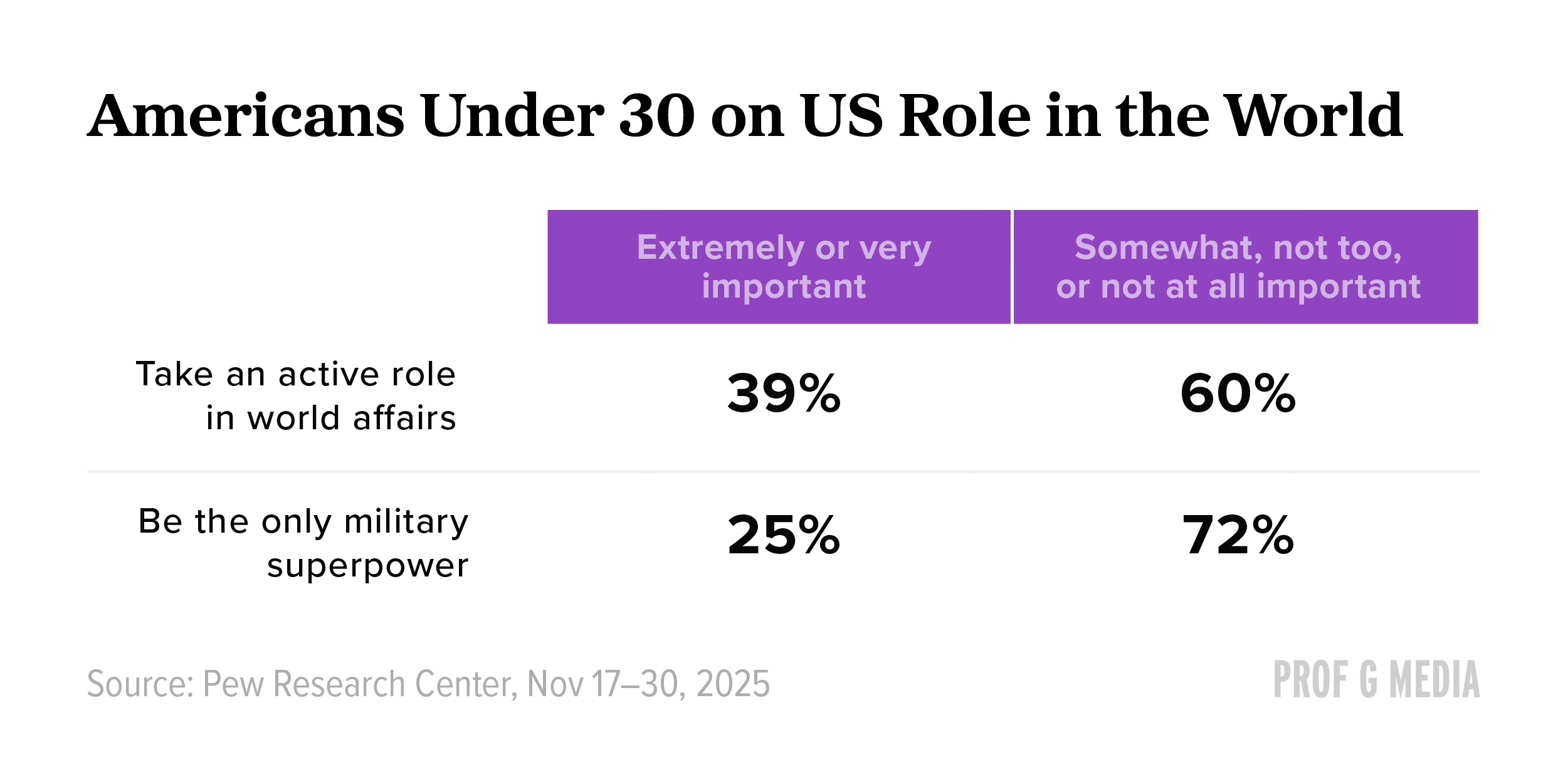
Pew asked Americans last year how active the US should be internationally, and the contrast is stark:
While 73% of those aged 65 or older said the country should take an extremely or very active role, only 39% of those aged 18-29 agreed. That’s a 34-point gap, and greater than the gap between Democrats (59%) and Republicans (50%).
There was a similar chasm on military superpower status: 51% of Americans 65+ said it was extremely or very important for the US to be the only superpower, while only 25% of 18-29 year olds agreed.
Young voters have good reason to feel this way. They didn’t live through global conflicts on the scale of the First or Second World War, or even the Cold War. The only wars they know first-hand are America’s disastrous forays into the Middle East, which killed millions and left taxpayers with an $8 trillion bill.
Meanwhile, the most recent crises that young Americans have experienced have been domestic: the recession, COVID, and a cost-of-living crisis. Each a global problem, but exacerbated by homegrown dysfunction: decades of financial deregulation, a crumbling health care system, and poor infrastructure.
The youngest Americans also rarely hear about what life is like without human rights and free expression. News stories about the state of democracy in foreign countries don’t exactly light social media algorithms on fire.
Zoom out, and the world order is still relevant
To young voters, the term itself – “world order” – also sounds abstract. Trump takes advantage of that by framing it as a system where a shadowy group of globalist elites “control” and “dominate” Americans.
Beneath the surface, the concept is still relevant. Consider the three promises of the world order: security, trade, and American values.
Safety at home and abroad
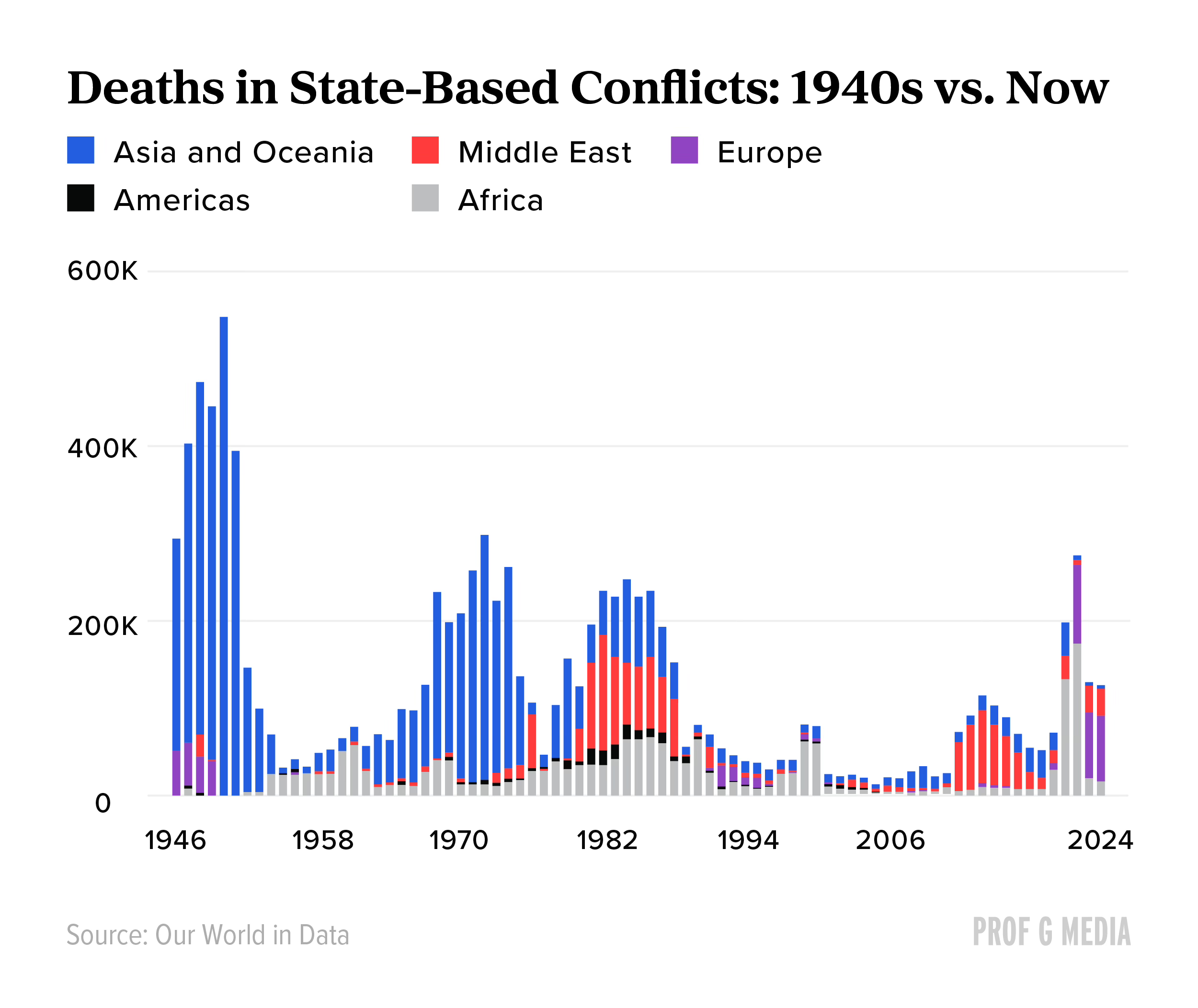
One hundred million people died during the 20th century’s two world wars, or as Melanie Sisson writes, one of out every 23 humans on Earth at the time. It is no wonder that countries with shared values, led by the US, would seek to prevent that with a set of global rules administered through the UN and NATO.
Whatever conflicts countries might have, those rules serve today as a baseline to ensure some stability. Last we checked, the tally for world wars still stands at two.
Article 5, in particular (an attack on one is an attack on all) has lowered the risk of another world war. And we have recent proof that the system works: the article has been invoked only once, by the US, after 9/11 – when our allies jumped into action.
Economic growth and cheaper goods
Decades of protectionism and tariffs had depressed economies and destabilized relationships between countries. The creation of the UN, the IMF, World Bank and later the WTO created economic ties between countries, and eventually open trade and predictable borrowing with the US dollar as the world’s reserve currency.
There is no simple math for the right balance between trade and protectionism, but the benefits have been undeniable. The shift towards trade agreements beginning in the 1950s has, according to Congressional research, lowered prices of goods and increased the real purchasing power of both consumers and producers.
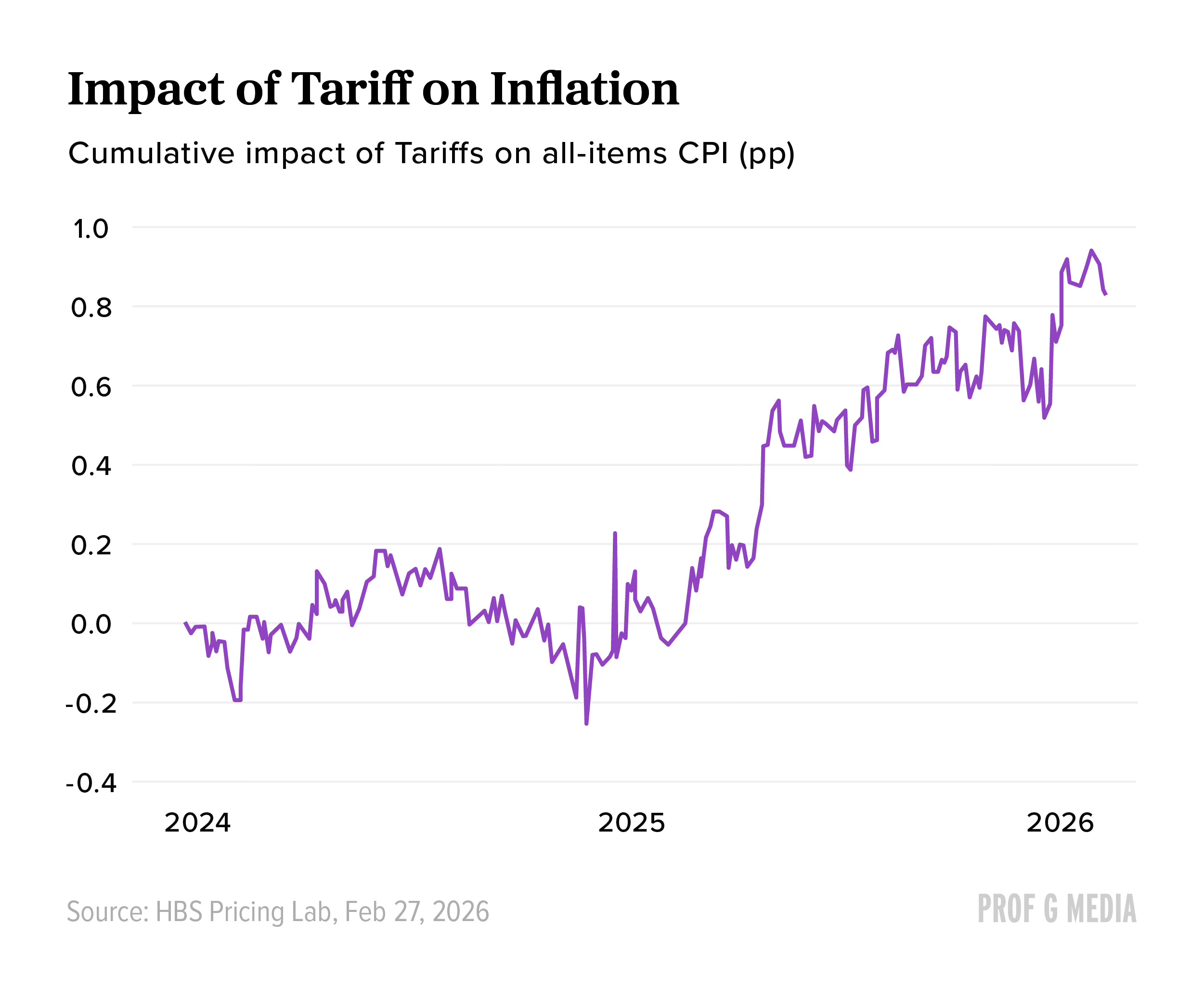
We’re seeing in real time what a return to barriers does: Harvard’s Tariff Tracker shows that tariffs have increased the price of imported goods by 7% and domestic goods by 5% in one year.
Pride in our values
The post-war world order also promoted a set of values to the world. Democracies that prioritized human rights, especially free expression, gained significant power. Principles like free and fair elections are only norms because countries like the US said they were important, putting American ideals at the heart of global institutions.
America sat at the center of this world order until the end of 2024, both in the sense that its values became institutional ideals, and that it had a powerful seat within those institutions, especially the UN and NATO.
Trump wants to replace that by chairing a “Board of Peace” that’s no more than a grab bag of middling powers.
Democrats can win by talking about what really matters
All three of these issues – security, trade, and our values – are at risk while Donald Trump is in the White House. Instead of letting a phrase like “world order” do the work for them, Democrats can win by addressing the specific ways that Trump is making life worse for young voters.
The Iran War is another threat to our security
Donald Trump is still arguing that the Iran War is an effort to promote peace and stability. The reality is that this is a war nobody asked for, that the president didn’t get permission for (from voters or Congress), and for young Americans who voted for Trump because of his stance on war, a betrayal of a core promise.
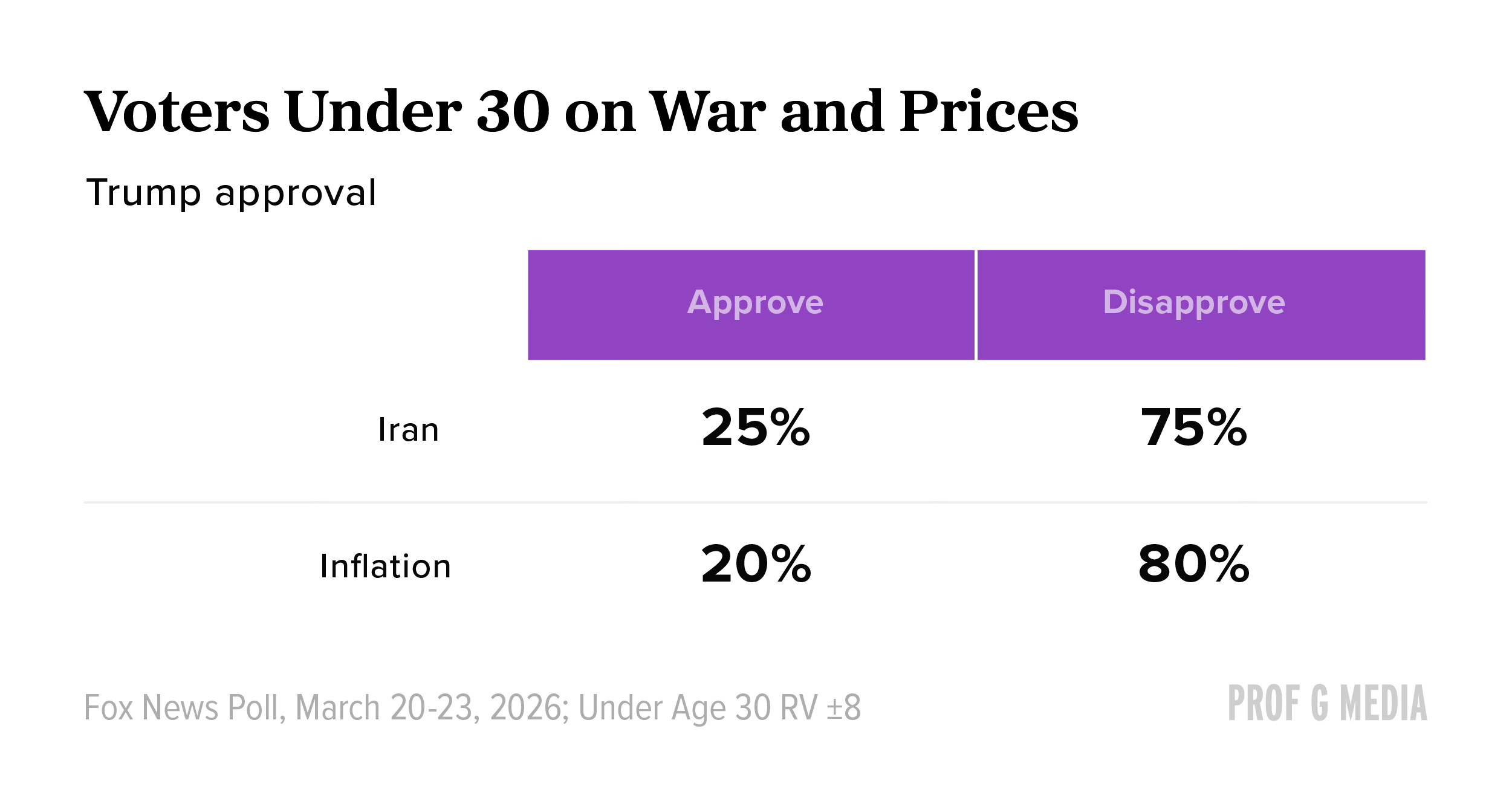
In the latest Fox News Poll, 36% of voters approve of the conflict. That’s already low. Among voters under 30, it’s an anemic 25%.
Even before the war, Democrats had a case to make on instability: we have been talking more than ever about our commitment to NATO and Article 5, and throughout Trump’s first year in office, we’ve seen more attacks on US soil, including in New Orleans, Michigan, and Virginia.
Tariffs are driving up prices
Then there’s inflation, where Trump has his lowest approval ratings of any issue. Like the war, price rises are unpopular with every group, but Trump is doing particularly poorly with young voters: Trump has just a 20% approval rating on inflation with voters under 30.
Democrats can point not only to the overall increase in the price of goods, but to specific examples: basics like clothing (17%), building materials (11%), and furniture (8%) are up whether they’re imported or made in America.
Democracy and human rights matter
The primary emphasis has to be on stability and affordability. But there is evidence that young Americans strongly support democracy and human rights:
81% agree or strongly agree on the importance of having elected leaders chosen in free and fair elections.
80% agree or strongly agree that fair laws and equal treatment of all people are essential.
They also like being part of a connected world. They know problems like climate change and health are global issues. They’ve eschewed the traditional media in favor of global platforms. They even want to travel abroad more than other groups.
A targeted message on these issues can still be part of the mix.
We’re in a foreign policy doom loop. But Democrats have an opportunity. Talk to voters about what matters to them about this topic: the Iran War, prices, and to the right voters, our values.
By dropping the old-school framing and focusing on the real issues, especially affordability, Democrats will still be defending the world order. They’ll just win the argument when they do.
“What experience and history teach is this—that people and governments never have learned anything from history…”
— Georg Wilhelm Friedrich Hegel
“Hard times create strong men, strong men create good times, good times create weak men, and weak men create hard times.”
— G. Michael Hop
If you're a Dem running for office, you need to read this!
What matters to those under 30 and how Trump is making life worse for them:
1) Cost of living - message: tariffs are driving up prices
2) Safety at home and abroad - message: Iran War is another threat to our security
3) Pride in our values - message: Democracy and human rights matter
* elected leaders chosen in free and fair elections
* fair laws and equal treatment of all people are essential