


Ten years ago this month, I began writing No Mercy / No Malice (NM2) every Friday. My firm at the time, L2, was a reincarnation of my first business, Prophet, but I wanted to get it (more) right this time. Prophet was/is a good firm, but it was trapped in a transactional/service model, vs. a recurring revenue model. This created a more fragile revenue stream with a greater cost of sales, as there were only so many weekends I could play golf.
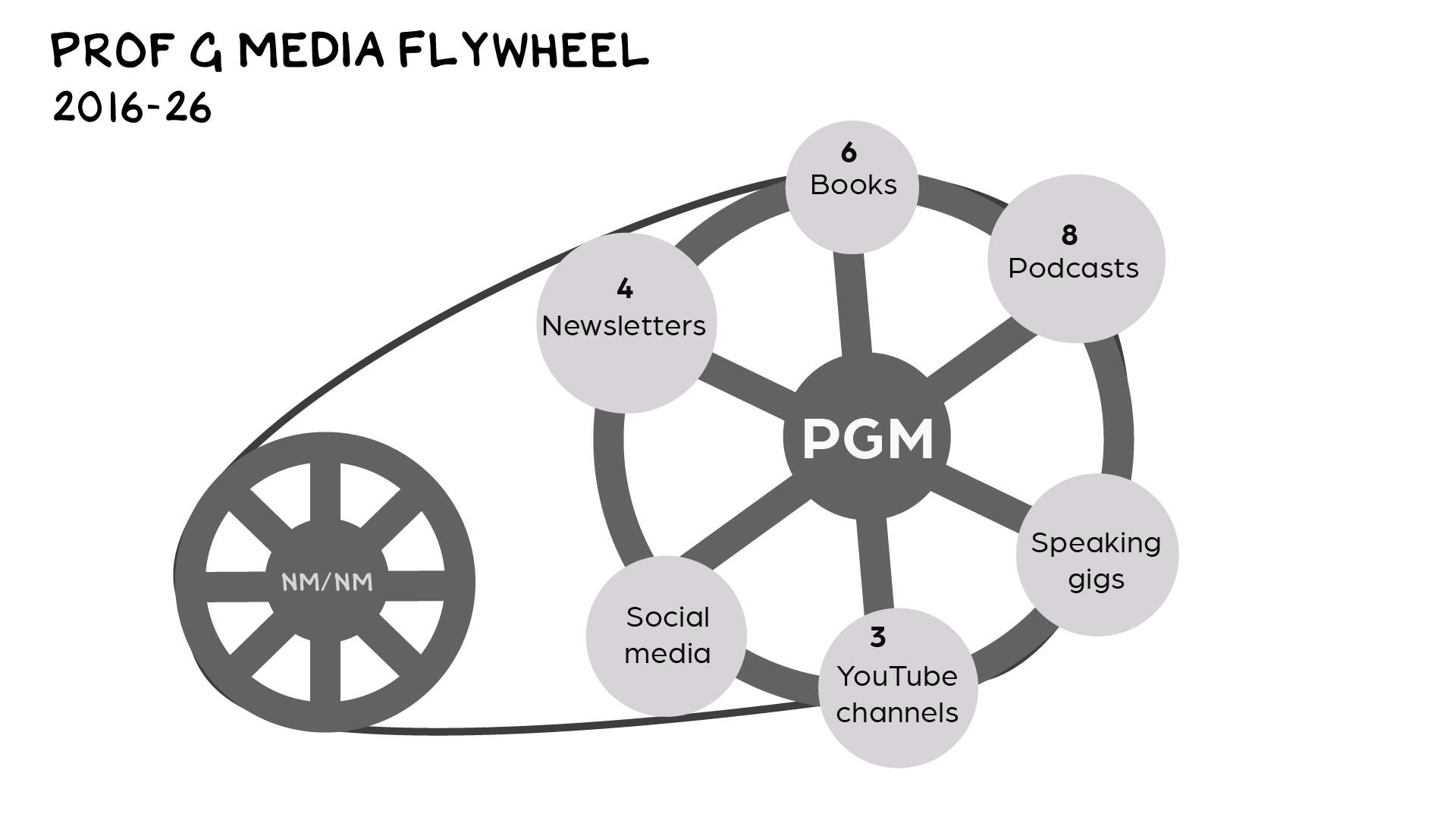
We conceived L2 around a membership model (annual fee), and we tracked touch points — how many times the client interacted with our product, which predicted renewal. Note: This strategy paid off (twice) — I sold Prophet for 2.8x revenue and L2 for 8x. Before I sold L2, we’d launched a series of media products to create more engagement. Winners & Losers was a video series exploring innovation in the consumer sector, and NM2 was meant to be a newsletter exploring, well, whatever was on my mind that week. In addition, I enjoy writing — I pen a book every 18 months — believing it’s effectively exercise for the brain. I’ve convinced myself that I’m less prone to early-onset dementia when I’m struggling to fix that last sentence. NM2 was too salty for Gartner (the acquiring company), and they said it could not be affiliated with the firm, but I could have the IP. A decade later, we have 430k subscribers, and the newsletter is the center of the flywheel for ProfG Media. The tone/aim of NM2 is simple: provide insight and be fearless.
Time Capsule
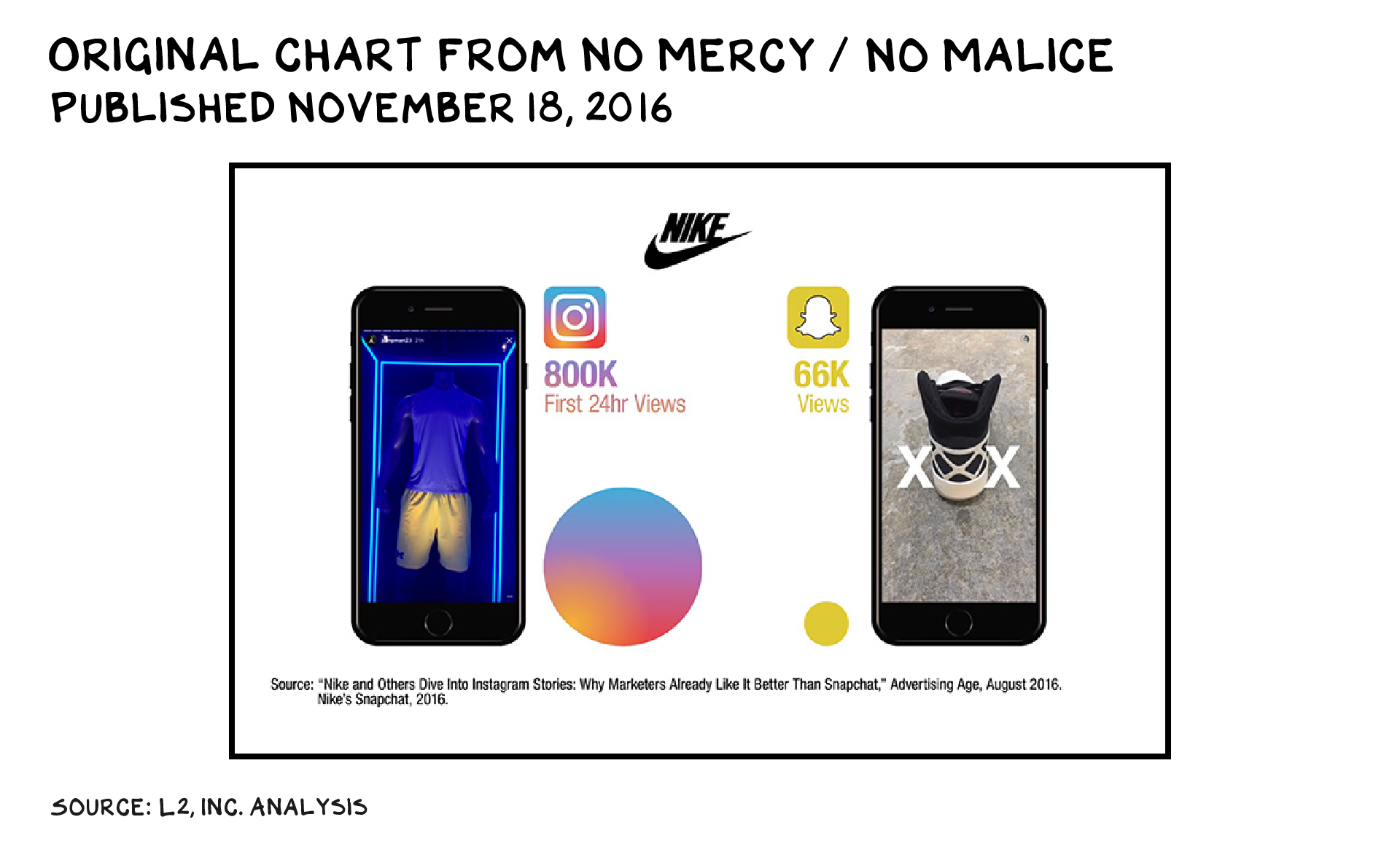
The oldest surviving No Mercy / No Malice post dates to November 18, 2016. It’s only 288 words — roughly 20% of a typical post these days. A few things stand out. The post, “Warby Snarker,” was about Snap’s new camera-equipped glasses, known as Spectacles. A decade later, Snap CEO Evan Spiegel continues to pursue his wearable white whale, despite erasing more than 90% of the company’s market cap over the past five years. The 2016 post contains an early example of Prof G Media’s visual storytelling — in this case, a chart comparing Nike’s performance on Instagram’s (new at the time) Stories feature to its performance on Snapchat. Also, there’s a prediction from L2 co-founder Maureen Mullen. It proved to be correct, highlighting an NM2 commitment to making bold calls that catalyze conversations. Finally, the post links to my message about the 2016 election. As I noted at the time, every CEO and founder felt compelled to say something to their troops about the political earthquake that was sending (and continues, to this day, to send) shockwaves through our society and the world.
In the subsequent decade, however, most of those leaders have gone silent. I’ve grown louder, consistently writing about the topics I believe matter most. Hint: I believe Trump Inc. is a criminal enterprise and a stain on the American experience. Another hint: Accusing me of TDS has no effect.
On Writing
Whenever I’m in public, I can tell which media channel is the catalyst for someone approaching me. If someone says, “The Dawg!” or uses a similar bro-pener, they likely recognize me from our videos. If the approach is more familiar, like we’re old friends, they’re a podcast listener. My favorite thing about podcasting is the friends you don’t know — it’s a parasocial medium. But if they want to discuss losing a parent or the tension between making a living and being a present dad, I know they’re a reader … of my newsletter and/or books. The written word is a bunker buster, reaching emotions we think are safely buried.
We believe storytelling is the most valuable skill — a superpower you’d grant your children, if possible. The arc of evolution bends toward good storytellers, as storytelling = the efficient transmission of survival-relevant information. Business runs on the same code. Entrepreneurs, aka storytellers, deploy a narrative that captures imaginations and capital to pull the future forward. Regardless of the medium, however, I believe storytelling begins with writing. Joan Didion put it best: “I write entirely to find out what I’m thinking, what I’m looking at, what I see, and what it means.”
In other words, when we write we’re learning and teaching. In a widely cited 1977 paper, composition scholar Janet Emig concluded that “writing involves the fullest possible functioning of the brain, which entails the active participation in the process of both the left and the right hemispheres.” According to Emig, writing simultaneously engages three cognitive processing styles: enactive (learning by doing/the physical act of writing), iconic (scanning and depicting text with the eyes), and symbolic (restating thoughts into structured words). Translation: Writing is a full-body cognitive workout.
Talent matters, but reps matter more. It’s a practice. As Stephen King explained in On Writing: A Memoir of the Craft, “Amateurs sit and wait for inspiration, the rest of us just get up and go to work.” My advice: Commit to a certain amount of time to write on a regular basis and have deadlines (or some other form of accountability). As the Nike ads famously say, “Just do it.” The first 100 newsletters were written by me, late Thursday night, after I came home from drinking. It pains me to say this, but some are better when I’m a bit fucked up — I’m less guarded — as the “white space” the better missives tap into is straight men who aren’t in touch with their emotions. It’s a big market.
Writing isn’t just a personal discipline, however — it confers a competitive advantage, and the best-run organizations treat it that way. Jeff Bezos said the smartest thing they ever did at Amazon was to ban PowerPoints in favor of “six-page narratively structured memos.” His reasoning: Decks hide flaws in logic, functioning as sales tools meant to persuade, whereas memos expose weak arguments, force deep thinking, and compel clarity. The U.S. military adheres to a strict “Bottom Line Up Front” writing style that puts the most important information at the top of the document — if they bury the point it might cost lives. Reporters at the Associated Press, a journalistic institution dating to the 1846 Mexican-American War, deploy a similar “inverted pyramid” to communicate information in descending order of importance. AP Style is the operating system for news. The common thread: Good writing reduces storytelling to first principles. I’m going on Bill Maher next Friday. When the producer calls to review topics, I will write about the one that resonates most as prep.
Flywheel
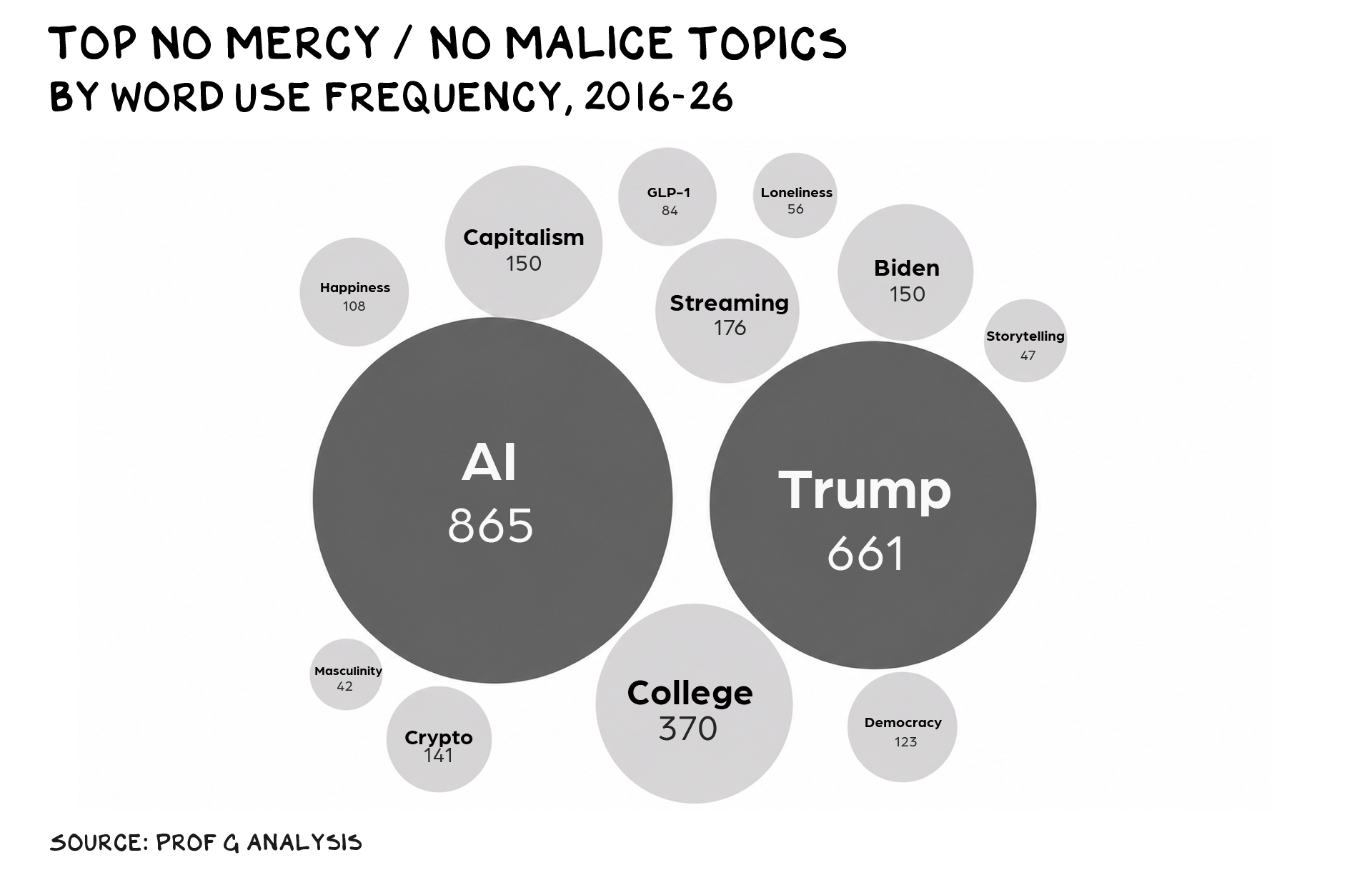
Last month, I wrote about metrics maxxing, specifically how a growing obsession with health and fitness data is obscuring life’s purpose and meaning. Many of the themes apply to NM2. Our team tracks the usual digital media metrics — open rates, views, etc. — but that data has zero influence on editorial decisions. I use NM2 as an incubator for new ideas and catharsis — things I’m thinking about but haven’t been able to express. The good ideas (usually) survive our editorial meetings and become posts. The best ideas, i.e., those that resonate deeply, turn into chapters in books. We want to be fearless and spark a conversation by wading into dangerous waters — the struggles of young men, college admissions, antisemitism, tech valuations, Trump. A by-product of my writing is criticism — a win, as I believe that criticism is the receipt for actually saying something. Also, often, I just plain get it wrong.
Creative Differentiation
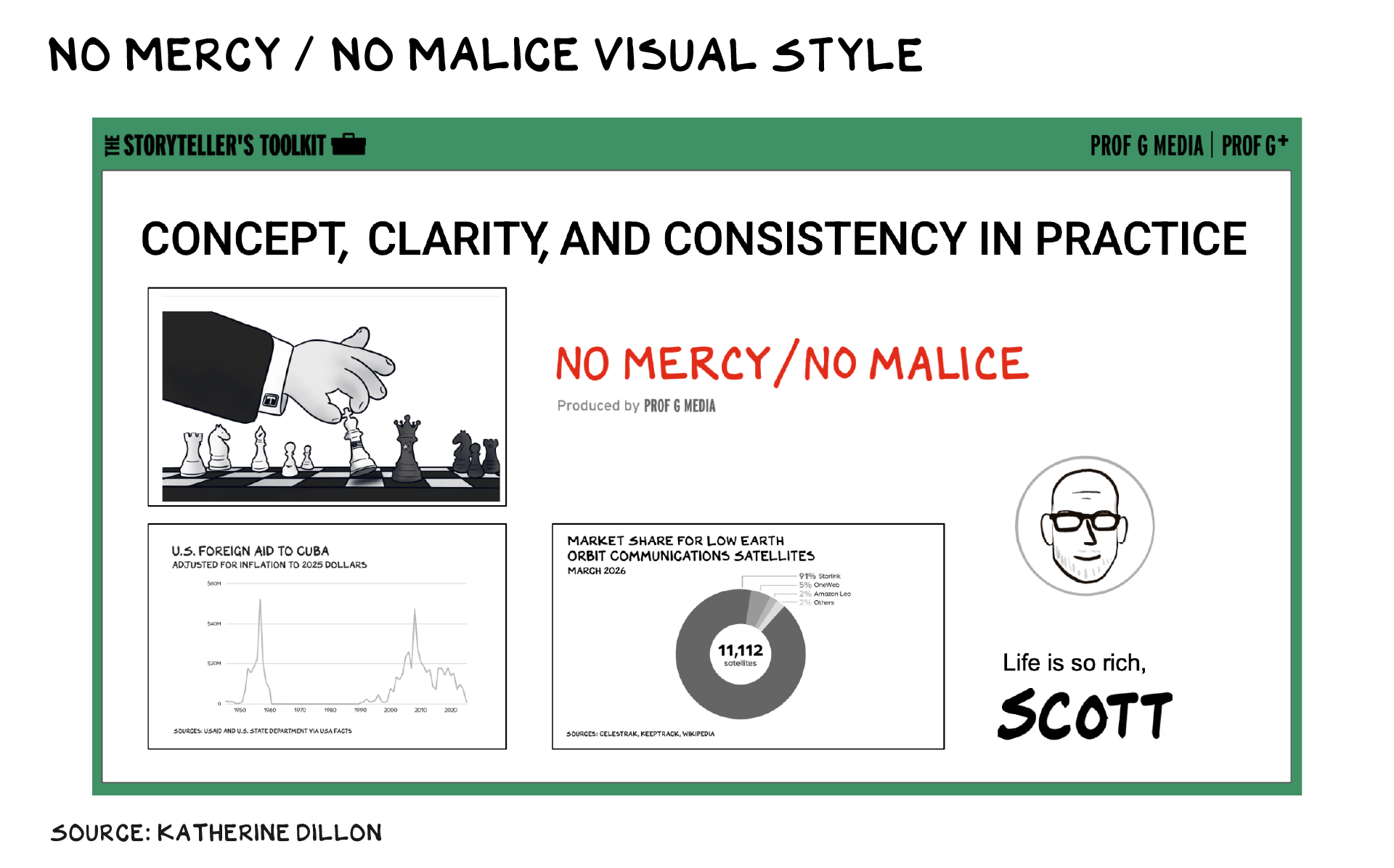
We sold L2 for 8x revenue, in part, because we manufactured scarcity (saying no to potential clients) and had a good subscription model. Our competitive advantage in a crowded marketplace, however, wasn’t a function of our proprietary data and analysis, but our commitment to investing in creative differentiation. As my business partner and the Chief Creative Officer at L2, Katherine Dillon, often reminds me, we hired our third animator before hiring our first salesperson. We also spent thousands of dollars licensing Getty Images photos, because we viewed our reports not as dry white papers, but as magazines that pull our clients deeper into the story.

As Katherine said in a recent presentation on design as a differentiator, “There are a lot of wonderful storytellers, Scott among them, but I think the visuals associated with No Mercy / No Malice separate it from the pack.” Katherine is biased, and correct. One frequently asked question from readers: Do you draw those charts yourself? A: No, but the woman who created the visual style for NM2 deployed hand-drawn, grayscale illustrations to communicate a personal/professorial tone that lets readers feel like they’re inside an idea incubator. In other words, Katherine and the designer nailed it.
Vulnerable
One of the joys of podcasting is meeting your listeners IRL and discovering that (most) people are … lovely. Newsletters, sadly, don’t go on tour. On the internet, spam, bots, and bad-faith actors conspire to reduce our expectations for humanity. As I’ve previously written, most people, including me, are lesser versions of themselves online. Vulnerable writing is a full-contact sport that exposes you to injury. It’s also incredibly powerful. One of the most popular posts I’ve ever published was about putting down our dog Zoe. “Love Persevering” doesn’t fit in a newsletter about business, technology, and the forces shaping society, yet it sits in the archive sandwiched between a post about the attention economy and another about individualism vs. institutions. Five years on, my tribute to Zoe is a reminder that, while fear permeates our culture, action — in this case, writing — absorbs anxiety. Also, for an economic animal ruthlessly focused on maximizing my career/financial trajectory, a post about trading my arrested-adolescence lifestyle (SoHo loft, apartment in South Beach) for marriage, kids, and dogs proves that the key to happiness is investing in deep, meaningful relationships. The theme that rests at the center of NM2 is the only observation I’m near certain is true: Happiness is love, full stop.
The End
I write a lot about … the end — death. Believing that I’ll go first and that someday I’ll look into my sons’ eyes and know our relationship is coming to an end. This has been an unlock. All the fear of shaming, worrying what other people think, and reticence to tell people I love them melts as the light at the end of the tunnel draws nearer. My boys have little interest in my work; I doubt they’ve ever read a post. But they will. It will transport them back to this era, the good and bad, and cement what they feel but may not know — how much I think about and love them. And, how much I’m going to miss them. That’s the real mission here, that NM2 will be read by my sons years from now and remind them how much they miss me. If you want to live forever, start writing.
Life is (still) so rich,

P.S. Forgive yourself, forgive others.
Hands down one of THE best newsletters! Endlessly edifying, vexing and inspiring – like good writing should. I keep the ones that resonate in a folder in my Inbox – I'd much rather they were in a book. Give us the hits!
I was thinking today why Scott appears to be having a cultural moment (not an overnight success but a lifetime built moment). And then I read this, being relatively new to his work, and it dawned on me it's his humanity and his lack of fear in expressing it (clearly he's intelligent and insightful too) Humanity and bravery are under threat at least in many forums that humans seem to be attracted towards in these current times! And the idea of the written word being a cornerstone of so many positive human effects makes me applaud this newsletter and ponder as less and less humans humans actually write anything meaningful what does that mean.....cheers and keep up the humanity Scotty G