


Do you remember writing 20-page papers in college? That’s not happening anymore. Today’s college students struggle to write 750 words. That’s according to college writing professor Tyler Jagt who assigned a 20-page essay and found that none of his students could complete it. They couldn’t pay attention long enough and kept forgetting what the paper was about.
Jagt isn’t alone. A professor at Pepperdine reported that Gen Z students have “an inability to critically think.” At Columbia University, students “seem bewildered” by the idea of finishing multiple books in a semester, and at the University of Virginia, students are “shutting down” when they encounter ideas they don’t understand.
The professors blame smartphones and AI.
The good news: 26 states have now passed full bans on phone use in elementary, middle, and high school. The bad news: the bans took roughly 15 years to materialize, and if it takes us as long to manage AI’s impact on education, there will be drastic consequences.
According to the most recent research, AI disrupts the learning process by allowing students to outsource their thinking to large language models. They avoid thinking hard, and therefore they don’t actually learn.
AI can help students learn, but only if it’s prompted to act as a tutor and not give answers away. This requires immense restraint that students with immature prefrontal cortices don’t have. Kids who spend seven hours a day on TikTok likely don’t have the capacity to refuse AI’s offer to write their essay for them.
Teachers can try to fight cheating by using AI detectors or even tracking writing progress in Google Docs — but they’re up against a burgeoning industry of VC-backed companies working to make AI detection impossible.
It’s hard to think of a more important resource to protect than young minds. As Jagt wrote: “The students who cannot read a 20-page article today are the voters who will not be able to read a bill, or the jurors who cannot follow a closing argument, tomorrow.”
The Status Quo
Before we go any further it’s important to understand the current state of American schools. Data released earlier this month gave us an update on students’ academic achievement. The results were bleak: Math and reading scores for nine and 13-year-olds have steadily declined since 2012. Teenagers are now scoring at the same level they were 50 years ago, back when calculators had just been invented.
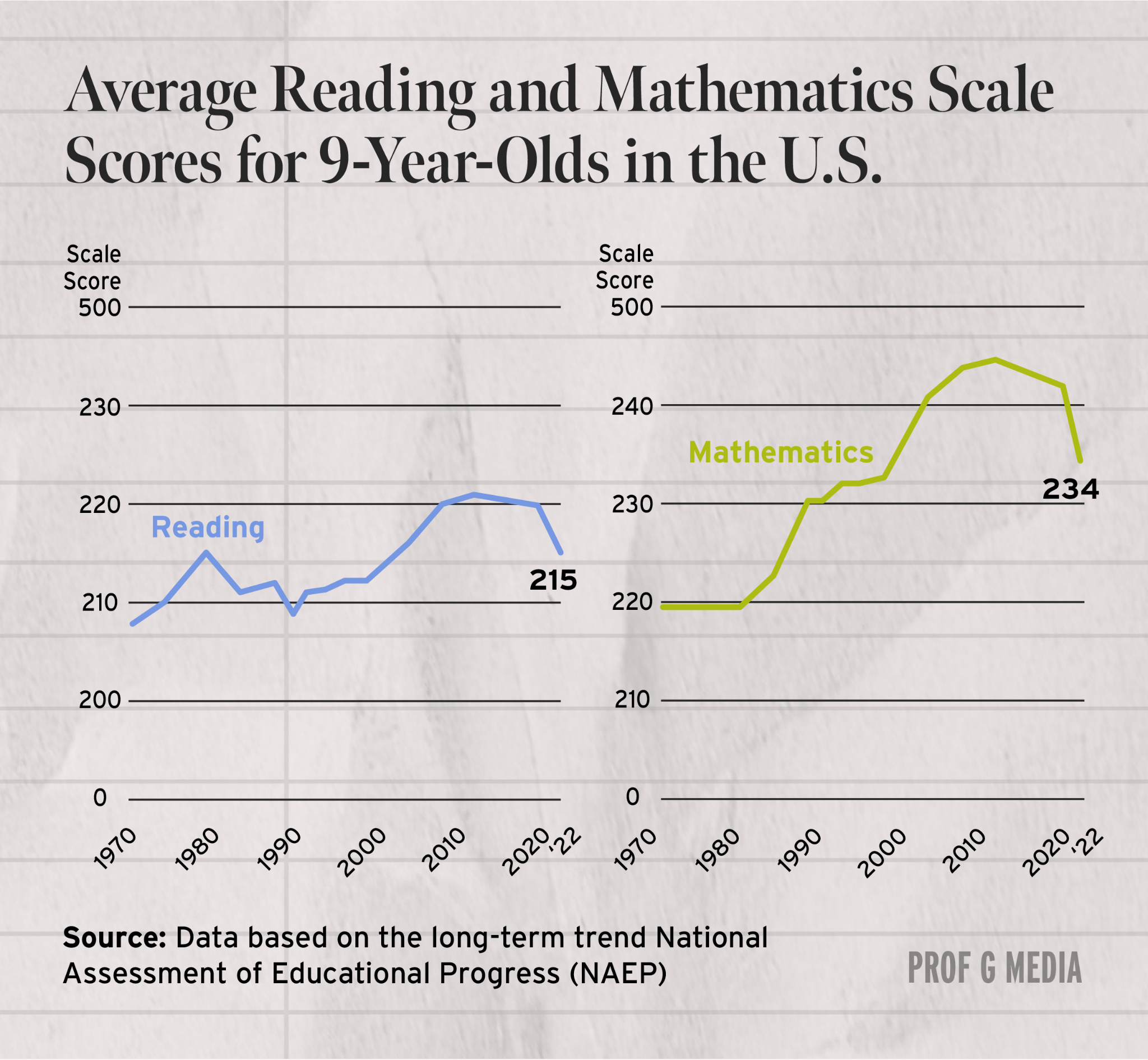
To put it another way: One third of 12th graders don’t have basic reading skills, and 80% of hiring managers believe that today’s high school students are less prepared to enter the work force compared with previous generations.
As I wrote in a previous piece, key markers of intelligence are on the decline for adults, too. The OECD assessed literacy and math skills of thousands of adults in 31 developed countries. It found that, over the past 10 years, literacy proficiency improved significantly in only two countries (Finland and Denmark), remained stable in 14, and declined significantly in 11, including in the U.S.
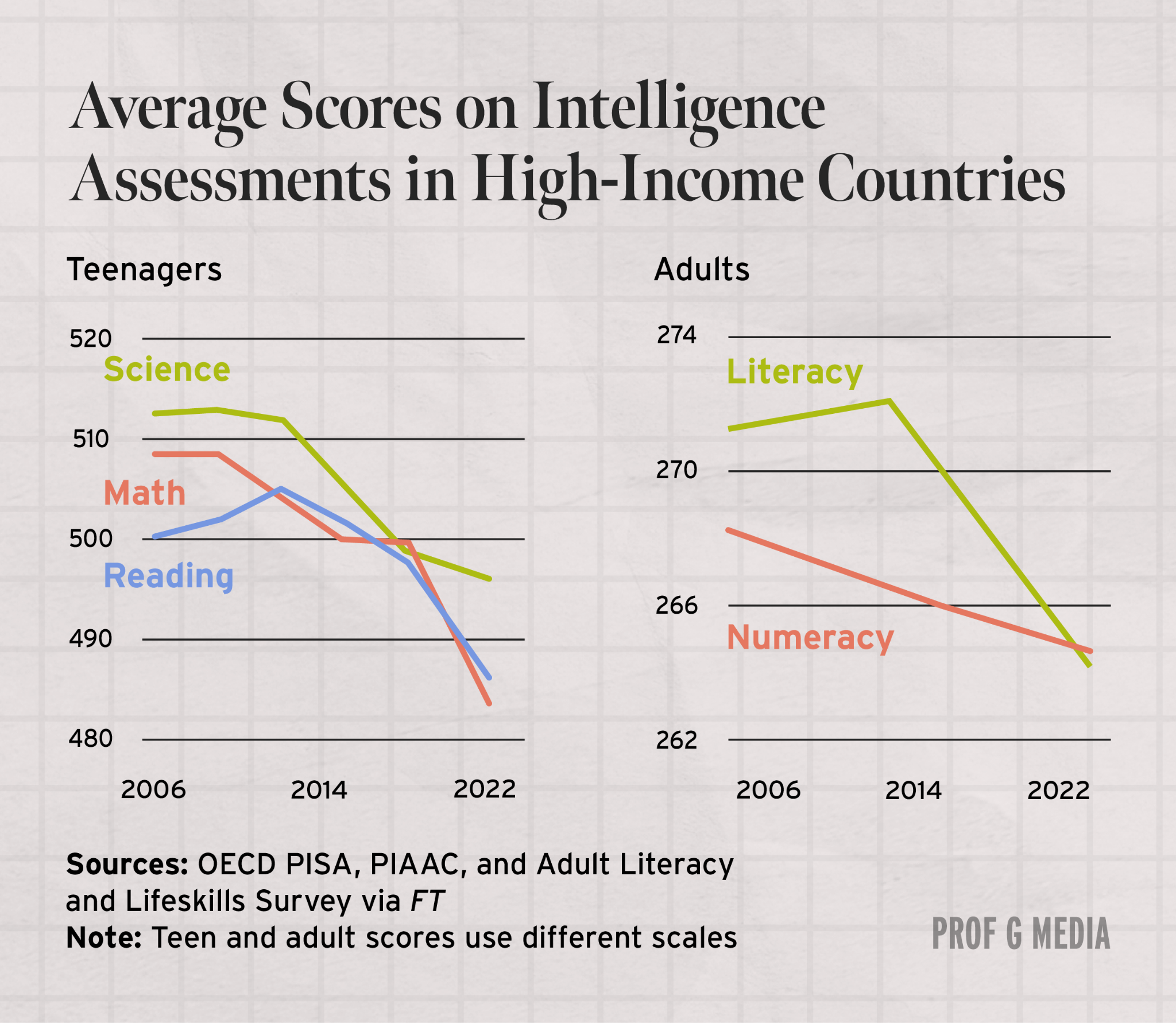
It’s too early to blame AI. These poor results are likely a combination of the attention-span destroyers known as smartphones, changes in accountability measurements in schools, and pandemic-related disruptions. The takeaway: AI’s arrival coincides with low points in cognition and education.
One teacher wrote as much in a survey I conducted (more on that later).
“With the rise of social media and quick dopamine hits, students have a lowered attention span. Students have less capacity to struggle through difficult tasks and high level thinking. AI has provided an out for students in these moments — rather than working through a tough task, they can just let AI do the work.”
We are unprepared, and the disruption is already here. Roughly 85% of high schoolers and college students admit to using AI for coursework; I believe the other 15% are lying.
What AI does to learning
AI compromises learning by allowing us to dodge crucial cognitive processes. What follows is an extremely oversimplified explanation of how you learn.
First, information from your eyes or ears is processed and held in your working memory, which depends on your prefrontal cortex. Then, your hippocampus helps encode that information into memory. It does so by coordinating activity across different parts of your brain, creating patterns of neural connections that can be reactivated later.
That distinct web of connections (memory) gets stronger as you reactivate it by recall. That’s why explaining a new concept to a friend or using flashcards work: both force you to reactivate, and thus strengthen, that neural network.
Reactivating learned concepts requires mental effort. To make cognitive work easier, humans have developed tools that alleviate some of that effort, like writing, typing, and calculators. Using those tools is referred to as cognitive offloading.
AI is not one of those tools. Unlike calculators or even the internet, AI doesn’t give you just one part of an answer: it gives you the entire answer. In most traditional academic use cases, if you have AI, you don’t have to engage mentally. You don’t have to reactivate those neural networks and therefore you don’t learn.
Tyler Jagt, the college professor whose students can’t complete 20-page essays, explained the problem with AI in school: “Offloading the struggle to a chatbot does not ‘free students up for higher-order work.’ It deprives them of building the strength to do any substantial cognitive work at all.”
Researchers came up with a new term that encapsulates that idea: cognitive surrender. In their own words, cognitive surrender “represents a deeper abdication of critical evaluation, where the user relinquishes cognitive control and adopts the AI’s judgment as their own… they stop deliberative thinking altogether.”
Scientific studies support this. In one experiment, two groups of college students completed a research project, with one group using an LLM, and one using traditional search. The group using the LLM experienced lower mental effort and produced weaker reasoning than peers using search engines.
In another study, students used ChatGPT to prepare for a math test. They did well on practice sets, but when ChatGPT was taken away, they performed substantially worse.
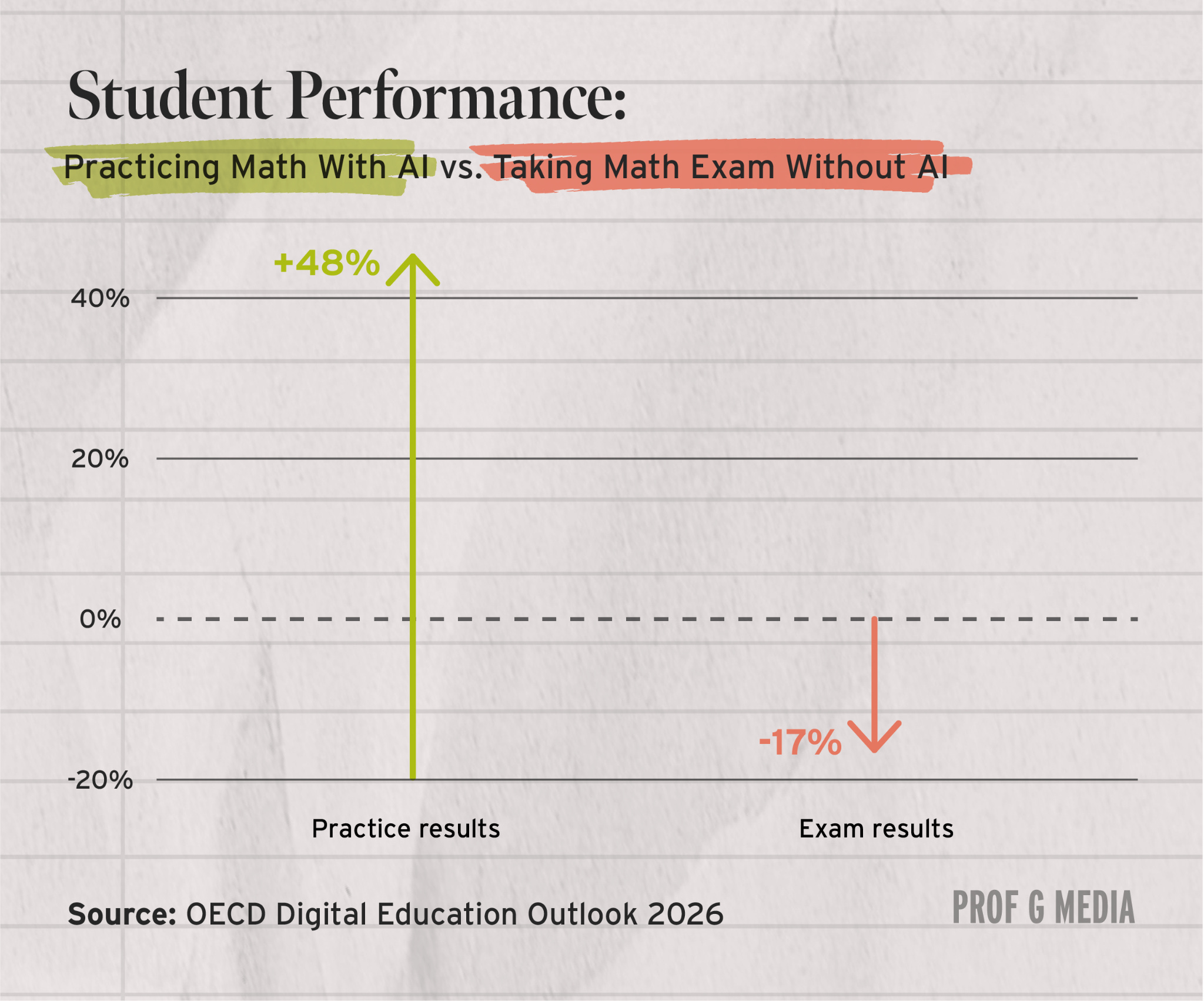
A Stanford University review of over 800 academic papers on AI in K-12 education came to a similar conclusion: AI boosted students’ performance when they had access to the tool, but when taken away, those gains disappear, or in some cases, reverse. The paper concluded that AI use does “not necessarily result in deeper learning.”
The Adults in the Room
Scientific studies of AI in academia are essential, but they lack the urgency and emotionality of first-person accounts. That’s why I asked teachers to tell their stories.
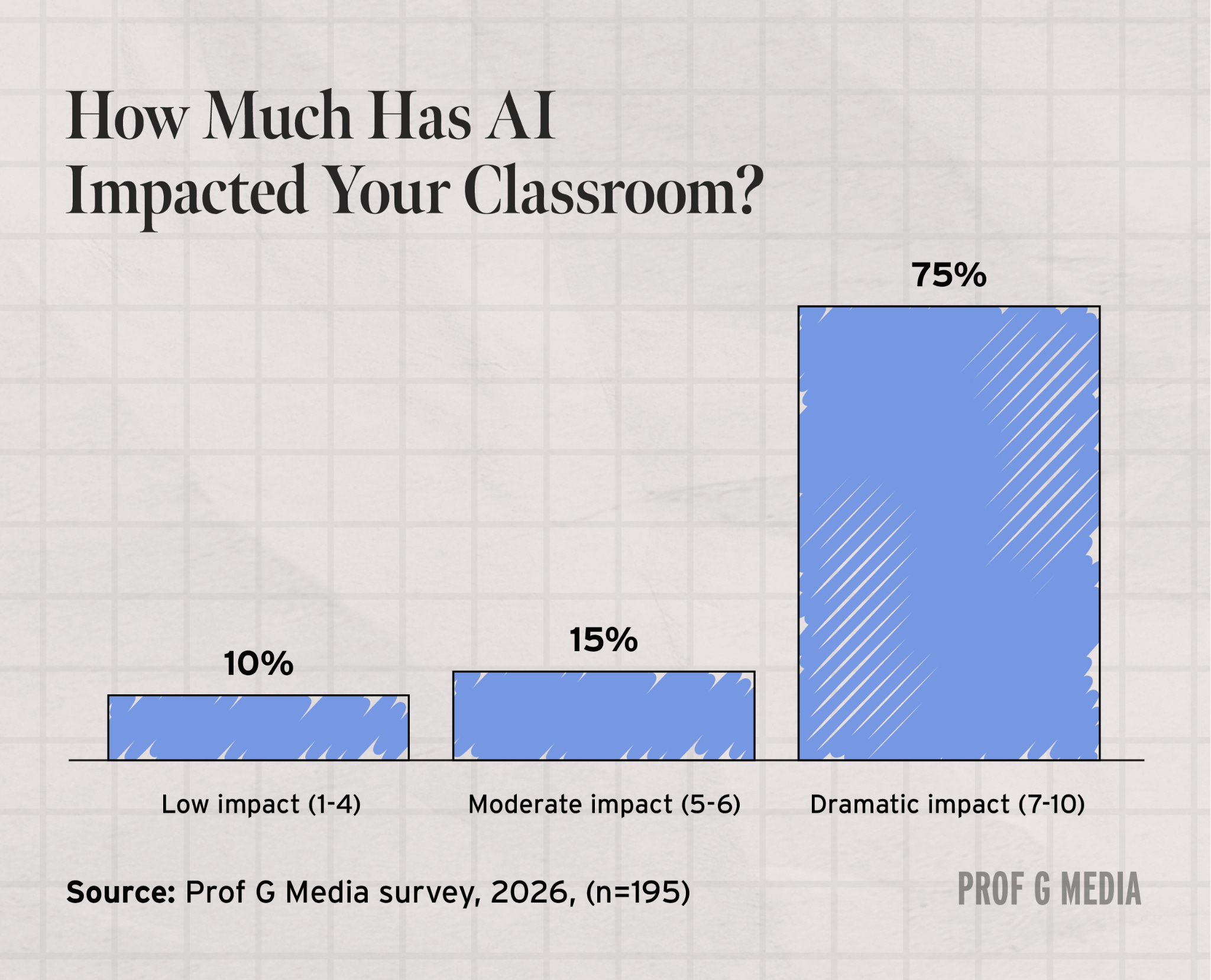
Close to 200 U.S. educators filled out my survey. Sixty-one percent teach at public schools. Roughly half teach kindergarten through 12th grade, and half teach at the university level.
Overall, educators perceive the impact of AI on student skills to be dramatic and predominantly negative.
The most negatively-impacted skills are writing, critical thinking, and creativity. Teachers believe math skills are less impacted by AI. This could be because math homework is still typically problem sets done by hand, or because most AI is still surprisingly bad at math.
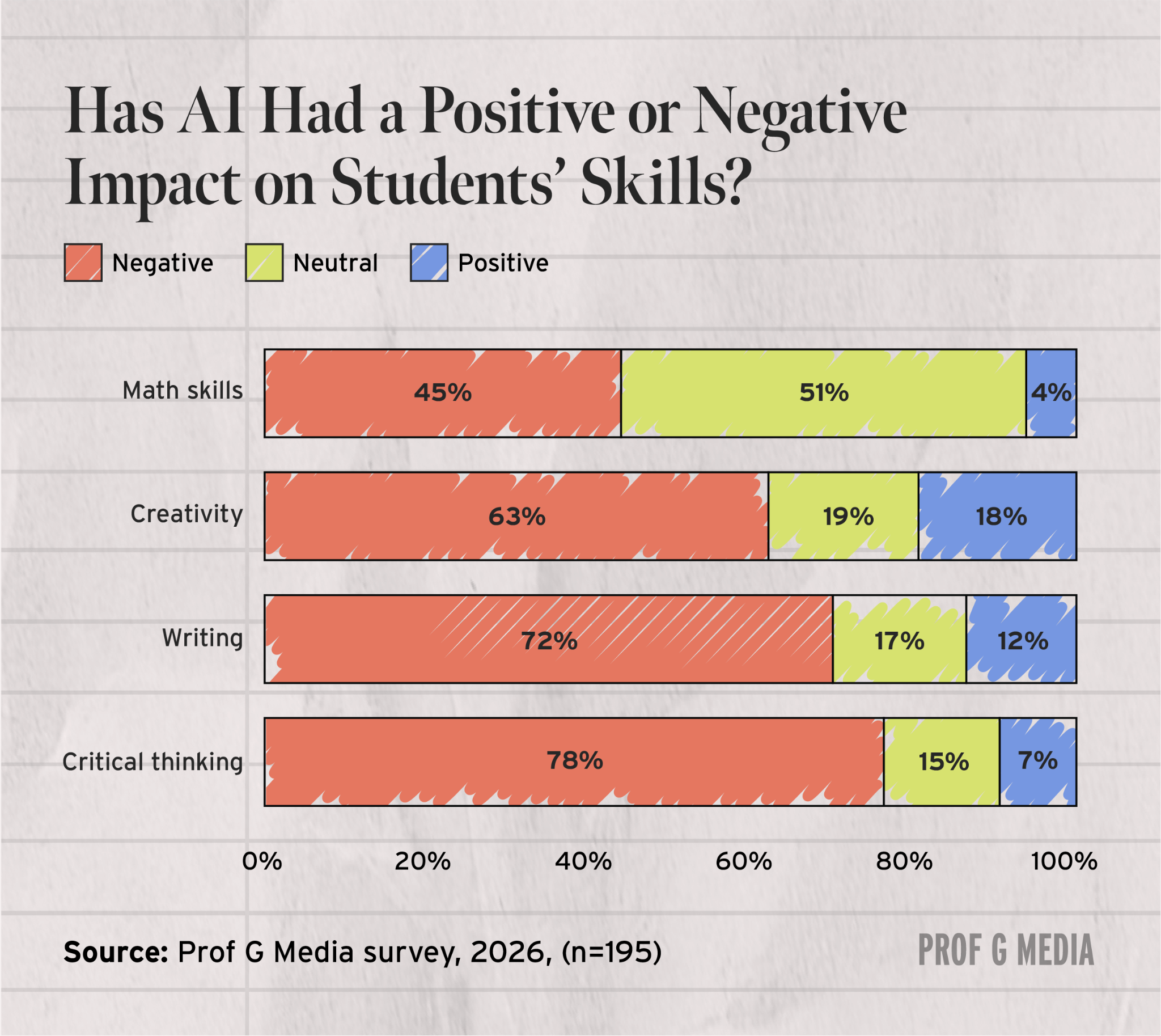
I also asked teachers to describe the impact that AI is having on their students. Ninety-five percent of survey respondents typed out an answer, and many of them were paragraphs long. I’ll include select quotes here. If you want to read all of them, check out the full list here.
Goodbye to Thinking and All That
Frequent AI use has been linked to lower critical thinking, lower brain activity, and weaker encoding of “learned” material. When answers and full essays are available at the touch of a button, students can easily opt out of mental effort.
Teachers agreed. Responses have been edited for clarity and length.
“Many students instantly turn to ChatGPT or Gemini for every question or assignment, even verbal discussion questions in class. They already believe they can’t come up with correct answers on their own so they are giving up on independent thought in advance.”
“Students rarely question the results AI provides. They use it on the easiest assignments without even attempting to complete them on their own.”
“AI has taken the ‘learning’ out of school.”
“AI is a tool that needs to be age-gated. In the same way we were required to learn multiplication tables and long division before getting access to a calculator; students today need to toil with the unknowing of the learning process.”
“Most students use it to look up answers, rather than think about and write responses. They will feed critical thinking questions (designed to help them use their brains to compile evidence to back up a thought) into AI to have the LLM do the thinking for them.”
Students understand that AI is impacting them, but they don’t know how to stop it. In a survey of 7,000 high school students, almost half agreed with the question “Do you feel that you are relying on AI too much for your learning?” Of those students, over 40% said, “I tried to limit my usage, but it was so difficult I failed.”
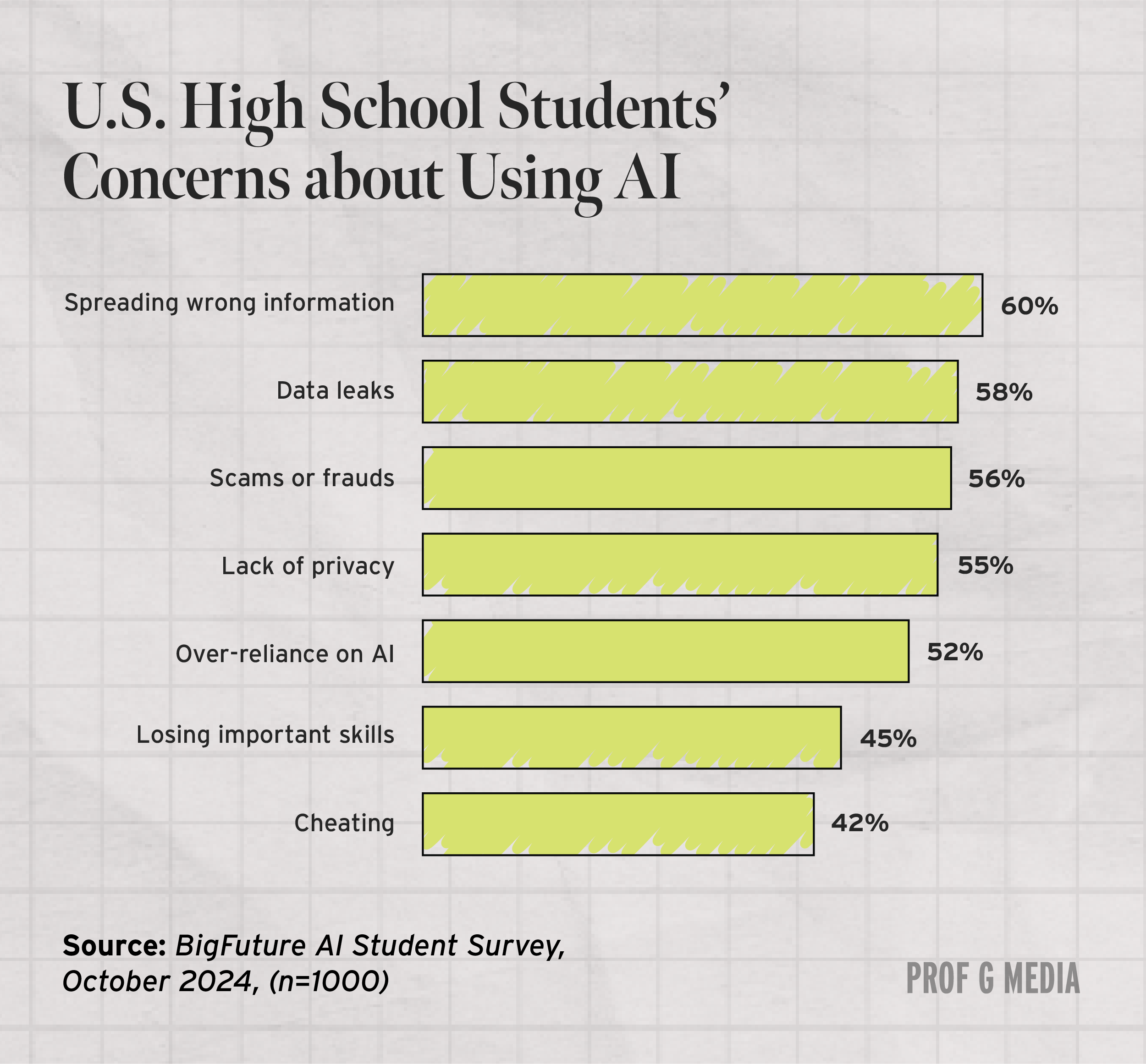
Students are starting to wonder why they should even bother to learn.
“Students have become conditioned to have AI think for them, and most of the time, it’s completely wrong. The students see no value in their own education or intellect.”
“The students are outsourcing their learning to AI. They don’t do the pre-work (like reading or watching videos), they don’t buy the materials, AI does their homework and papers for them, and they ask AI for responses for in-class discussion… They don’t even come to class. I honestly don’t know what they are getting out of college anymore.”
On Writing
One of the most common uses of AI is writing. Roughly half of ebooks released on Amazon now are written by AI, 18% of lawsuits filed this year are AI-generated, and 57% of scientific papers published last year contained AI-generated text. Even a much-anticipated book investigating AI’s impact on truth contained fake, AI-generated quotes.
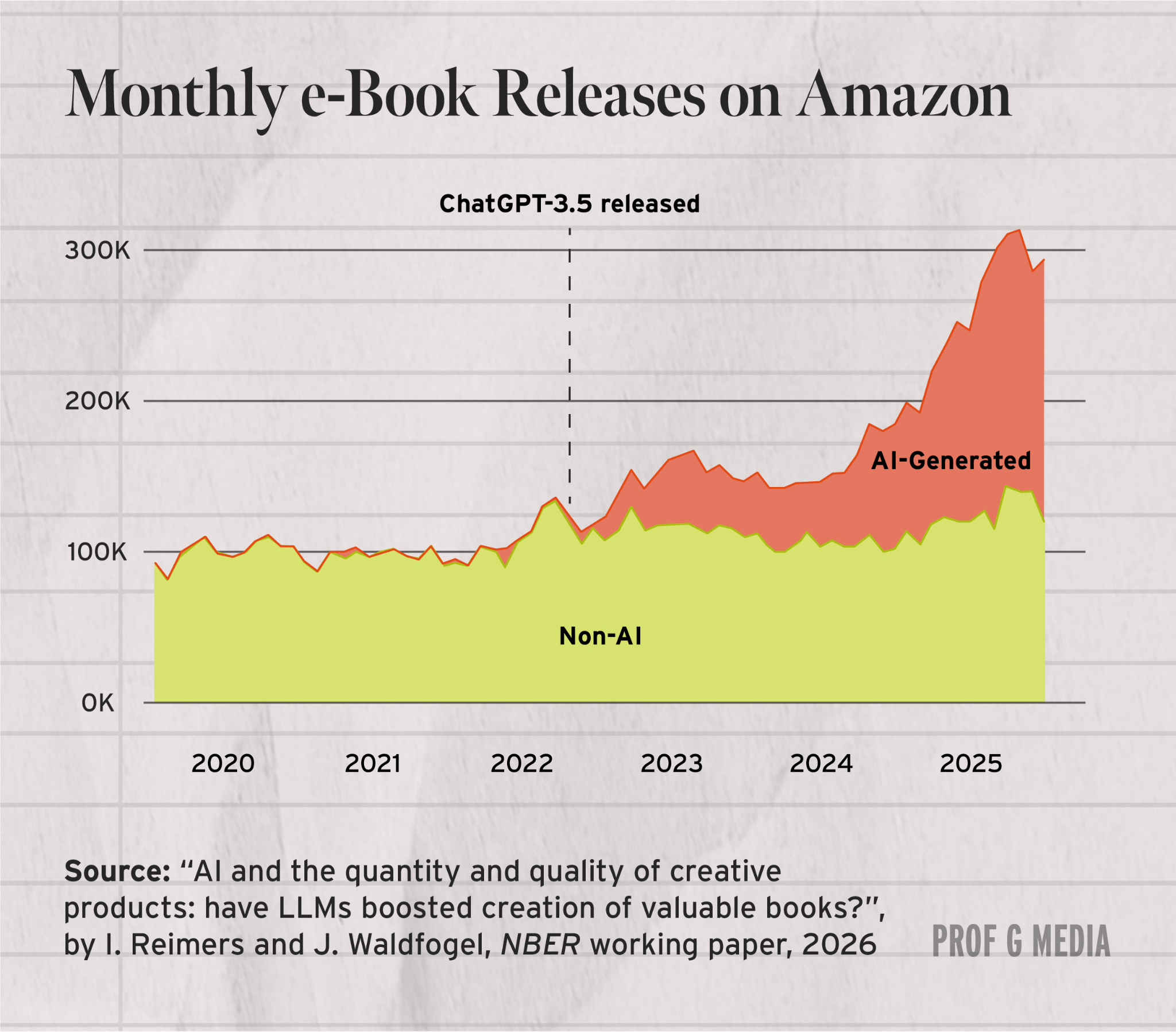
AI writing is ubiquitous in academia. A Gallup poll found that more than half of college students use AI daily or weekly for writing tasks, and anecdotes have surfaced on social media of students’ disbelief that anyone could write 20-page papers without AI.
One of the most-cited victims of AI in my survey was writing skills.
“Writing an essay takes sustained effort and a willingness to make mistakes, and my students no longer see the value in that process now that they can so easily avoid it.”
“Only about a quarter of my students regularly submit work written in their own words… I struggle with policing this for various reasons, but mostly because if I stuck to my AI and Academic Honesty policy, more than half of my class would fail the course.”
“I teach a communications class at NYU Stern. All of my students are using it for the final writing assignment … they don’t know that what they are submitting is slop.”
“Every structure is the same, every anecdote is impersonal, every conclusion begins with ‘overall’. I would rather read what a student prompted the LLM with than its reply; the imperfections in my students’ original works are endearing, impactful, and most importantly, they are human.”
Everyone’s Writing About Apple Pie
AI is also impacting students’ creativity.
“There is a significant decline in critical thinking, effort and creativity. I was teaching in a culinary program in a college. I gave my students an assignment to get them thinking about food. It was to write about a food memory in detail, then create a recipe that represents that. One of my classes was about 50% first generation students from India and the other from the Philippines. A majority of the class wrote about apple pie, and how they used to walk past a window when their grandma made apple pie all listing a similar recipe.”
This, too, is supported by large-scale studies. Georgetown University neuroscientist Adam Green analyzed thousands of college application essays and found that those judged to be human-written contained 8x more novel ideas than those generated by AI. Though the AI-generated essays contained more descriptive and flowery language, the topics were more homogeneous.
It’s likely too soon to see the full impact of AI on student achievement, but we can infer what they might be from teachers’ first-hand accounts.
“Genuine understanding and the ability to recall is disappearing.”
“Students who use AI regularly have demonstrated a lesser ability to do analysis and recognize patterns, especially in qualitative data.”
“I teach first year writing at both a public and a private university, and it is a disaster for practicing critical thinking and developing the ability to write cogently.”
“This is a profound paradigm shift and a dawn of new reality. The school system is totally unprepared.”
AI Policy
Educators do not have the resources they need to teach in an AI-enabled world, and policy makers aren’t acting quickly enough. The few AI-related education bills that have passed in the states are hardly prescriptive. For example, Illinois has decreed that AI bots cannot teach community college classes in lieu of human instructors, and Ohio, Oklahoma, and Maryland have all required school districts to, wait for it, come up with AI policies.
Having an AI policy is no guarantee of progress. Sixty percent of teachers I surveyed said that their school had an AI policy — but nearly two-thirds of them deemed it ineffective.
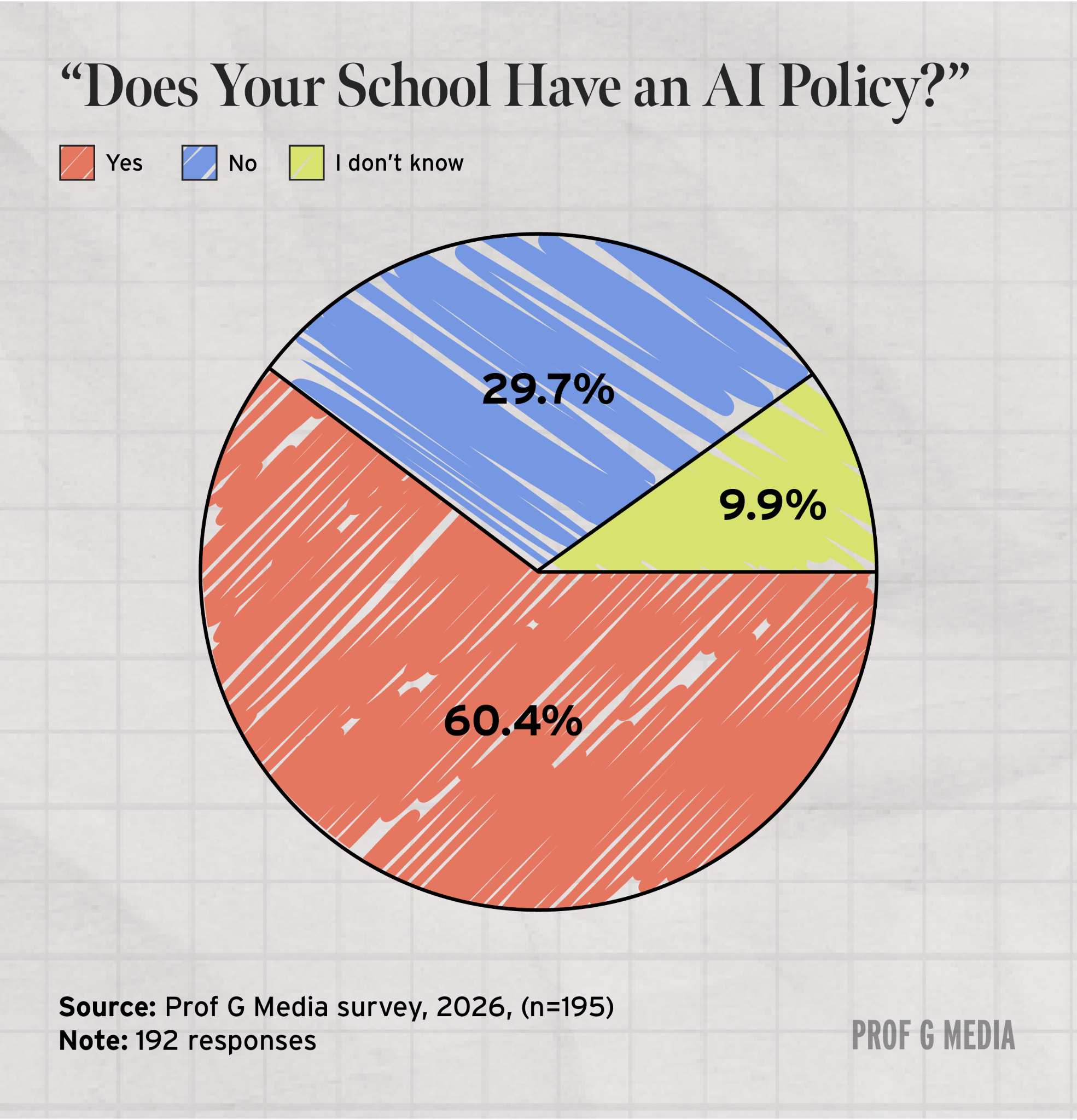
One reason it is so hard to regulate AI in school is because detection is fraught. Schools are spending thousands on AI detection software, but studies show that the detection tools on the market don’t work. Only 6% of teachers said that they used an AI detector; the vast majority said they didn’t use them because they weren’t effective.
Teachers also shared anecdotes of parents getting involved when they felt their child was unfairly accused of AI plagiarism.
“The student used language beyond their understanding… The student denied [AI use]. The parents consulted a lawyer, and together they prepared a PowerPoint presentation. The administration caved.”
This is a solvable problem — but the top AI companies don’t want to solve it. In fact, OpenAI invented a technology that was 99.9% accurate in detecting AI-generated work years ago, but decided to not release it because they were worried it would discourage some users.
Not All Bad
The Trump administration has dismantled the Department of Education and cut nearly $900 million in education research grants. It’s a terrible time to reduce education research because we need to know more about how AI disrupts learning, but also about how it could improve it.
Studies have shown that student outcomes improve when they use tailored versions of large language models that don’t do students’ work for them, but instead ask questions like a tutor would.
Teachers in my survey explained how AI could be used to enhance learning.
“Used responsibly, AI can empower learners to go further faster. It might be the only feasible way for an average teacher to differentiate for a classroom of 25 to 30 students effectively. Imagine not only differentiating for the students who need extra support, but actually being able to serve the students who are ahead of the class.”
But without effective training, AI is just a powerful weapon.
“AI is so new to teachers that most don’t know how to use it to teach, students only know how to use it to make life easier and cheat. Parents don’t know anything so they are useless to help their students.”
The Stakes
Countries with more educated populaces have governments with better rule of law, less corruption, and higher rates of productivity and innovation. By letting students outsource their learning and thinking to AI, we risk raising a generation of Americans who are not only unable to continue our proud tradition of innovation and achievement, but who are also less equipped to preserve democracy. As British statistician Claus Moser said: “Education costs money, but then so does ignorance.”
One teacher summarized the dilemma succinctly: “No thinking = no learning.” If the very practice of thinking is under threat, isn’t everything at stake?

One lesson I’ve learned from Scott is: always end on an emotional note. He does this in all of his presentations and his No Mercy / No Malice posts. The emotions aren’t always the same — they can be somber or hopeful or angry. But the point is to ensure that readers and viewers walk away feeling something. Scientifically, emotion makes content more memorable. I tried to end this piece by invoking fear. Did it work?

The modern world is destroying focus—but a new study shows how to get it back
Student cheating is becoming impossible to detect
What does it all mean? Once a year, French students try to explain
P.S. Thank you to all 195 educators who took my survey. I appreciate your time.
Educators need to reassess the objective for students to learn in each class, and then design the participation to accomplish that in an AI world. For example, if the objective is to be able to write a essay, they should have them write by hand in class. This is the way things were done just a few decades ago, we should be flexible in reevaluating the best method in this new world
I forgot that the Trump sledge hammer also dismantled the department of education. What a train wreck.
I am on a committee regarding AI use and cheating in our school. It looks quite different and has different solutions in different subjects.
Generally, the solution is live assessment, oracy, but it takes time. Pencil to paper works, socratic discussion works. Providing frames and heuristics and applying to real world examples works. The only drawback is coverage. Less coverage of standards because assessment without paper writing takes a long time.